
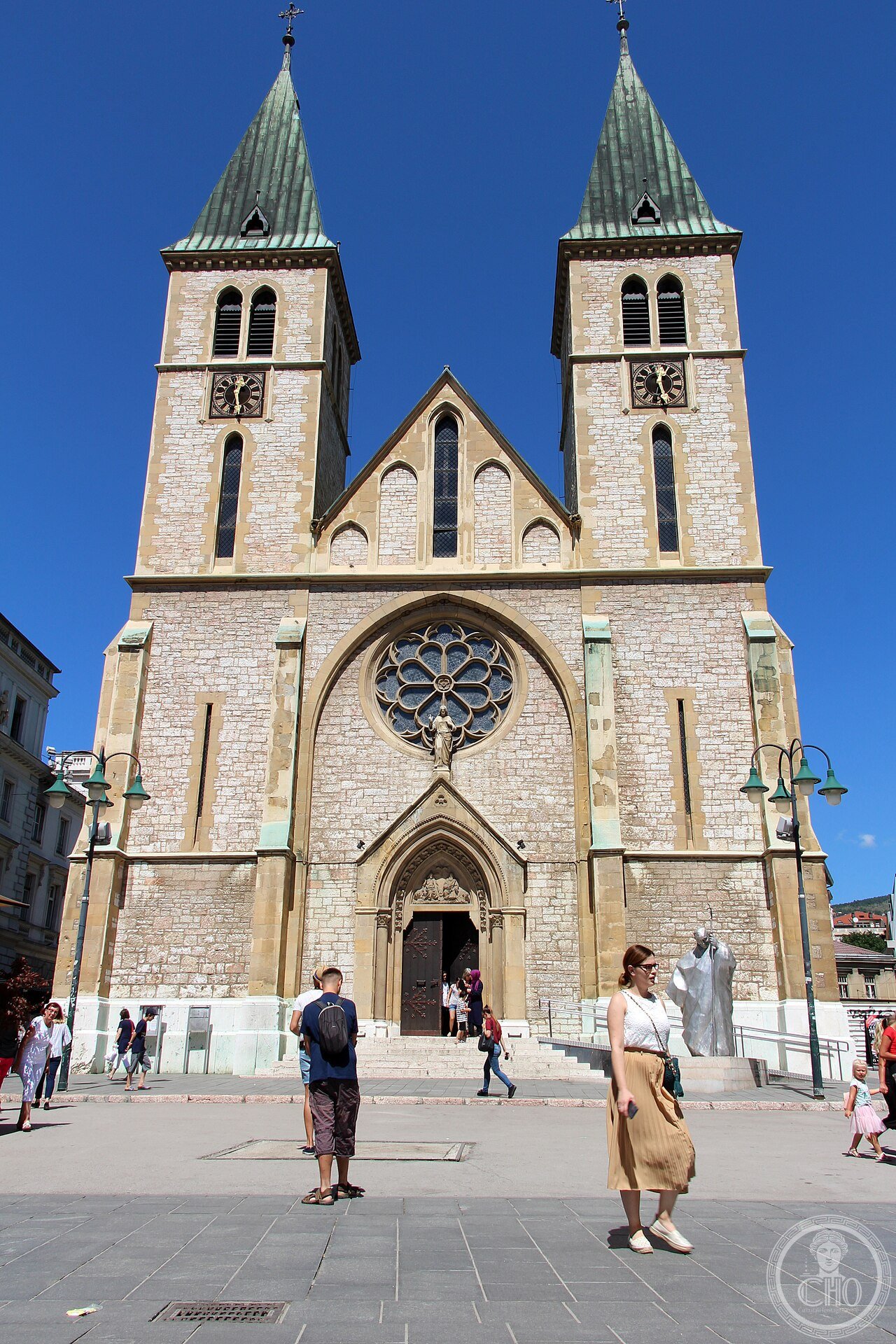
La costruzione della cattedrale del Sacro Cuore, la più grande di Bosnia ed Erzegovina, iniziò il 25 agosto 1884 e si concluse il 9 novembre 1887; fu consacrata il 14 settembre 1889 alla presenza del vescovo di Ragusa. In stile neogotico con elementi neoromanici, con le sue guglie gemelle e il rosone si ispira liberamente a Notre-Dame di Parigi. Durante l’assedio di Sarajevo, tra il 1992 e il 1996, la cattedrale fu colpita dai bombardamenti: i segni delle schegge sono ancora visibili sulle pareti esterne, e davanti all’edificio si trova una “Rosa di Sarajevo” — il cratere lasciato da una granata, riempito di resina rossa in memoria dei civili uccisi in quel punto. Nel 1997, appena un anno dopo la fine dell’assedio, Giovanni Paolo II visitò la cattedrale: la prima visita di un papa in Bosnia nella storia, un gesto carico di significato per un paese ancora nel pieno della propria guarigione dalla guerra. Una statua del pontefice fu collocata all’esterno dell’edificio in ricordo di quella visita.
About Sacred Heart Cathedral, Sarajevo
The Sacred Heart Cathedral, commonly known simply as Sarajevo Cathedral, is a Catholic church built in the late 19th century and remains the largest cathedral anywhere in Bosnia and Herzegovina. Construction began on 25 August 1884 and was completed on 9 November 1887, with the finished cathedral formally consecrated on 14 September 1889 in the presence of the Bishop of Dubrovnik. Built in the Neo-Gothic style with Romanesque Revival elements, the cathedral’s tall twin towers and prominent rose window have long drawn comparisons to Notre-Dame de Paris, though on a considerably smaller scale, with a statue of the Sacred Heart set above the stone portal and its octagonal rosette window. The cathedral suffered direct damage during the Siege of Sarajevo, the prolonged military blockade of the city that lasted from 1992 to 1996 during the Bosnian War, one of the longest sieges of a capital city in modern military history. Marks left by shelling and shrapnel remain visible on the cathedral’s outer walls to this day, and immediately in front of the building lies a Sarajevo Rose — a mortar shell crater in the pavement filled with red resin, one of many such memorials scattered across the city marking the sites where civilians were killed during the siege’s shelling and sniper attacks. In 1997, only a year after the siege’s end, Pope John Paul II visited the cathedral as part of the first-ever papal visit to Bosnia and Herzegovina, a historically significant gesture undertaken while the country was still in the earliest stages of recovering from the war. A statue of the pope was subsequently erected outside the cathedral to commemorate this visit, standing today as a permanent marker of that moment of postwar reconciliation.
Key facts
- 25 August 1884: construction begins
- 9 November 1887: cathedral completed
- 14 September 1889: formal consecration
- Status: largest cathedral in Bosnia and Herzegovina
- 1992-1996: Siege of Sarajevo; cathedral damaged by shelling
- Sarajevo Rose: mortar shell crater memorial outside the cathedral
- 1997: Pope John Paul II visits, the first papal visit to Bosnia
History
Built during the period of Austro-Hungarian administration of Bosnia and Herzegovina in the late 19th century, the cathedral’s Neo-Gothic design consciously echoed major Western European cathedral architecture, reflecting the broader Habsburg cultural and religious ambitions for the newly annexed province. The cathedral’s damage during the 1992-1996 Siege of Sarajevo situates the building within one of the most extensively documented urban sieges in modern history, its shrapnel scars and the Sarajevo Rose outside forming a permanent physical record of a conflict that claimed thousands of civilian lives in the city.
Pope John Paul II’s 1997 visit, the first papal visit to Bosnia and Herzegovina in history, carried profound symbolic weight for a country still grappling with the aftermath of ethnic conflict and religious violence, positioning the cathedral as a site of postwar reconciliation as much as a place of ordinary Catholic worship — a role formally commemorated by the statue erected in the pope’s honour outside its doors.
What you see
The Neo-Gothic cathedral’s twin clock towers and large rose window dominate the facade facing Trg fra Grge Martića in central Sarajevo, with visible shrapnel scarring on the exterior walls preserved as a deliberate reminder of the 1990s siege. The Sarajevo Rose memorial and the statue of Pope John Paul II stand together outside the cathedral, marking both the violence the building survived and the postwar reconciliation that followed.
Practical information
- Opening hours: generally open daily with seasonal variation; free admission; check current hours before visiting
- Address: Trg fra Grge Martića, 71000 Sarajevo, Bosnia and Herzegovina
Getting there
Sacred Heart Cathedral stands in the historic centre of Sarajevo, easily reachable on foot near the boundary between the city’s Austro-Hungarian and Ottoman-era districts. GPS: 43.8594° N, 18.4254° E.
Nearby
- Baščaršija — Sarajevo’s historic Ottoman-era old town, a short walk away
- Ferhadija Street — the city’s main pedestrian thoroughfare, adjacent
- Sarajevo City Hall (Vijećnica) — historic landmark rebuilt after wartime destruction, nearby
Sources
- Wikipedia — “Sacred Heart Cathedral, Sarajevo” (en.wikipedia.org)
- Destination Sarajevo — “The Cathedral of Jesus’ Sacred Heart” (sarajevo.travel)
- Lonely Planet — “Sacred Heart Cathedral” (lonelyplanet.com)
Find it on the map
See this place and what’s around it →📷 Become a Cultural Heritage Online photographer
Share your photos of places: they stay published under your name as the author. The more they're seen, the more you get noticed — and soon a contest will reward the most appreciated photos.
Log in or sign up free to add a photo