
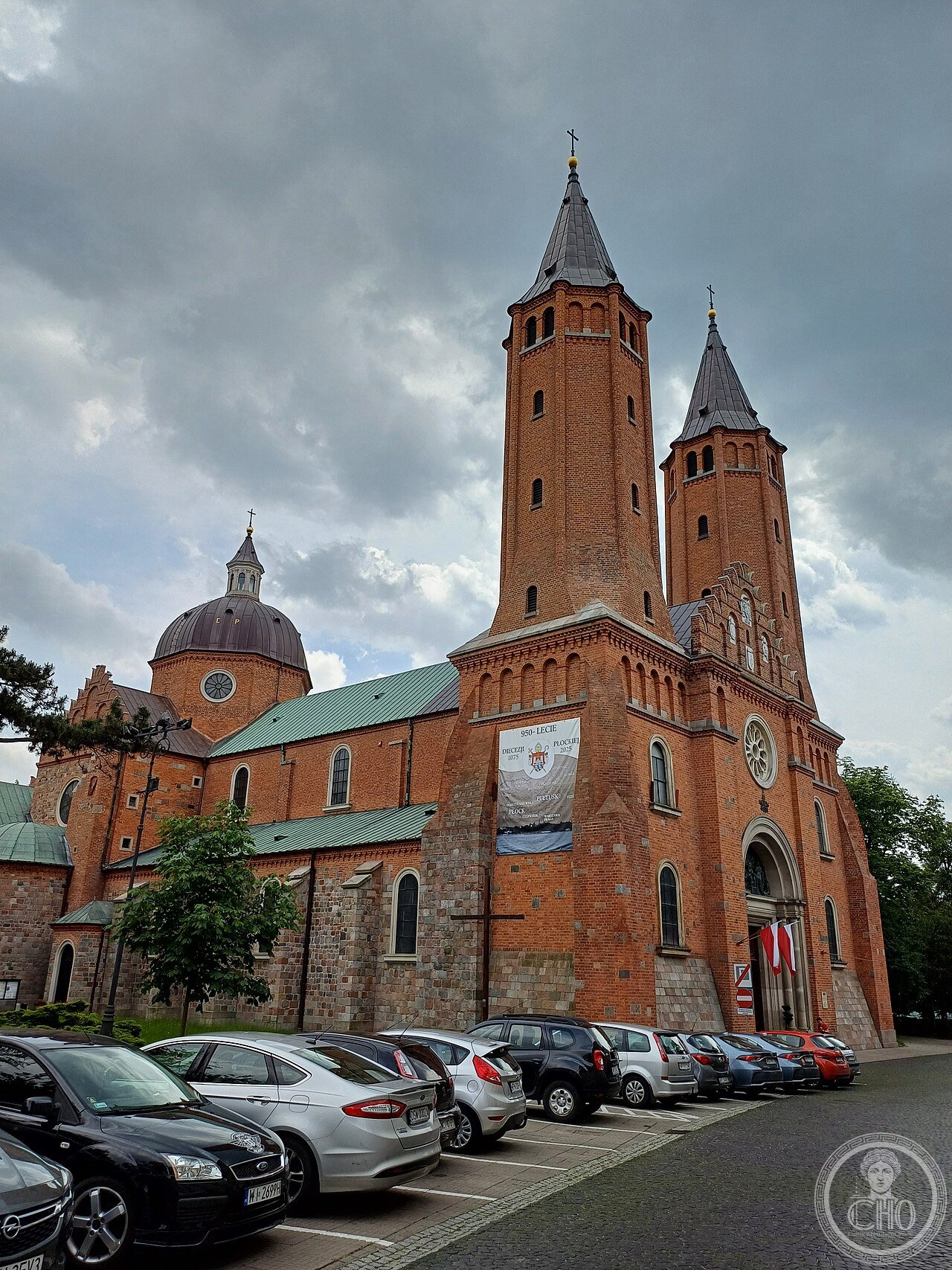
La diocesi di Płock fu fondata intorno al 1075; l’attuale cattedrale romanica, ricostruita dopo un incendio dal principe Bolesław III Bocca Storta e dal vescovo Alessandro di Malonne tra il 1136 e il 1144, fu consacrata come chiesa della Beata Vergine Maria nel 1144. Nella cattedrale sono sepolti alcuni dei più importanti sovrani della dinastia Piast, tra cui Władysław I Herman e suo figlio Bolesław III: in totale, la basilica di Płock ospita la più grande necropoli piast di Polonia, con 18 membri della famiglia sepolti nell’arco di dodici generazioni e quattro secoli. Nel giugno 2025, un team guidato dal professor Marek Figlerowicz del Politecnico di Poznań ha pubblicato su Nature Communications i risultati dell’analisi del DNA di 33 scheletri esumati dalle cripte piast, tra cui la più ampia raccolta proprio a Płock: tutti gli scheletri maschili condividevano un raro aplogruppo del cromosoma Y oggi diffuso soprattutto in Gran Bretagna, con la corrispondenza genetica più vicina in un uomo pitto sepolto in Scozia nel V o VI secolo — un risultato che ha riacceso il dibattito sulle origini stesse della dinastia fondatrice della Polonia.
About Płock Cathedral
The Cathedral Basilica of the Assumption of the Blessed Virgin Mary in Płock, an outstanding example of 12th-century Romanesque architecture, ranks as the oldest and most historically significant monument in the city. The Diocese of Płock was established around 1075, and the present Romanesque cathedral was built following an earlier fire, commissioned by Prince Bolesław III Wrymouth together with Bishop Aleksander of Malonne; construction ran from 1136 to 1144, when the rebuilt church was consecrated as the Church of the Blessed Virgin Mary. Płock Cathedral holds a unique position in Polish history as the resting place of numerous early Polish rulers, including Prince Władysław I Herman (1043-1102) and his son Bolesław III Wrymouth (1086-1138), alongside the remains of several Dukes of Mazovia — together making the basilica the largest surviving necropolis of the Piast dynasty anywhere in Poland, with 18 documented family members (17 men and one woman) buried across 12 successive generations spanning some four centuries. A wrought-iron gate leads visitors into the cathedral’s Royal Chapel, at whose centre stands a Classicist black marble sarcophagus containing the collected remains of these Polish rulers. In June 2025, a research team led by Professor Marek Figlerowicz of the Poznań University of Technology and the Polish Academy of Sciences published findings in the journal Nature Communications based on DNA sequencing of 33 individuals — 30 men and three women — exhumed from more than a dozen Piast-era crypts, including the largest single collection of remains at Płock Cathedral itself, dated across the period from 1100 to 1495. Every male skeleton examined shared a rare Y-chromosome haplogroup, R1b-S747, found today primarily among populations of the British Isles; the closest genetic match identified came from a Pictish man buried in eastern Scotland during the 5th or 6th century. The researchers suggested the Piasts may have originated as a foreign elite who married into and gradually integrated with an already well-established Slavic population, with their political success perhaps owing as much to advantageous timing and trade connections as to conquest — though the study’s methodology and interpretation have also drawn significant criticism from other specialists in the field.
Key facts
- c. 1075: Diocese of Płock founded
- 1136-1144: present Romanesque cathedral rebuilt after fire, consecrated 1144
- 18 Piast family members buried in the cathedral across 12 generations, four centuries
- Notable burials: Władysław I Herman and Bolesław III Wrymouth
- Royal Chapel: black marble sarcophagus holding the rulers’ collected remains
- June 2025: DNA study of 33 Piast-era skeletons published in Nature Communications
- Finding: male Piast remains share a Y-chromosome haplogroup linked to the British Isles
History
As the largest surviving necropolis of the Piast dynasty, the ruling house that founded and consolidated the medieval Polish state, Płock Cathedral occupies a position of extraordinary significance in Polish national memory, its Royal Chapel serving as a physical link across nearly a millennium to the country’s earliest documented rulers. The cathedral’s Romanesque reconstruction in the 1130s and 1140s, undertaken jointly by a reigning Piast prince and his bishop, reflects the close intertwining of secular and ecclesiastical authority that characterised medieval Polish statehood from its very foundations.
The 2025 genetic study’s suggestion of British Isles ancestry among the male Piast line represents one of the most significant and controversial recent developments in Polish historical scholarship, directly challenging longstanding assumptions about the dynasty’s Slavic origins and prompting vigorous scholarly debate — a live controversy that gives Płock Cathedral’s ancient royal remains a newly reopened, actively contested significance in the 21st century.
What you see
The Romanesque cathedral, rebuilt 1136-1144, presents the characteristic massive stonework and rounded arches of its era, standing on Tumskie Hill overlooking the Vistula River in Płock’s old town. Inside, the wrought-iron gate leading to the Royal Chapel opens onto the Classicist black marble sarcophagus containing the remains of the Piast rulers, the physical focal point of the cathedral’s status as Poland’s largest royal necropolis.
Practical information
- Opening hours: generally open daily with seasonal variation; check current hours before visiting
- Address: Tumska, 09-418 Płock, Poland
Getting there
Płock Cathedral stands on Tumskie Hill in the old town of Płock, on the Vistula River in central Poland, reachable by bus or car. GPS: 52.5410° N, 19.6896° E.
Nearby
- Płock Castle — the former ducal castle, adjacent to the cathedral
- Vistula River — running below Tumskie Hill
- Płock Diocesan Museum — museum of religious art, nearby
Sources
- Wikipedia — “Płock Cathedral” (en.wikipedia.org)
- Nature Communications — “Genetic genealogy of the Piast dynasty and related European royal families” (nature.com)
- The Conversation — “Were the first kings of Poland actually from Scotland?” (theconversation.com)
Find it on the map
See this place and what’s around it →📷 Become a Cultural Heritage Online photographer
Share your photos of places: they stay published under your name as the author. The more they're seen, the more you get noticed — and soon a contest will reward the most appreciated photos.
Log in or sign up free to add a photo