
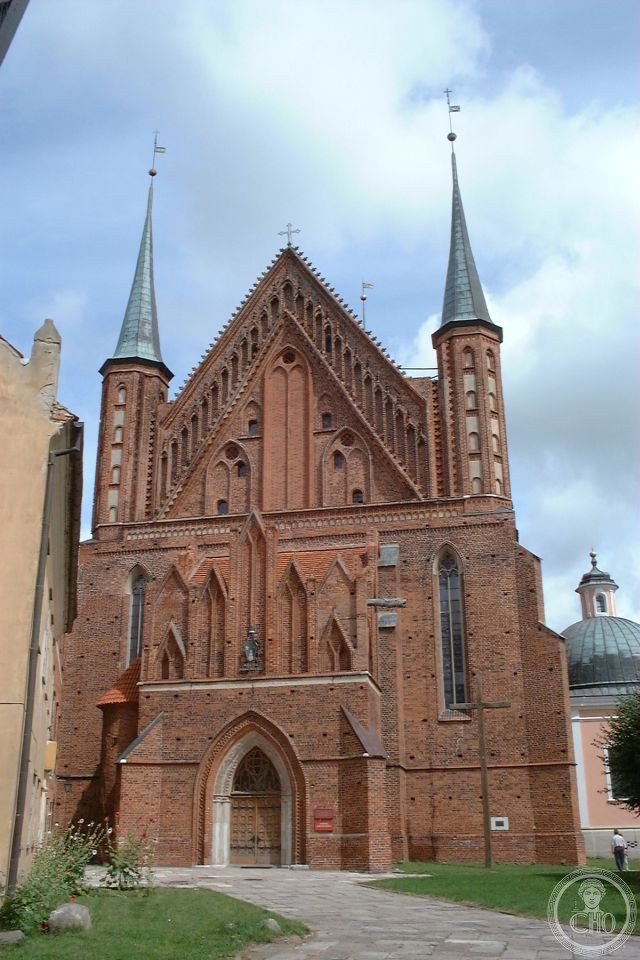
Frombork Cathedral, built between 1329 and 1388, was for decades the workplace of the astronomer Nicolaus Copernicus, a canon of the chapter. When he died in 1543 he was buried in an unmarked grave, as was the custom for canons, and its exact place was lost for almost five centuries. In 2005 a team of Polish archaeologists followed the theory of the historian Jerzy Sikorski, who held that Copernicus would lie near the altar in his care. They found thirteen skeletons by that altar, among them a man of between 60 and 70 who seemed to match. Confirmation came only in 2008: mitochondrial DNA taken from the teeth and bones proved identical to that of two hairs found in a calendar that had belonged to Copernicus, now kept at the Gustavianum museum in Uppsala, Sweden. On 22 May 2010 Copernicus was buried again, with a state funeral in the same cathedral, under a black granite slab engraved with a map of the solar system.
About Frombork Cathedral
The Archcathedral Basilica of the Assumption of the Blessed Virgin Mary and Saint Andrew in Frombork, built between 1329 and 1388, is inseparably linked with Nicolaus Copernicus, who served for decades as a canon of the cathedral and carried out much of his astronomical work while resident there. Upon his death in 1543, Copernicus was buried, in keeping with the custom for cathedral canons of his era, in an unmarked grave beneath the cathedral floor — and the precise location of his remains was lost for nearly five centuries thereafter. In 2005, a team of Polish archaeologists, guided by historian Jerzy Sikorski’s theory that Copernicus would likely have been buried near the altar for which he held canonical responsibility, discovered thirteen skeletons in that area of the cathedral, including the incomplete remains of a man aged between 60 and 70, identified as the closest match to Copernicus’s known age at death. Definitive confirmation came only in 2008, through a striking piece of forensic detective work: researchers extracted mitochondrial DNA from teeth and bone recovered from the skeleton and compared it against DNA extracted from two hairs discovered pressed inside a calendar that had belonged to Copernicus for much of his life, an object now held at the Museum Gustavianum in Uppsala, Sweden. The mitochondrial DNA profiles from both sources matched, providing strong scientific confirmation that the skeleton was indeed that of Copernicus himself; Polish police subsequently used the recovered skull to create a facial reconstruction bearing a notable resemblance to historical portraits of the young astronomer. On 22 May 2010, Copernicus’s remains were given a full state funeral and reburied within Frombork Cathedral, his new grave marked by a black granite headstone engraved with a depiction of the solar system, with the ceremony led by the papal nuncio and Poland’s newly named primate before a cathedral packed with mourners and a military honour guard.
Key facts
- 1329-1388: cathedral constructed.
- Copernicus: served as a canon of the cathedral for decades, conducting astronomical work there.
- 1543: Copernicus dies and is buried in an unmarked grave.
- 2005: archaeologists discover thirteen skeletons near the altar, including a likely match.
- 2008: mitochondrial DNA from the skeleton matches hairs from Copernicus’s own calendar, held in Uppsala.
- 22 May 2010: Copernicus reburied with full state funeral honours.
- Grave marker: black granite headstone engraved with a map of the solar system.
History
Frombork Cathedral’s central role in Copernicus’s life and work situates it as one of the most significant sites in the entire history of modern astronomy, the place where the heliocentric model that would eventually revolutionise humanity’s understanding of the solar system was substantially developed by a working cathedral canon rather than a court-appointed scholar. The nearly five-century mystery surrounding the exact location of his remains, finally resolved through a combination of documentary research, careful excavation, and cutting-edge mitochondrial DNA analysis, represents one of the most methodologically rigorous forensic identifications ever conducted on a major historical figure’s remains.
The 2010 state funeral, conducted with full Catholic and national honours nearly 467 years after Copernicus’s original, unmarked burial, transformed a purely scientific identification into a significant act of Polish national commemoration, formally restoring public, marked recognition to a figure whose scientific legacy had long outpaced any physical monument to his memory.
What you see
The Gothic cathedral, built across the 14th century, stands atop Cathedral Hill in Frombork, its brick construction and fortified character reflecting the wider architectural traditions of the Teutonic Order’s territories in medieval Prussia. Inside, Copernicus’s 2010 grave, marked by its distinctive black granite headstone engraved with a solar system diagram, lies near the altar where the 2005 excavation first uncovered his remains, while the wider cathedral complex includes a museum dedicated to the astronomer’s life and work.
Practical information
- Opening hours: generally open daily with seasonal variation; combined ticket available with the Nicolaus Copernicus Museum; check current hours before visiting.
- Address: Katedralna, 14-530 Frombork, Poland.
Getting there
Frombork Cathedral stands on Cathedral Hill in the small town of Frombork, on Poland’s Vistula Lagoon coast in the Warmian-Masurian Voivodeship, reachable by bus or car. GPS: 54.3569° N, 19.6832° E.
Nearby
- Nicolaus Copernicus Museum — museum dedicated to the astronomer, within the cathedral complex.
- Vistula Lagoon — coastal lagoon bordering Frombork.
- Elbląg — nearby regional town, reachable by road.
Sources
- PNAS — “Genetic identification of putative remains of the famous astronomer Nicolaus Copernicus” (pnas.org).
- Space.com — “The strange story of the grave of Copernicus” (space.com).
- Phys.org — “Copernicus’s remains reburied in Polish cathedral” (phys.org).
Find it on the map
See this place and what’s around it →📷 Become a Cultural Heritage Online photographer
Share your photos of places: they stay published under your name as the author. The more they're seen, the more you get noticed — and soon a contest will reward the most appreciated photos.
Log in or sign up free to add a photo