
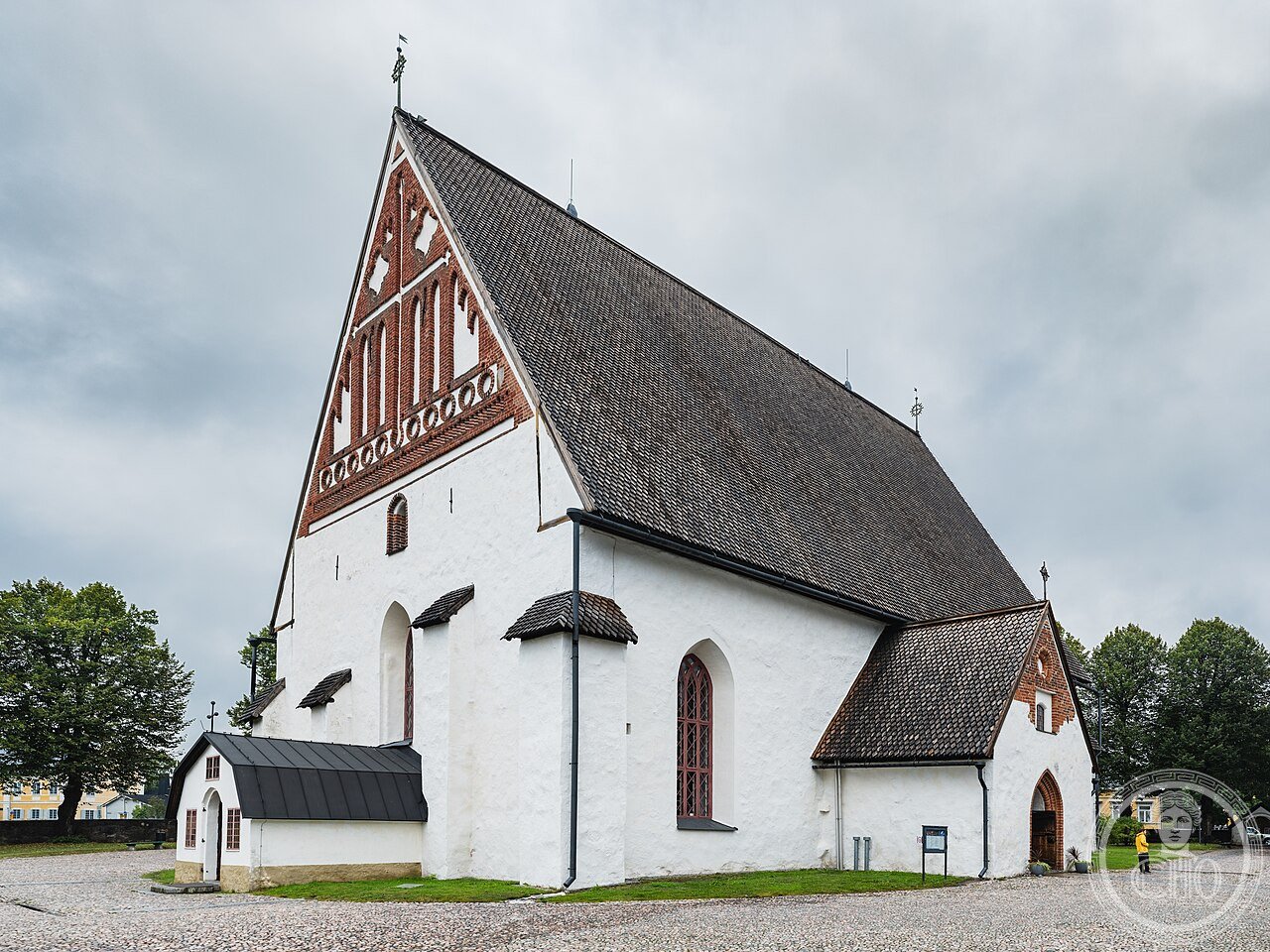
La cattedrale di Porvoo, le cui parti più antiche risalgono al XIII secolo mentre l’edificio principale fu costruito nel XV, ha un posto centrale nella storia finlandese: qui, il 28 marzo 1809, si aprì la prima Dieta di Finlandia, durante la quale lo zar Alessandro I di Russia dichiarò la Finlandia un Granducato autonomo, con l’imperatore russo come Granduca — l’atto fondativo della statualità finlandese moderna. Il 29 maggio 2006, un incendio doloso appiccato da un diciottenne, batterista in diverse band heavy metal, fece crollare il tetto esterno della cattedrale, pur lasciando intatti il soffitto interno e gli arredi. Il giovane fu condannato a sei anni e mezzo di carcere. I lavori di restauro, costati circa sei milioni di euro, si conclusero con la riapertura della cattedrale il 2 luglio 2008.
About Porvoo Cathedral
Porvoo Cathedral, seat of Finland’s Evangelical Lutheran Diocese of Porvoo, occupies a site with religious use dating back to the 13th century, though the main body of the present church was constructed in the 15th century. The cathedral holds an especially significant place in Finnish national history as the location of the first Diet of Finland, which opened on 28 March 1809. At this assembly, Tsar Alexander I of Russia formally declared Finland an autonomous Grand Duchy, with the Russian emperor himself holding the title of Grand Duke of Finland — a pivotal constitutional moment that established the framework for Finnish self-governance under Russian rule and laid essential groundwork for the country’s eventual full independence in 1917. Nearly two centuries later, on 29 May 2006, the cathedral suffered a severe act of arson: a fire, determined by police investigators to have originated outside the building, caused the outer roof to collapse, though the inner ceiling and the cathedral’s interior furnishings remained largely intact. The perpetrator, an 18-year-old local resident named Kalle Holm, a drummer in various heavy metal bands, was found guilty of the arson and sentenced to six and a half years in prison; he was later ordered to pay millions of euros in damages. Repairs to the fire-damaged cathedral cost approximately six million euros in total, and the fully restored building was formally reconsecrated and reopened to the public on 2 July 2008.
Key facts
- 13th century: earliest religious use of the site
- 15th century: main body of the present cathedral built
- 28 March 1809: first Diet of Finland opens in the cathedral; Tsar Alexander I declares Finland an autonomous Grand Duchy
- 29 May 2006: arson fire collapses the outer roof, interior largely spared
- Perpetrator: 18-year-old Kalle Holm, sentenced to 6.5 years in prison
- Restoration cost: approximately €6 million
- 2 July 2008: cathedral reopens after full restoration
History
The 1809 Diet of Finland held within these walls ranks among the single most consequential events in the entire history of the Finnish nation, marking the formal transition from Swedish to Russian rule while simultaneously establishing the autonomous Grand Duchy status that preserved distinct Finnish legal, religious, and administrative institutions for over a century — a foundation without which Finland’s 1917 declaration of independence would have taken a very different form. Porvoo Cathedral’s role as the physical setting for this constitutional turning point gives the building a significance in Finnish civic memory comparable to major parliamentary or constitutional sites elsewhere in Europe.
The 2006 arson attack, and the cathedral’s subsequent two-year, six-million-euro restoration, represents a stark and comparatively recent reminder of how vulnerable even nationally significant medieval buildings remain to sudden, deliberate destruction, while the relatively swift, well-documented reconstruction and reconsecration by 2008 demonstrates the strength of continued civic and religious commitment to preserving the cathedral’s historic fabric.
What you see
The cathedral’s medieval stone structure, with its main body dating to the 15th century, stands prominently within the historic old town of Porvoo, its roof entirely rebuilt following the 2006 fire while the interior retains its historic furnishings, largely spared by the blaze. The building continues to serve as the seat of the Diocese of Porvoo, its restored form giving little outward indication of the 2006 disaster beyond what a knowledgeable visitor might notice in the renewed roofline.
Practical information
- Opening hours: generally open daily with seasonal variation; check current hours before visiting
- Address: Kirkkotori 1, 06100 Porvoo, Finland
Getting there
Porvoo Cathedral stands in the historic old town of Porvoo, roughly 50 kilometres east of Helsinki, reachable by bus from the Finnish capital. GPS: 60.3972° N, 25.6578° E.
Nearby
- Porvoo Old Town — historic riverside district with colourful wooden warehouses, surrounding the cathedral
- Porvoonjoki river — the river running through the old town
- Helsinki — Finland’s capital, roughly 50 km to the west
Sources
- Wikipedia — “Porvoo Cathedral” (en.wikipedia.org)
- Yle — “Arson Likely Cause of Porvoo Cathedral Fire” (yle.fi)
- Yle — “Porvoo Cathedral Reconsecrated” (yle.fi)
Find it on the map
See this place and what’s around it →📷 Become a Cultural Heritage Online photographer
Share your photos of places: they stay published under your name as the author. The more they're seen, the more you get noticed — and soon a contest will reward the most appreciated photos.
Log in or sign up free to add a photo