

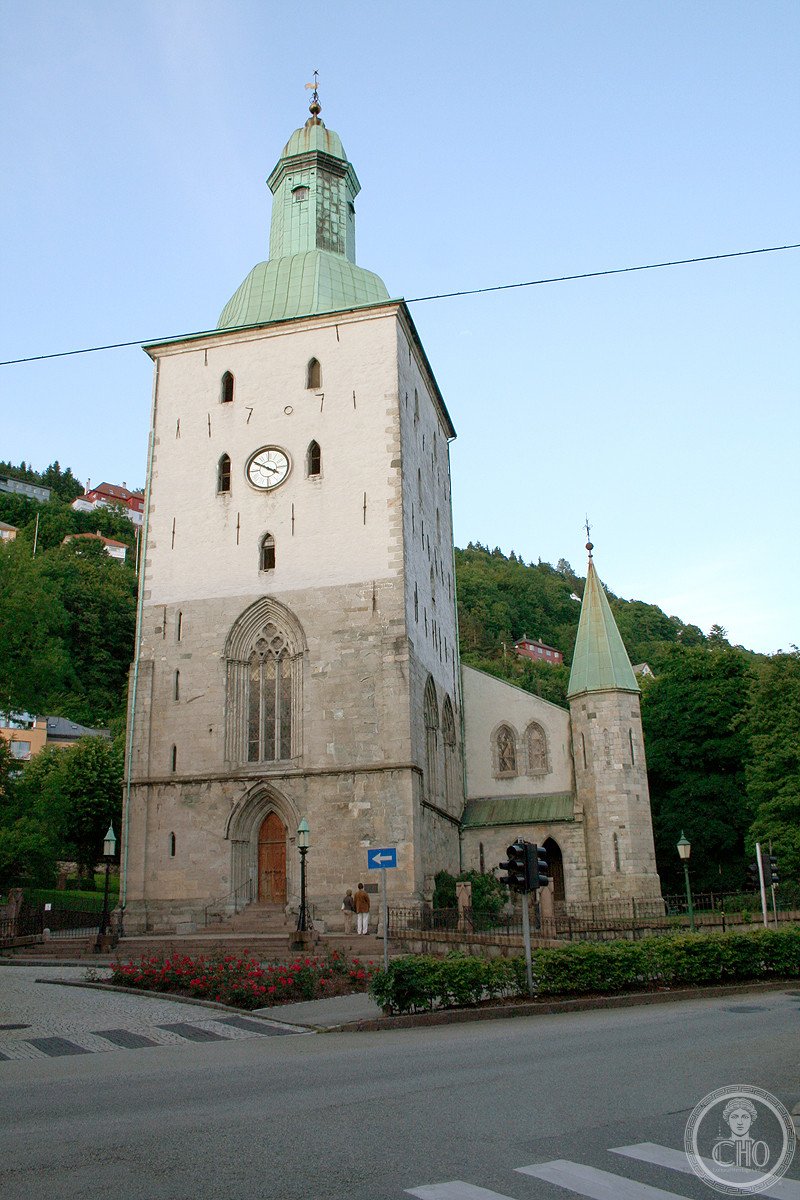
Bergen Cathedral began as a church dedicated to Saint Olaf, patron of Norway, around 1150, and is mentioned in the saga of king Sverre. In the first half of the thirteenth century it passed to the Franciscan friars, who built a convent there; the Franciscan church was consecrated by bishop Narve in 1301. Its history is marked by repeated fires: badly damaged in 1248 and in 1270, it burned again in 1463 without being fully rebuilt until the 1550s, and took its present appearance after the fires of 1623 and 1640. But the most surprising detail of the front dates from 1665: during the battle of Vågen, a naval engagement of the Second Anglo-Dutch War fought in the harbour of Bergen between the Dutch merchant fleet and a squadron of English warships, a cannonball struck the outer wall of the cathedral. Instead of removing it during the restorations that followed, the people of Bergen decided to leave it there, where it has remained visible to this day as a living monument to that battle.
About Bergen Cathedral
Bergen Cathedral began as a church dedicated to Saint Olav (Olav the Holy), Norway’s patron saint, around the year 1150, and is recorded in the historical saga of King Sverre. In the first half of the 13th century, Franciscan friars were granted use of the church and built an adjoining friary, with the resulting Franciscan basilica formally consecrated by Bishop Narve in 1301. The building’s subsequent history has been repeatedly marked by fire: the church suffered heavy damage in both 1248 and 1270, then burned down again in 1463, not being fully reconstructed until the 1550s. Following further fires in 1623 and 1640, Bergen Cathedral acquired the general appearance it retains today, and the date 1707 inscribed on its facade commemorates an extensive renovation and restoration project undertaken after the devastating 1702 city-wide fire that swept through Bergen. Among all these episodes of destruction and rebuilding, the cathedral’s single most distinctive surviving feature dates to 1665: during the Battle of Vågen, a naval engagement fought in Bergen’s main harbour as part of the Second Anglo-Dutch War between a Dutch merchant fleet sheltering in port and an attacking English flotilla of warships, a cannonball struck the cathedral’s exterior wall. Rather than removing the embedded shot during later repairs, Bergen’s residents chose to leave it in place as a tangible historical monument, and the cannonball remains visibly lodged in the cathedral’s stonework to this day, a direct physical trace of a 17th-century naval battle fought in the city’s own harbour.
Key facts
- c. 1150: church founded, dedicated to Saint Olav
- First half of 13th century: Franciscan friars take over the church
- 1301: Franciscan basilica consecrated by Bishop Narve
- 1248, 1270, 1463: church repeatedly damaged or destroyed by fire
- 1623 and 1640: further fires give the cathedral its present general form
- August 1665: Battle of Vågen; a cannonball embeds in the exterior wall and is deliberately left in place
- 1702: devastating city fire prompts major restoration, commemorated by the 1707 facade date
History
Bergen Cathedral’s repeated destruction by fire across more than four centuries — 1248, 1270, 1463, 1623, 1640, and 1702 — reflects the broader vulnerability of Bergen’s densely built wooden harbour city to catastrophic urban fires throughout the medieval and early modern periods, with the cathedral itself serving as a recurring casualty and beneficiary of the city’s cycles of destruction and rebuilding. The building’s transition from a parish church dedicated to Saint Olav to a Franciscan basilica in the 13th century situates it within the broader expansion of mendicant religious orders across medieval Scandinavian towns.
The deliberate decision to leave the 1665 cannonball embedded in the cathedral wall, rather than repair the damage invisibly, transformed a moment of wartime violence into a permanent and unusually direct piece of civic memory — few European cathedrals retain such an immediately legible physical trace of a specific naval battle fought within sight of their own walls.
What you see
The cathedral’s present form, largely dating to reconstruction following the 1623, 1640, and 1702 fires, includes a west-end tower that replaced an earlier nave steeple torn down during these rebuilding phases. The embedded 1665 cannonball remains visible in the exterior wall, a small but historically vivid detail set within the cathedral’s broader Gothic and post-fire architectural fabric.
Practical information
- Opening hours: generally open daily with seasonal variation; check current hours before visiting
- Address: Domkirkeplassen, 5017 Bergen, Norway
Getting there
Bergen Cathedral stands in the historic centre of Bergen, on Norway’s western coast, easily reachable on foot from the Bryggen harbour district. GPS: 60.3939° N, 5.3310° E.
Nearby
- Bryggen — UNESCO-listed historic wharf district, a short walk away
- Bergen Fish Market — harbourside market, nearby
- Vågen harbour — site of the 1665 naval battle, adjacent to the city centre
Sources
- Wikipedia — “Bergen Cathedral” (en.wikipedia.org)
- Visit Bergen — “Bergen Cathedral” (en.visitbergen.com)
- VoiceMap — “The Cathedral and The Battle of Vågen” (voicemap.me)
Find it on the map
See this place and what’s around it →📷 Become a Cultural Heritage Online photographer
Share your photos of places: they stay published under your name as the author. The more they're seen, the more you get noticed — and soon a contest will reward the most appreciated photos.
Log in or sign up free to add a photo