
Willibrordo, missionario nato nel 658 nel Northumbria inglese, evangelizzò la Frisia a partire dal 690 e fu consacrato vescovo da papa Sergio I nel 695; nel 698 ricevette terre a Echternach, dove fondò un’abbazia benedettina. Morì il 7 novembre 739 e fu sepolto nella stessa abbazia. Sotto l’abate Umberto, a partire dal 1028, il monastero raggiunse il suo massimo splendore, ospitando lo scriptorium più importante dell’epoca della dinastia salica, che produsse capolavori come il Codex Aureus, oggi custodito a Norimberga. Ogni martedì di Pentecoste, dal 1100 documentato, si tiene la processione danzante di Echternach: circa ottomila danzatori, divisi in 45 gruppi secondo un rituale tramandato di generazione in generazione, saltellano fino alla tomba del santo — l’ultima processione danzante tradizionale rimasta in Europa, iscritta nel 2010 nel patrimonio culturale immateriale dell’UNESCO. L’abbazia, distrutta durante la battaglia delle Ardenne nel 1944, fu ricostruita tra il 1948 e il 1953.
About Echternach Abbey
Echternach’s recorded history begins with the arrival of the monk Willibrord in 698 CE. Born in 658 in Northumbria, England, Willibrord became a missionary who evangelised Frisia beginning in 690 and was consecrated bishop by Pope Sergius I in 695, before receiving land at Echternach in 698, where he founded a Benedictine abbey. He died on 7 November 739 and was buried within the same abbey he had founded, establishing what would become a major centre of medieval Christian learning and pilgrimage. Under Abbot Humbert, whose tenure began in 1028, the monastery reached the height of its splendour, particularly through its scriptorium — the largest of its kind anywhere during the era of the Salian dynasty. This scriptorium produced dozens of masterpieces of Carolingian and Ottonian manuscript illumination, most famously the Codex Aureus of Echternach, an illuminated Gospel Book created around 1030-1050 containing over 60 decorative pages, including 16 full-page miniatures and 5 evangelist portraits; the manuscript survives today in the Germanisches Nationalmuseum in Nuremberg. Since at least the year 1100, Echternach has been the site of an extraordinary living tradition: the hopping (or dancing) procession, held every year on the Tuesday following Pentecost through the medieval streets of Echternach, Luxembourg’s oldest town. Rooted in the cult of Saint Willibrord, venerated for his missionary work, kindness, and reputed gift of healing certain illnesses, the procession involves around 8,000 dancers organised into 45 groups following a ritual choreography passed down across generations, making it the last traditional dancing procession still practised anywhere in Europe; UNESCO inscribed the tradition on its Representative List of the Intangible Cultural Heritage of Humanity in 2010. The abbey complex itself suffered severe destruction during the Battle of the Bulge in 1944 and was subsequently rebuilt between 1948 and 1953, restoring the basilica in a Neo-Romanesque style consistent with its historic character.
Key facts
- 698 CE: abbey founded by Saint Willibrord
- 739 CE: Willibrord dies and is buried in the abbey
- From 1028: abbey’s scriptorium becomes the largest of its era under Abbot Humbert
- c. 1030-1050: the Codex Aureus of Echternach produced
- Documented since 1100: the hopping procession of Echternach, held every Whit Tuesday
- 2010: procession inscribed on the UNESCO Intangible Cultural Heritage list
- 1944: abbey severely destroyed during the Battle of the Bulge
- 1948-1953: basilica rebuilt in Neo-Romanesque style
History
Willibrord’s foundation of Echternach in 698, following his missionary work across Frisia and episcopal consecration by the pope himself, places the abbey among the most significant Anglo-Saxon missionary foundations on the European continent, part of a wider wave of English monks who played a central role in the Christianisation of the early medieval Frankish and Frisian territories. The abbey’s 11th-century scriptorium, producing manuscripts of the calibre of the Codex Aureus under Abbot Humbert, situates Echternach among the most artistically and intellectually significant monastic centres of the entire Salian imperial period in Central Europe.
The unbroken continuation of the hopping procession since at least 1100, surviving through the Reformation, the French Revolution, two World Wars, and the abbey’s own near-total destruction in 1944, makes it a uniquely resilient piece of living medieval religious culture — the last of its kind in Europe — and gives the rebuilt basilica a continuing role as the literal endpoint of an annual ritual older than the current building itself.
What you see
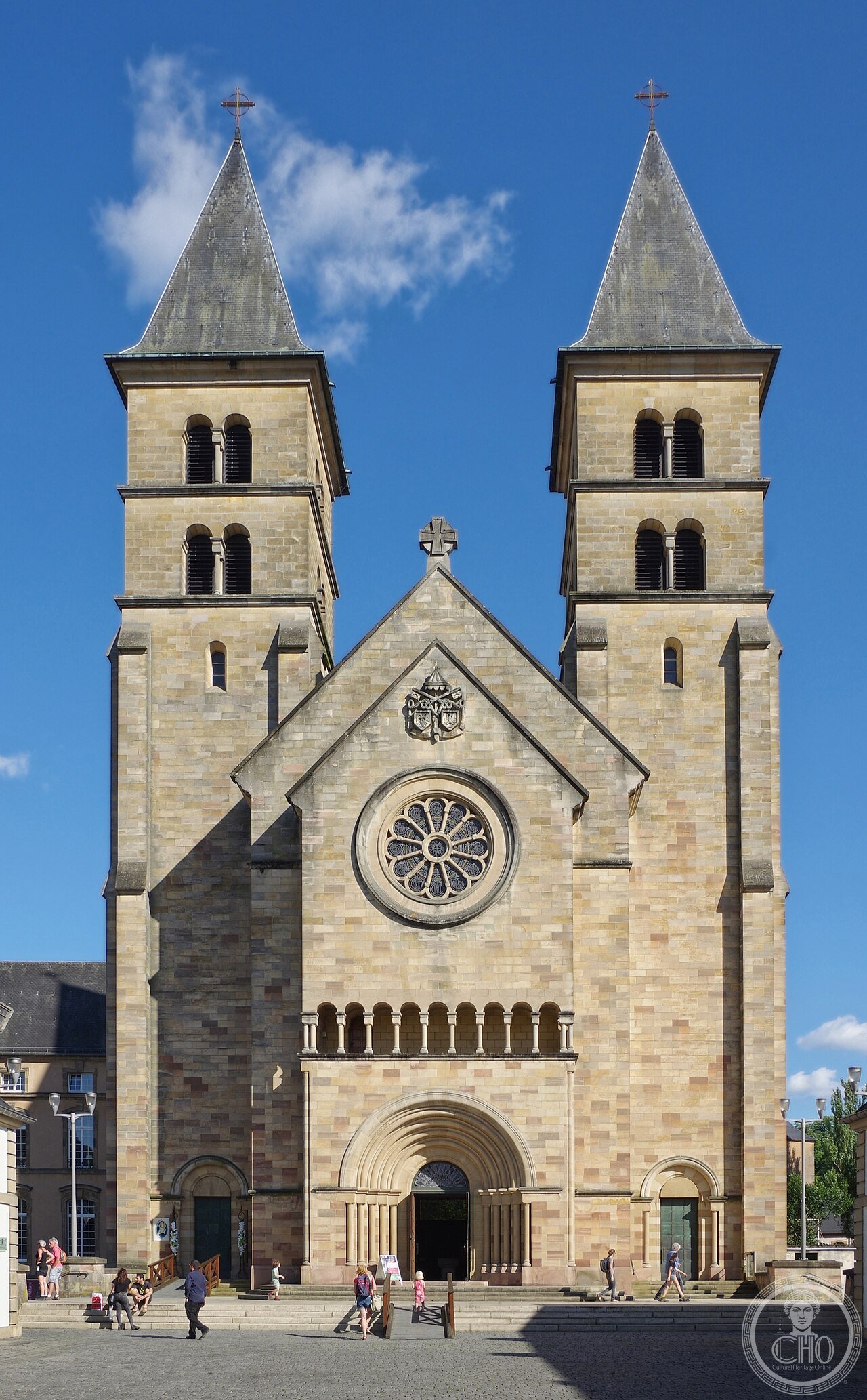
The Neo-Romanesque basilica, rebuilt between 1948 and 1953 after its near-total destruction in the 1944 Battle of the Bulge, preserves the historic form and character of its medieval and Baroque predecessors, including a Baroque basilica entrance dating to 1737. Willibrord’s tomb lies within the basilica’s crypt, forming the destination of the annual hopping procession, while the wider abbey complex includes buildings from across its long architectural history.
Practical information
- Opening hours: generally open daily with seasonal variation; free admission; check current hours before visiting; the hopping procession takes place annually on Whit Tuesday
- Address: Parvis de la Basilique, 6486 Echternach, Luxembourg
Getting there
Echternach Abbey stands in the historic centre of Echternach, Luxembourg’s oldest town, in the country’s east near the German border, reachable by bus from Luxembourg City. GPS: 49.8134° N, 6.4217° E.
Nearby
- Echternach Old Town — the medieval town centre surrounding the abbey
- Sûre River and German border — forming the eastern edge of the town
- Luxembourg City — the capital, roughly 35 km away by road
Sources
- UNESCO Intangible Cultural Heritage — “Hopping procession of Echternach” (ich.unesco.org)
- Wikipedia — “Abbey of Echternach” (en.wikipedia.org)
- Wikipedia — “Codex Aureus of Echternach” (en.wikipedia.org)
Find it on the map
See this place and what’s around it →📷 Become a Cultural Heritage Online photographer
Share your photos of places: they stay published under your name as the author. The more they're seen, the more you get noticed — and soon a contest will reward the most appreciated photos.
Log in or sign up free to add a photo