

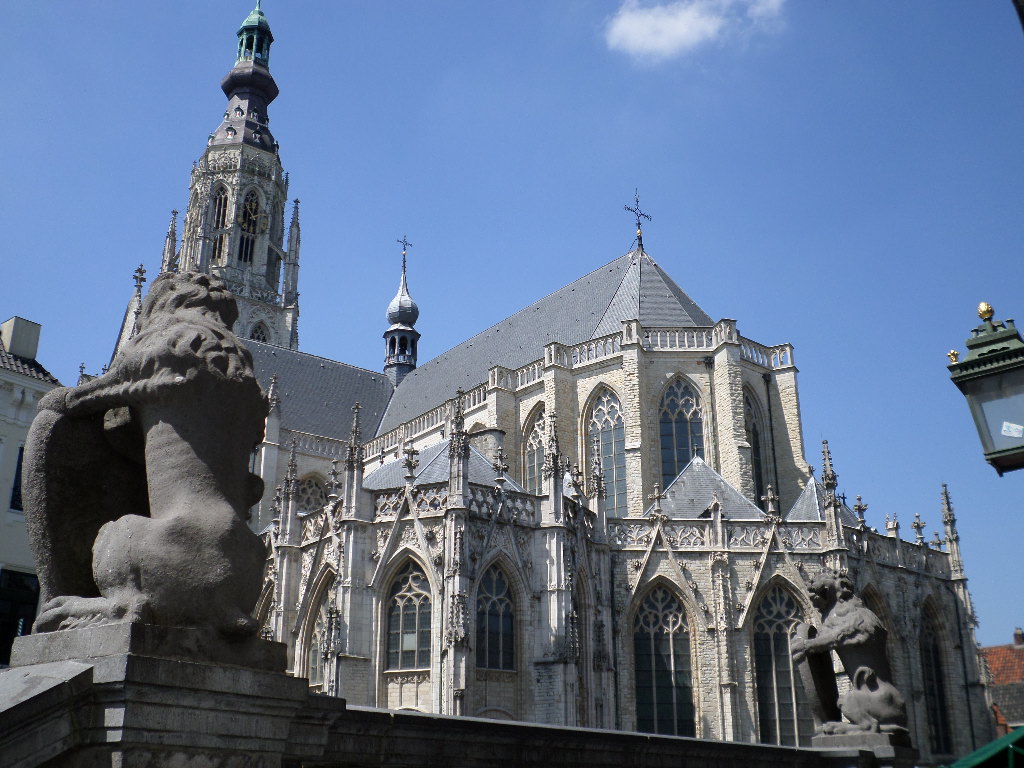
Building of the present Grote Kerk began in 1410, commissioned by Engelbrecht I of Nassau to mark the birth of his son Jan IV. The first tower collapsed in 1457; the present one, 97 metres high, was raised between 1468 and 1509, while the whole church reached its present form only in 1547. Built of white limestone carried from the Ardennes, the tower is affectionately nicknamed “de Witte Vrouwe”, the White Lady. Nine members of the Nassau family rest in the church, among them Engelbert II of Nassau, the first Prince of Orange, whose Renaissance tomb — the oldest known Renaissance sculpture in the northern Netherlands — marks symbolically the origin of the Orange-Nassau dynasty, from which several European royal houses still descend today.
About Grote Kerk, Breda
The Grote Kerk, also known as the Onze-Lieve-Vrouwekerk (Church of Our Lady), traces its origins to the mid-14th century, when Jan van Polanen I, a wealthy and influential local figure, acquired the seigniory of Breda. Construction of the church as it largely stands today began in 1410, commissioned by Engelbrecht I of Nassau to mark the birth of his son, Jan IV of Nassau. The original church tower collapsed in 1457, and the present tower — the church’s defining landmark — was built between 1468 and 1509; construction of the wider church continued until 1547, when it finally reached its current Brabantine Gothic form. Built from white limestone transported specifically from the Ardennes, the tower has long been affectionately nicknamed “de Witte Vrouwe,” the White Lady, for its distinctive pale colour rising above Breda’s skyline at 97 metres. A fire in 1694 destroyed the tower’s original topping, which was not fully restored until 1702. The church holds deep significance for the House of Orange-Nassau: nine members of the Nassau family are buried within its walls, most notably Engelbert II of Nassau, recognised as the first Prince of Orange, whose elaborate tomb — shared with his wife, Cimburga of Baden — is considered the oldest known Renaissance sculpture in the northern Netherlands. As the first to formally hold the title Prince of Orange within the family line that would eventually produce William the Silent and the later House of Orange-Nassau, Engelbert II’s burial here places the Grote Kerk at the symbolic origin point of a dynasty whose descendants continue to occupy European royal houses today.
Key facts
- Mid-14th century: Jan van Polanen I acquires the seigniory of Breda
- 1410: present church construction begins, commissioned by Engelbrecht I of Nassau
- 1457: original tower collapses
- 1468-1509: present 97-metre tower built
- 1547: church reaches its final Brabantine Gothic form
- 1694: fire destroys the tower’s original topping, restored by 1702
- Nine Nassaus buried here, including Engelbert II, first Prince of Orange
- Nickname: “de Witte Vrouwe” (the White Lady), for the tower’s Ardennes limestone
History
The church’s deep association with the House of Nassau, formalised through Engelbrecht I’s commissioning of the present building and cemented by the burial of nine family members including Engelbert II, the first Prince of Orange, situates Breda’s Grote Kerk at a genuinely foundational moment in European dynastic history — the same Orange-Nassau line whose later descendants, through William the Silent, would go on to found the modern Dutch royal house and, through subsequent marriages, connect to several other European monarchies. Engelbert II’s Renaissance tomb, predating comparable Renaissance sculptural work elsewhere in the northern Netherlands, marks an early and significant point of Italian Renaissance artistic influence reaching the Low Countries.
The tower’s near-century-long construction from 1468 to 1509, following the collapse of an earlier structure in 1457, and its subsequent 1694 fire and restoration, trace a familiar pattern of ambition, disaster, and renewal common to major medieval and early modern church towers across the Low Countries, with the distinctive white Ardennes limestone giving Breda’s version its own memorable civic nickname.
What you see
The 97-metre White Lady tower, built from pale Ardennes limestone between 1468 and 1509, dominates Breda’s skyline and offers panoramic views over the city from its viewing platform. Inside, the Brabantine Gothic nave houses the Renaissance tomb of Engelbert II of Nassau and Cimburga of Baden, alongside further Nassau family monuments, intricate woodwork, and stained glass accumulated across the church’s long construction and restoration history.
Practical information
- Opening hours: generally open daily with seasonal variation; free admission; tower climbs available separately; check current hours before visiting
- Address: Kerkplein 2, 4811 XT Breda, Netherlands
Getting there
Grote Kerk stands on the Grote Markt in the historic centre of Breda, in the Netherlands’ North Brabant province, easily reachable on foot from Breda railway station. GPS: 51.5891° N, 4.7753° E.
Nearby
- Grote Markt — Breda’s central market square, immediately adjacent
- Kasteel van Breda — the former Nassau castle, now a military academy, nearby
- Breda railway station — the city’s main station, a short walk away
Sources
- Wikipedia — “Grote Kerk (Breda)” (en.wikipedia.org)
- Grote Kerk Breda — “History” (grotekerkbreda.nl)
- Explore Breda — “The rich history of the Grote Kerk Breda” (explorebreda.com)
Find it on the map
See this place and what’s around it →📷 Become a Cultural Heritage Online photographer
Share your photos of places: they stay published under your name as the author. The more they're seen, the more you get noticed — and soon a contest will reward the most appreciated photos.
Log in or sign up free to add a photo