
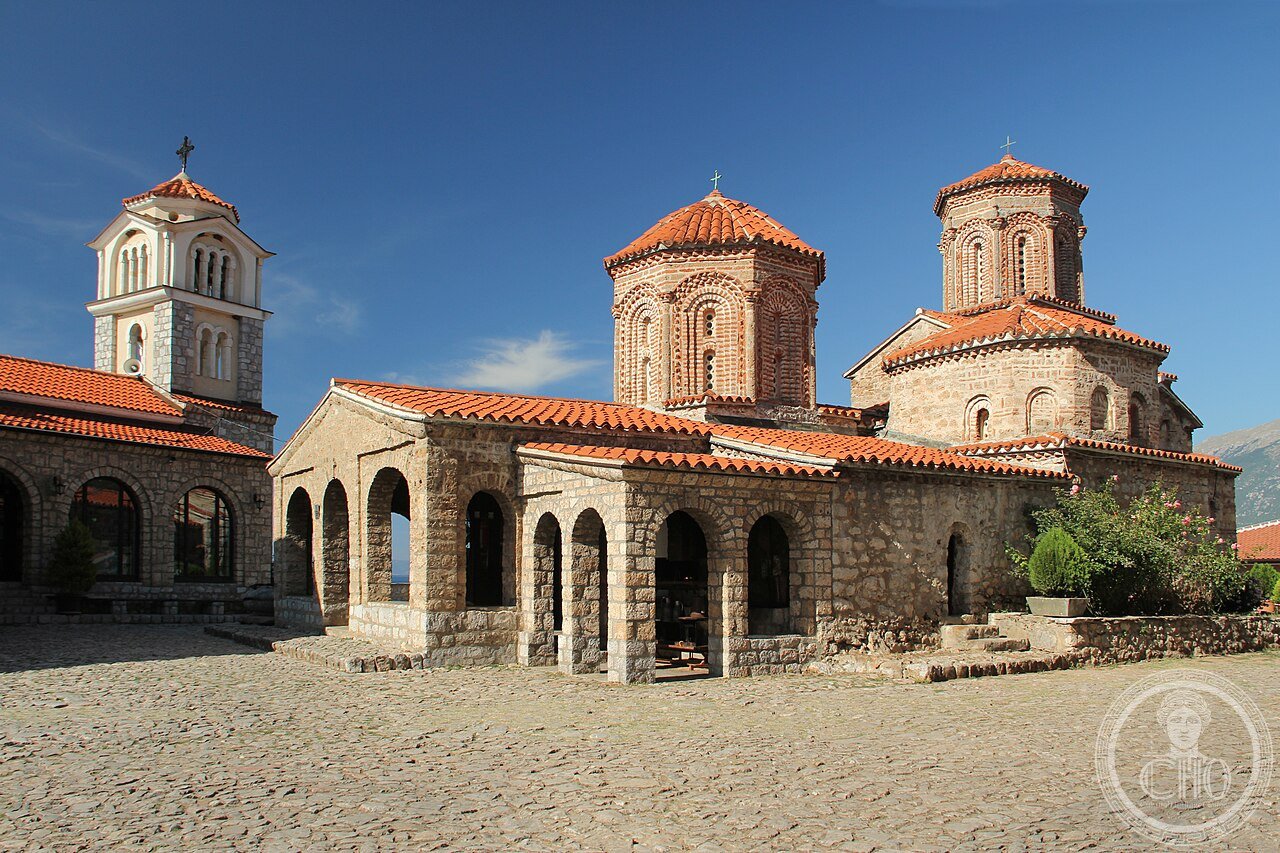
San Naum di Ohrid, discepolo dei santi Cirillo e Metodio ed egli stesso studioso e missionario, fondò questo monastero nel 905, contribuendo insieme a san Clemente a diffondere la lingua slava, l’ortodossia e l’alfabeto cirillico nella regione di Ohrid, uno dei più importanti centri spirituali e culturali del mondo slavo medievale. Fu sepolto qui nel 910. Secondo la leggenda, chi appoggia l’orecchio al suo sarcofago di pietra all’interno della chiesa può ancora sentire il battito del suo cuore: in realtà il suono proviene dalle sorgenti sotterranee che alimentano il lago, ma la leggenda continua a unire il miracolo religioso alla potenza della natura circostante, oggi popolata da pavoni che passeggiano liberi nei giardini del monastero.
About Saint Naum Monastery
Saint Naum Monastery was founded in 905 CE by Saint Naum of Ohrid, a leading disciple of Saints Cyril and Methodius and himself a medieval scholar and missionary who, together with Saint Clement of Ohrid, played a central role in promoting the Slavic liturgical language, Orthodox Christianity, and the early spread of the Cyrillic script throughout the Ohrid region. The monastery ranks among the oldest and most historically significant spiritual and cultural centres of Slavic Orthodoxy, and Saint Naum himself was buried within its walls in 910, only five years after its founding. Over the following centuries the monastery complex was destroyed and rebuilt multiple times amid the region’s turbulent history; the main church standing today was largely reconstructed in the 16th century, during the Ottoman era, upon the surviving original foundations, with most of its interior frescoes dating to a later restoration campaign in 1806. The monastery’s most enduring legend concerns Saint Naum’s stone tomb inside the church: visitors and pilgrims who press an ear to the sarcophagus report hearing what sounds unmistakably like a beating heart. The sound is in fact produced by the powerful underground springs that flow directly beneath the monastery and feed into Lake Ohrid nearby — the Springs of the Black Drin — but the coincidence has cemented the legend as a striking symbol of the union between religious devotion and the surrounding natural landscape. Owing to its abundant, exceptionally clear spring waters, the monastery historically also functioned as a centre for physical and mental healing, drawing pilgrims seeking restoration alongside religious pilgrims. Today the monastery grounds are further enlivened by dozens of free-roaming peacocks in its lush gardens, popularly said to descend from birds kept by the monks themselves centuries ago, and now regarded as a living symbol of the site’s peaceful harmony between faith and nature.
Key facts
- 905 CE: monastery founded by Saint Naum of Ohrid.
- 910 CE: Saint Naum buried within the monastery, five years after its founding.
- 16th century: main church rebuilt on original foundations during Ottoman era.
- 1806: most surviving interior frescoes painted.
- Legend: Saint Naum’s heartbeat reportedly audible through his stone tomb.
- Springs of the Black Drin: underground spring source feeding Lake Ohrid, beneath the monastery.
- Today: monastery gardens home to dozens of free-roaming peacocks.
History
Saint Naum’s role, alongside Saint Clement of Ohrid, in disseminating the Cyrillic script and Slavic-language Orthodox Christianity places this monastery at one of the true founding sites of Slavic literary and religious culture, its 10th-century establishment predating by centuries the wider spread of Cyrillic literacy across the Balkans and beyond. The monastery’s repeated destruction and reconstruction across a millennium of shifting regional powers — Byzantine, Bulgarian, Serbian, and Ottoman — mirrors the broader turbulent history of the Ohrid region itself, even as the site’s core spiritual identity, anchored by Naum’s own tomb, remained continuously intact.
The enduring “heartbeat” legend, rooted in the genuinely audible sound of underground springs beneath the saint’s tomb, exemplifies a recurring pattern across pilgrimage sites worldwide in which a natural phenomenon becomes inseparably woven into a site’s religious meaning, reinforcing rather than undermining its spiritual significance for visitors across more than eleven centuries.
What you see
The 16th-century domed church, rebuilt on its original 10th-century foundations, stands within a walled monastery complex overlooking the southeastern shore of Lake Ohrid, its interior frescoes largely dating from an 1806 restoration campaign. Saint Naum’s tomb lies within the church itself, while the surrounding gardens and adjacent Black Drin springs — navigable by small rowing boat — form an integral part of the visitor experience, alongside the resident peacocks that roam the grounds freely.
Practical information
- Opening hours: generally open daily with seasonal variation; admission fee applies; check current hours before visiting.
- Address: Sveti Naum, Ohrid Municipality, North Macedonia, near the Albanian border.
Getting there
Saint Naum Monastery sits on the southeastern shore of Lake Ohrid, roughly 29 kilometres south of the city of Ohrid, reachable by road, boat, or organised tour. GPS: 40.9135° N, 20.7410° E.
Nearby
- Springs of the Black Drin — natural spring pools immediately adjacent, navigable by rowboat.
- Ohrid — UNESCO-listed lakeside city, roughly 29 km to the north.
- Albanian border — a short distance south of the monastery.
Sources
- Discovering Macedonia — “The Magnificent Monastery of Saint Naum” (discoveringmacedonia.com).
- Lonely Planet — “Sveti Naum Monastery” (lonelyplanet.com).
- Wikidata — “Monastery of Saint Naum” (wikidata.org).
Find it on the map
See this place and what’s around it →📷 Become a Cultural Heritage Online photographer
Share your photos of places: they stay published under your name as the author. The more they're seen, the more you get noticed — and soon a contest will reward the most appreciated photos.
Log in or sign up free to add a photo