
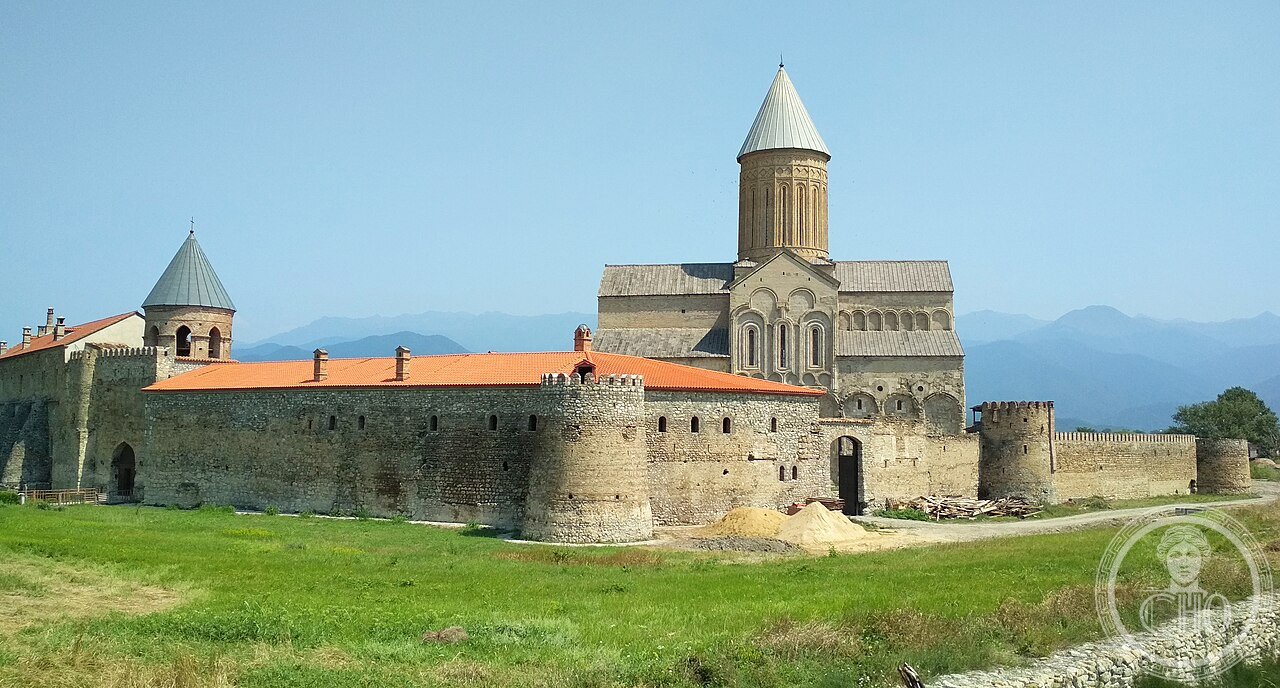
Il monaco assiro Giuseppe (Yoseb) Alaverdeli, giunto da Antiochia come uno dei leggendari Tredici Padri assiri, si stabilì ad Alaverdi, allora un villaggio sede di un antico culto pagano dedicato alla luna, e vi fondò un monastero già nel VI secolo. L’attuale cattedrale di San Giorgio fu costruita nell’XI secolo dal re Kvirike III di Kakheti, sostituendo una chiesa più antica: con i suoi oltre 50 metri d’altezza, rimase l’edificio religioso più alto di tutta la Georgia fino alla consacrazione della cattedrale della Santissima Trinità di Tbilisi nel 2004, quasi mille anni dopo. Il monastero è oggi anche un centro vinicolo attivo: i monaci producono vino in una cantina restaurata dell’XI secolo, usando ancora il metodo tradizionale delle qvevri, le grandi giare di argilla sepolte nel terreno.
About Alaverdi Cathedral
Alaverdi Monastery traces its origins to the Assyrian monk Joseph (Yoseb) Alaverdeli, who travelled from Antioch as one of the Thirteen Assyrian Fathers credited with strengthening monastic Christianity across Georgia in the 6th century, and who settled at Alaverdi, then a small village and former pagan religious centre dedicated to the moon. While parts of the monastery complex date to this 6th-century foundation, the present-day Cathedral of Saint George was built in the 11th century by King Kvirike III of Kakheti, replacing an earlier church also dedicated to the saint. The cathedral is counted among the four Great Cathedrals of the Georgian Orthodox world, and at a height of over 50 metres (roughly 55 metres by some measurements), it stood as the tallest religious building anywhere in Georgia for nearly a millennium — a record it held until the consecration of the Holy Trinity Cathedral in Tbilisi in 2004. Inside, light filters through 25 narrow slit windows set high in the walls, illuminating a cycle of important 11th-century frescoes, some of which were not fully completed until as late as the 15th to 17th centuries; decorative carvings on the altar column include large bunches of grapes, a direct reference to the deep importance of viticulture and winemaking in the Kakheti region. Alaverdi served for centuries as a major spiritual and cultural centre of Georgian monastic life, home to notable writers, calligraphers, and bibliophiles. That winemaking tradition remains a living part of the monastery today: resident monks produce wine in a restored 11th-century wine cellar using the traditional qvevri method, fermenting and ageing the wine in large egg-shaped clay vessels buried underground, a technique recognised by UNESCO as an element of Intangible Cultural Heritage.
Key facts
- 6th century: monastery founded by Joseph Alaverdeli, one of the Thirteen Assyrian Fathers
- Site history: built over an earlier pagan centre dedicated to the moon
- 11th century: present Cathedral of Saint George built by King Kvirike III of Kakheti
- Over 50 m tall: tallest religious building in Georgia for nearly 1,000 years, until 2004
- Interior: 25 high slit windows, 11th-17th century frescoes
- Today: active monastic winemaking using the traditional buried-qvevri method
History
As one of the Thirteen Assyrian Fathers whose 6th-century missions across Georgia are credited with reinforcing the country’s still-young Christian monastic tradition, Joseph Alaverdeli’s foundation at a former pagan lunar shrine situates Alaverdi within a broader pattern of early Georgian Christianity deliberately establishing itself on sites of pre-Christian religious significance. The cathedral’s near-millennium status as Georgia’s tallest religious building, only surpassed in the 21st century, reflects both the scale of King Kvirike III’s 11th-century ambitions and the remarkable structural durability of medieval Georgian ecclesiastical architecture across nearly a thousand years of regional upheaval.
Alaverdi’s continuing role as a working monastic winery, using an unbroken traditional method now recognised by UNESCO as Intangible Cultural Heritage, connects the site’s deep religious history directly to Kakheti’s still-thriving identity as one of the world’s oldest wine-producing regions, making the monastery a rare case of a major medieval cathedral remaining economically as well as spiritually active in its original function.
What you see
The cathedral’s tall, slender cross-in-square silhouette rises dramatically above the surrounding Alazani Valley vineyards, its height accentuated by minimal exterior ornamentation typical of medieval Kakhetian church architecture. Inside, 25 narrow slit windows admit filtered light onto an extensive fresco cycle spanning the 11th to 17th centuries, while the surrounding monastery complex includes the restored 11th-century wine cellar where monks continue to produce wine in buried clay qvevri.
Practical information
- Opening hours: generally open daily with seasonal variation; free admission; check current hours before visiting
- Address: Alaverdi, Akhmeta Municipality, Kakheti, Georgia
Getting there
Alaverdi Cathedral is located in the Alazani Valley of the Kakheti wine region, roughly 20 kilometres from the town of Telavi, reachable by car or organised tour. GPS: 42.0325° N, 45.3773° E.
Nearby
- Telavi — the main town of the Kakheti wine region, nearby
- Ikalto Monastery — another historic Kakhetian monastery with its own ancient winery
- Gremi — medieval royal citadel and church complex, in the Alazani Valley
Sources
- Wikipedia — “Alaverdi Monastery” (en.wikipedia.org)
- UNESCO World Heritage Centre — “Alaverdi Cathedral” (whc.unesco.org)
- Georgia About — “Alaverdi Cathedral” (georgiaabout.com)
Find it on the map
See this place and what’s around it →📷 Become a Cultural Heritage Online photographer
Share your photos of places: they stay published under your name as the author. The more they're seen, the more you get noticed — and soon a contest will reward the most appreciated photos.
Log in or sign up free to add a photo