
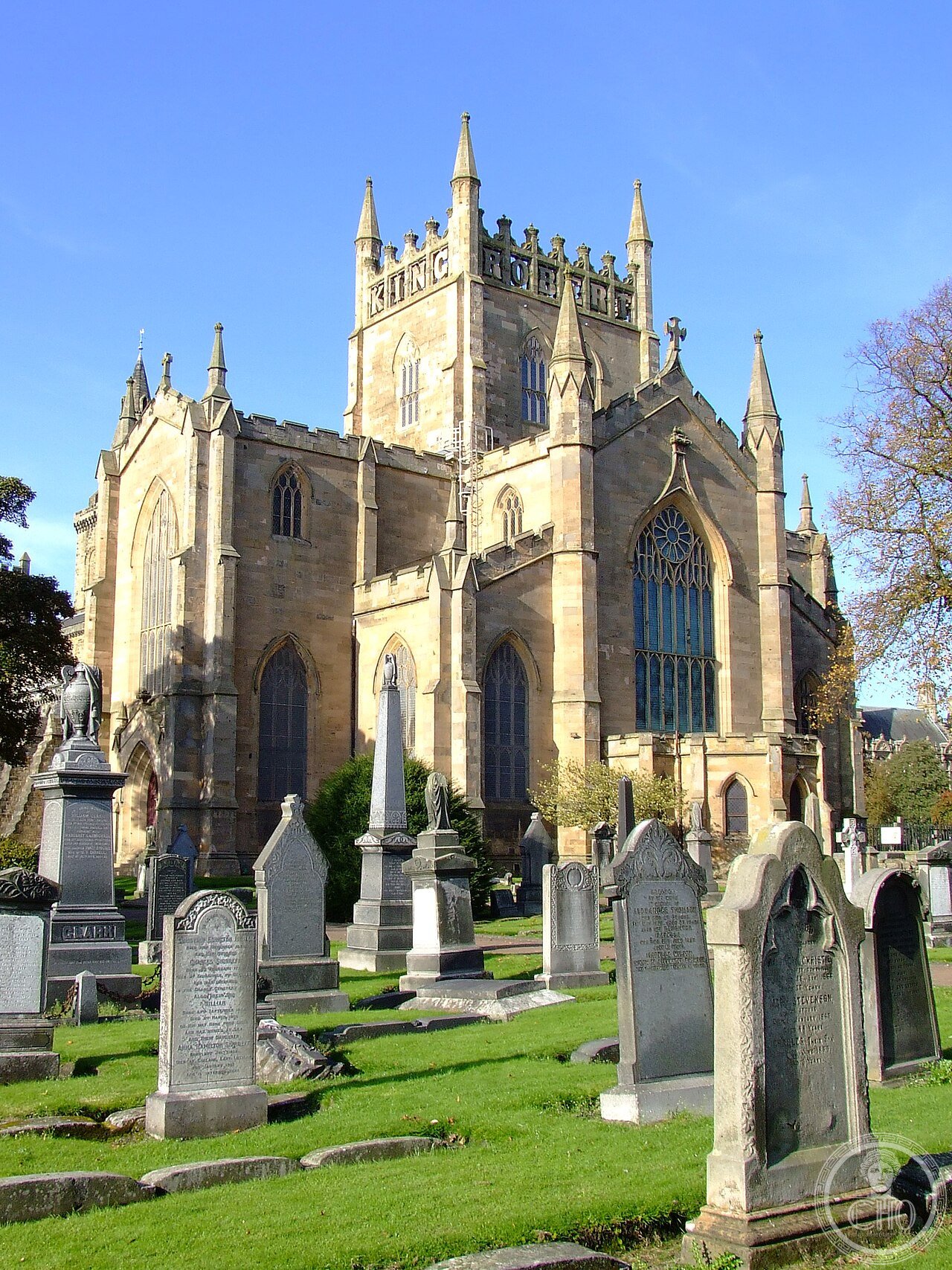
Sul luogo dove, intorno al 1070, la regina Margherita aveva sposato Malcolm III e fondato un piccolo priorato, il figlio Davide I fondò nel 1128 l’abbazia benedettina della Santissima Trinità e di santa Margherita, portando in Scozia i primi monaci benedettini da Canterbury. Qui fu sepolto nel 1329 Roberto Bruce, che per volontà testamentaria fece rimuovere il proprio cuore perché fosse portato verso la Terra Santa da sir James Douglas — morto in battaglia in Spagna nel 1330, con il cuore poi tornato in Scozia e sepolto all’abbazia di Melrose. Lo scheletro di Bruce, riscoperto nel 1818 durante lavori edilizi, fu risepolto con cerimonia sotto il pulpito della nuova chiesa.
About Dunfermline Abbey
Dunfermline Abbey traces its origins to around 1070, when Queen Margaret — the English-born wife of King Malcolm III, later canonised as Saint Margaret of Scotland — founded a small priory on the site where the royal couple had married, bringing the first organised Benedictine presence to Scotland. Margaret died at Dunfermline in 1093, was buried there, and was canonised in 1250; on 19 June of that year her remains were formally translated into a jewelled reliquary placed at the high altar, in a ceremony reportedly attended by King Alexander III. Her husband Malcolm III’s remains were later disinterred and reburied beside her, and their joint tomb, within the ruins of the abbey’s Lady Chapel, was restored and enclosed by order of Queen Victoria in the 19th century out of reverence for the royal saint. Margaret and Malcolm’s son, King David I, elevated the original priory into a full Benedictine abbey in 1128, dedicating it to the Holy Trinity and St Margaret and installing monks sent directly from Christ Church, Canterbury — the first true Benedictine community established in Scotland. The abbey’s royal associations reached their peak with the burial of King Robert the Bruce in the choir in 1329, following his death from illness; Bruce’s detailed funeral instructions specified that his heart be cut from his body and carried on crusade toward the Holy Land by his close companion Sir James Douglas, a mission cut short when Douglas was killed fighting the Moors in Spain in 1330, after which the heart was recovered and ultimately buried at Melrose Abbey in the Scottish Borders. Bruce’s own elaborate tomb, carved from white Italian marble and set upon a slab of Frosterley marble, was smashed and largely lost during the turmoil of the Scottish Reformation. In 1818, building work on a new parish church erected within the ruined choir uncovered a skeleton wrapped in lead and gilded cloth, identified as Robert the Bruce; it was reinterred with full public ceremony beneath the pulpit of the New Church, which still stands on the site today. Historians and heritage authorities have described Dunfermline as receiving, after Iona, more of Scotland’s royal dead than any other single site in the kingdom.
Key facts
- c. 1070: priory founded by Queen Margaret on her marriage site to Malcolm III
- 1093: Margaret dies and is buried at Dunfermline
- 1128: Benedictine abbey formally founded by King David I, monks sent from Canterbury
- 1250: Margaret canonised; remains translated to a reliquary at the high altar
- 1329: Robert the Bruce buried in the choir; his heart removed for a Holy Land pilgrimage
- 1330: Sir James Douglas killed in Spain carrying Bruce’s heart; heart later buried at Melrose Abbey
- Scottish Reformation: Bruce’s ornate marble tomb destroyed
- 1818: Bruce’s skeleton rediscovered and reinterred beneath the New Church pulpit
History
Dunfermline Abbey’s founding narrative is inseparable from the story of Queen Margaret, one of medieval Scotland’s most consequential royal figures, whose marriage to Malcolm III and subsequent religious patronage reshaped the Scottish Church’s ties to Rome and to continental monastic reform; her son David I’s decision to install Benedictine monks directly from Canterbury marked a deliberate act of ecclesiastical modernisation that placed Dunfermline at the centre of 12th-century Scottish religious life. The abbey’s status as the resting place of Robert the Bruce, architect of Scottish independence at Bannockburn in 1314, cemented its role as a site of national as well as religious significance, a status reinforced by the dramatic and well-documented episode of his heart’s aborted journey toward the Holy Land.
The rediscovery of Bruce’s skeleton in 1818, nearly five centuries after his death and the Reformation-era destruction of his original tomb, became a notable event in 19th-century Scottish antiquarian and national memory, prompting a public reburial that reasserted Dunfermline’s historic identity as a royal mausoleum second in importance only to Iona among Scottish ecclesiastical sites.
What you see
The site preserves both the ruined medieval abbey — including the Lady Chapel housing the restored tomb of Malcolm III and Margaret — and the working 19th-century New Church built within the footprint of the old choir, beneath whose pulpit Robert the Bruce’s remains now lie, marked externally by the words “King Robert The Bruce” built into the church tower’s parapet. The Romanesque nave of the original 12th-century abbey church survives largely intact and remains in use, ranked among the finest Norman ecclesiastical interiors in Scotland.
Practical information
- Opening hours: nave managed by Historic Environment Scotland with seasonal hours; the adjoining New Church operates separately; check current hours before visiting
- Address: St Catherine’s Wynd, Dunfermline, Fife KY12 7PE, Scotland, United Kingdom
Getting there
Dunfermline Abbey is located in the historic Heritage Quarter of central Dunfermline, Fife, reachable by train from Edinburgh (around 20 minutes) or by road. GPS: 56.0699° N, -3.4636° E.
Nearby
- Dunfermline Palace — the ruined royal palace adjoining the abbey, birthplace of King Charles I
- Pittencrieff Park — historic public park immediately adjacent, gifted by Andrew Carnegie
- Melrose Abbey — burial place of Robert the Bruce’s heart, in the Scottish Borders
Sources
- Historic Environment Scotland — “Dunfermline Abbey and Palace” (historicenvironment.scot)
- Wikipedia — “Dunfermline Abbey” (en.wikipedia.org)
- Historic UK — “Robert the Bruce” (historic-uk.com)
Find it on the map
See this place and what’s around it →📷 Become a Cultural Heritage Online photographer
Share your photos of places: they stay published under your name as the author. The more they're seen, the more you get noticed — and soon a contest will reward the most appreciated photos.
Log in or sign up free to add a photo