
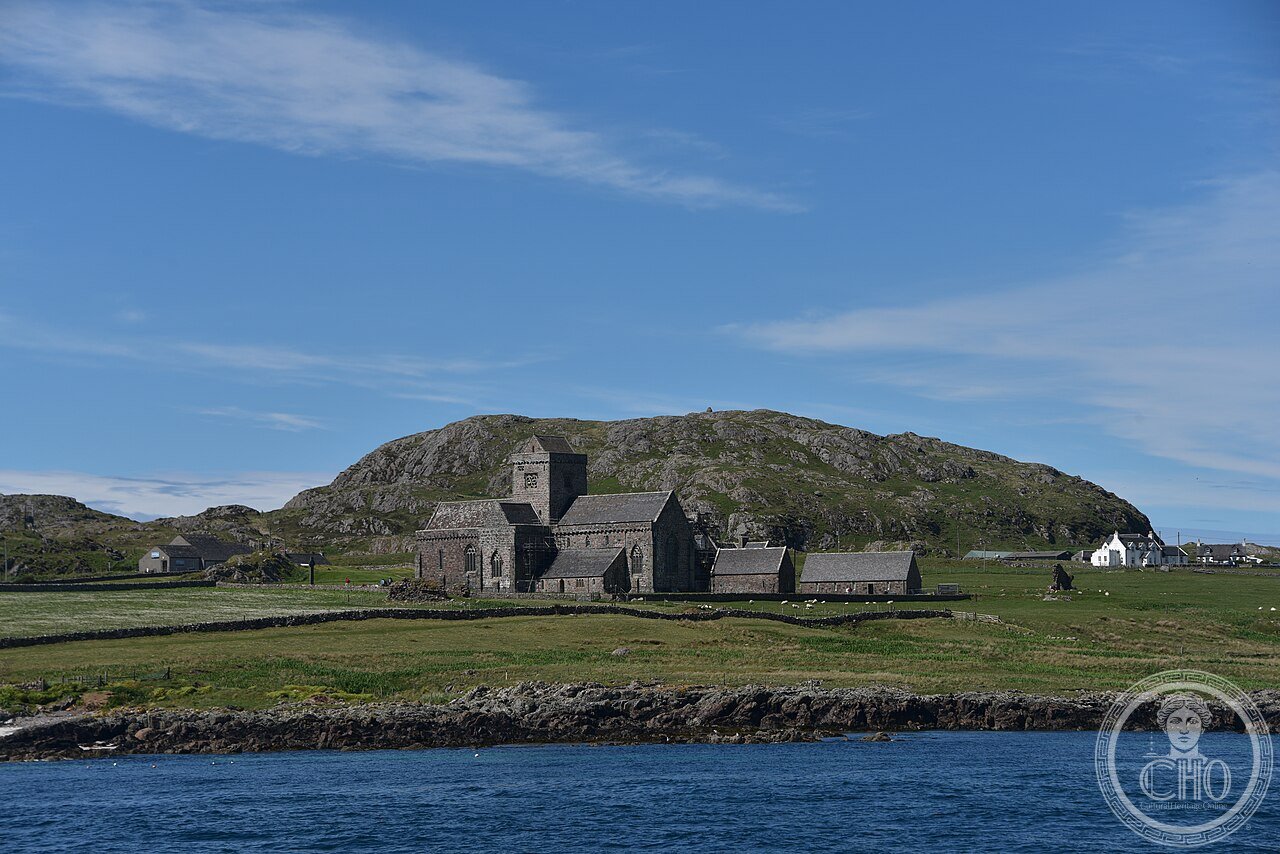
Nel 563, san Colombano approdò su questa piccola isola delle Ebridi con dodici compagni irlandesi e vi fondò un monastero destinato a diventare il cuore pulsante della cristianizzazione di Scozia e Pitti. La tradizione vuole che fino a 48 re — scozzesi, irlandesi e persino norvegesi — siano stati sepolti nel cimitero dell’abbazia. Verso la fine dell’VIII secolo, i monaci di Iona realizzarono probabilmente il celebre Book of Kells — poco prima che, nell’806 e di nuovo nell’830, i vichinghi facessero strage dei religiosi, uccidendone 68 in un solo attacco.
About Iona Abbey
Saint Columba and twelve Irish followers founded a monastery on the small Hebridean island of Iona in 563 CE, establishing what would become the heart of the early Scottish Church and one of the most influential centres anywhere in Western Europe for the spread of Christianity among the Picts and Scots. According to long-standing tradition, as many as 48 early kings — from Scotland, Ireland, Norway, and even France — were buried in the abbey’s graveyard, Reilig Odhráin, though modern scholars remain sceptical of the full extent of these claims, even as the tradition itself testifies to Iona’s exceptional prestige as a royal burial site across the early medieval Gaelic and Norse worlds. The monastery’s scholarly and artistic achievements reached their peak in the 8th century: it is widely believed that the celebrated illuminated manuscript known as the Book of Kells, now displayed in Dublin, was produced by the monks of Iona a little before the year 800, representing one of the supreme achievements of early medieval Christian art anywhere in Europe. Iona’s prosperity and relative isolation ended abruptly with the onset of Viking raids: the first devastating attack came in 806 CE, when many monks were slaughtered and much of their work destroyed; the community attempted to rebuild, but the Vikings returned repeatedly, and in 830 CE a further raid killed 68 monks in a single assault. Columba’s own relics were removed for safekeeping late in the 8th century, taken to Dunkeld in Perthshire and to Kells in Ireland. Despite these repeated catastrophes, Columba’s monastic foundation survived in some form until the end of the 12th century, and the site has since been restored and remains active today under the ecumenical Iona Community.
Key facts
- 563 CE: monastery founded by Saint Columba and twelve companions
- Reilig Odhráin: traditional burial site of up to 48 early kings
- c. before 800: the Book of Kells likely produced by Iona’s monks
- 806: first devastating Viking raid
- 830: further Viking raid kills 68 monks
- Late 8th century: Columba’s relics removed to Dunkeld and Kells for safekeeping
- Until end of 12th century: Columba’s foundation continues in some form
- Today: restored and active under the ecumenical Iona Community
History
Iona’s foundational role in the Christianisation of Scotland places it among the handful of truly seminal religious sites in the entire history of the British Isles, its influence radiating outward through the Columban familia of monasteries that Columba’s successors established across Scotland, northern England, and beyond. The tradition of 48 kings buried at Reilig Odhráin, whatever its precise historical accuracy, reflects the extraordinary prestige Iona commanded as a sacred site across the early medieval Gaelic and Norse-influenced world, drawing royal burials from a remarkably wide geographic and political range.
The devastating Viking raids of 806 and 830, killing dozens of monks and destroying irreplaceable manuscripts and treasures, mark Iona as one of the most severely and repeatedly targeted religious communities of the entire Viking Age in Britain and Ireland — its survival and eventual restoration standing as a powerful testament to the enduring significance of Columba’s original foundation even after centuries of catastrophic violence.
What you see
The present abbey buildings, substantially restored in the 20th century by the ecumenical Iona Community, occupy the site of Columba’s original 6th-century foundation, incorporating surviving medieval fabric from the monastery’s later centuries. The adjacent Reilig Odhráin graveyard preserves the traditional burial ground of Scottish and other early medieval kings, while the wider island retains numerous carved High Crosses and other early Christian monuments connected to Iona’s long monastic history.
Practical information
- Opening hours: generally open daily with seasonal variation; check current hours before visiting; admission fee applies
- Address: Sràid nam Marbh, Isle of Iona, Argyll and Bute PA76 6SQ, Scotland, United Kingdom
Getting there
Iona Abbey is located on the small island of Iona, off the southwest coast of Mull in the Inner Hebrides, reachable by ferry via Mull. GPS: 56.3350° N, -6.3914° E.
Nearby
- Reilig Odhráin — the abbey’s traditional royal burial ground, immediately adjacent
- Isle of Mull — reachable by ferry from Iona
- Nunnery of Iona — the ruins of a medieval Augustinian nunnery, nearby
Sources
- Historic Environment Scotland — “Iona Abbey” (historicenvironment.scot)
- Historic UK — “St Columba and the Isle of Iona” (historic-uk.com)
- Wikipedia — “Iona Abbey” (en.wikipedia.org)
Find it on the map
See this place and what’s around it →📷 Become a Cultural Heritage Online photographer
Share your photos of places: they stay published under your name as the author. The more they're seen, the more you get noticed — and soon a contest will reward the most appreciated photos.
Log in or sign up free to add a photo