
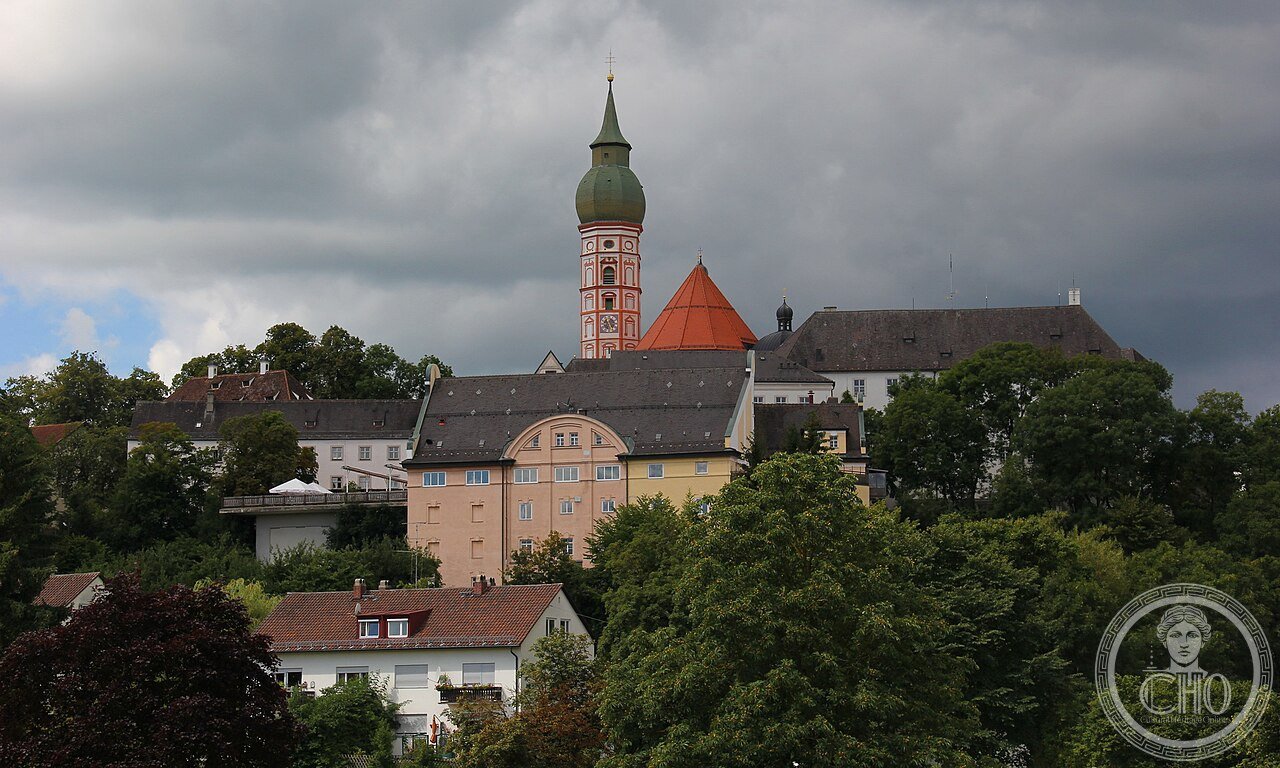
Nel 1246, il castello di Andechs fu raso al suolo e la sua preziosa collezione di reliquie — portata in Baviera nel X secolo dal conte Rasso di ritorno dalla Terra Santa — si credette perduta per sempre. Nel 1388, durante una messa nella cappella del castello, un topo trascinò alla luce un frammento del catalogo delle reliquie, rivelando che erano ancora sepolte sotto l’altare. Da quel ritrovamento nacque il “Monte Sacro” di Andechs: nel 1455 vi si insediò un monastero benedettino, che da allora produce ininterrottamente la propria birra.
About Kloster Andechs
The history of Andechs as a place of pilgrimage predates the founding of its Benedictine monastery by several centuries, rooted in a collection of relics traditionally said to have been brought to Andechs Castle in the 10th century by Count Rasso, an ancestor of the Counts of Andechs, following his own pilgrimage to the Holy Land. From 1128, Count Berthold II of Andechs made annual veneration of this relic collection mandatory for his subjects, establishing Andechs as a significant regional pilgrimage site. However, the fortunes of the Andechs comital family declined sharply from the 13th century onward amid political upheaval, and in 1246 Andechs Castle was largely destroyed, sparing only the castle chapel; the celebrated relic collection was believed lost along with the rest of the fortress. According to tradition, in 1388, during a Mass held in the surviving castle chapel, a mouse dragged fragments of the old relic register into view, and this unexpected clue led to the rediscovery of the buried relic collection beneath the chapel’s altar — after which pilgrims began returning to Andechs in growing numbers. Duke Ernst of Bavaria (1373-1438) subsequently gave the Andechs hill its enduring name, the “Heiliger Berg,” or Holy Mountain. In 1455, Duke Albrecht III of Bavaria formally established a Benedictine monastery at Andechs, bringing monks from Tegernsee Abbey to oversee the growing pilgrimage. The Benedictine monks who have lived at Andechs since that founding also began brewing beer at the monastery, with the earliest documented reference to Andechs beer dating to that same year, 1455; the monastery’s own non-corporate brewery has continued the tradition uninterrupted in the centuries since, making the “Holy Mountain” one of Bavaria’s most distinctive combinations of active pilgrimage site and working monastic brewery.
Key facts
- 10th century: Count Rasso brings relics from the Holy Land to Andechs Castle
- 1128: Count Berthold II makes annual relic veneration mandatory
- 1246: Andechs Castle largely destroyed; relics believed lost
- 1388: a mouse’s discovery leads to the relics’ rediscovery under the chapel altar
- 15th century: Duke Ernst names the hill the “Heiliger Berg” (Holy Mountain)
- 1455: Duke Albrecht III founds the Benedictine monastery, with monks from Tegernsee
- 1455-present: continuous monastic beer brewing tradition
History
The legend of the mouse revealing the location of Andechs’s lost relics in 1388 belongs to a broader medieval tradition of miraculous rediscovery narratives attached to important relic collections, in which chance or providence restores access to sacred objects believed permanently lost — a story that transformed a destroyed noble castle chapel into the foundation for one of Bavaria’s most enduring pilgrimage traditions. The 1455 founding of the Benedictine monastery, bringing monks from the established community at Tegernsee specifically to manage the growing pilgrimage, reflects the deliberate institutional formalisation of what had begun as a spontaneous popular devotional revival following the relics’ rediscovery.
The monastery’s unbroken brewing tradition since 1455 situates Andechs within the wider and still-thriving central European tradition of monastic beer production, in which religious communities historically combined spiritual life with self-sustaining economic activity — a combination that at Andechs has endured for well over five and a half centuries without interruption.
What you see
The monastery’s flamboyant Baroque pilgrimage church, rebuilt in the 18th century, dominates the hill above the Ammersee, its richly decorated interior reflecting the site’s long history as a major devotional destination. The monastery’s brewery, adjoining the church and monastic buildings, remains in active operation, with its beer garden offering visitors sweeping views over the surrounding Bavarian countryside alongside the monks’ traditional brews.
Practical information
- Opening hours: generally open daily with seasonal variation; check current hours before visiting; free admission to the church
- Address: Bergstraße 2, 82346 Andechs, Germany
Getting there
Kloster Andechs is located on a hill east of the Ammersee, in the Starnberg district of Upper Bavaria, reachable by road from Munich. GPS: 47.9744° N, 11.1831° E.
Nearby
- Ammersee — the lake below the monastery hill
- Herrsching am Ammersee — the nearest town
- Munich — roughly 40 kilometres away
Sources
- Kloster Andechs official site — “History” and “Pilgrimage history” (andechs.de)
- Wikipedia — “Andechs Abbey” (en.wikipedia.org)
- Beer Info — “Andechs Brewery and Monastery – Brewing Beer Since 1455” (beerinfo.com)
Find it on the map
See this place and what’s around it →📷 Become a Cultural Heritage Online photographer
Share your photos of places: they stay published under your name as the author. The more they're seen, the more you get noticed — and soon a contest will reward the most appreciated photos.
Log in or sign up free to add a photo