
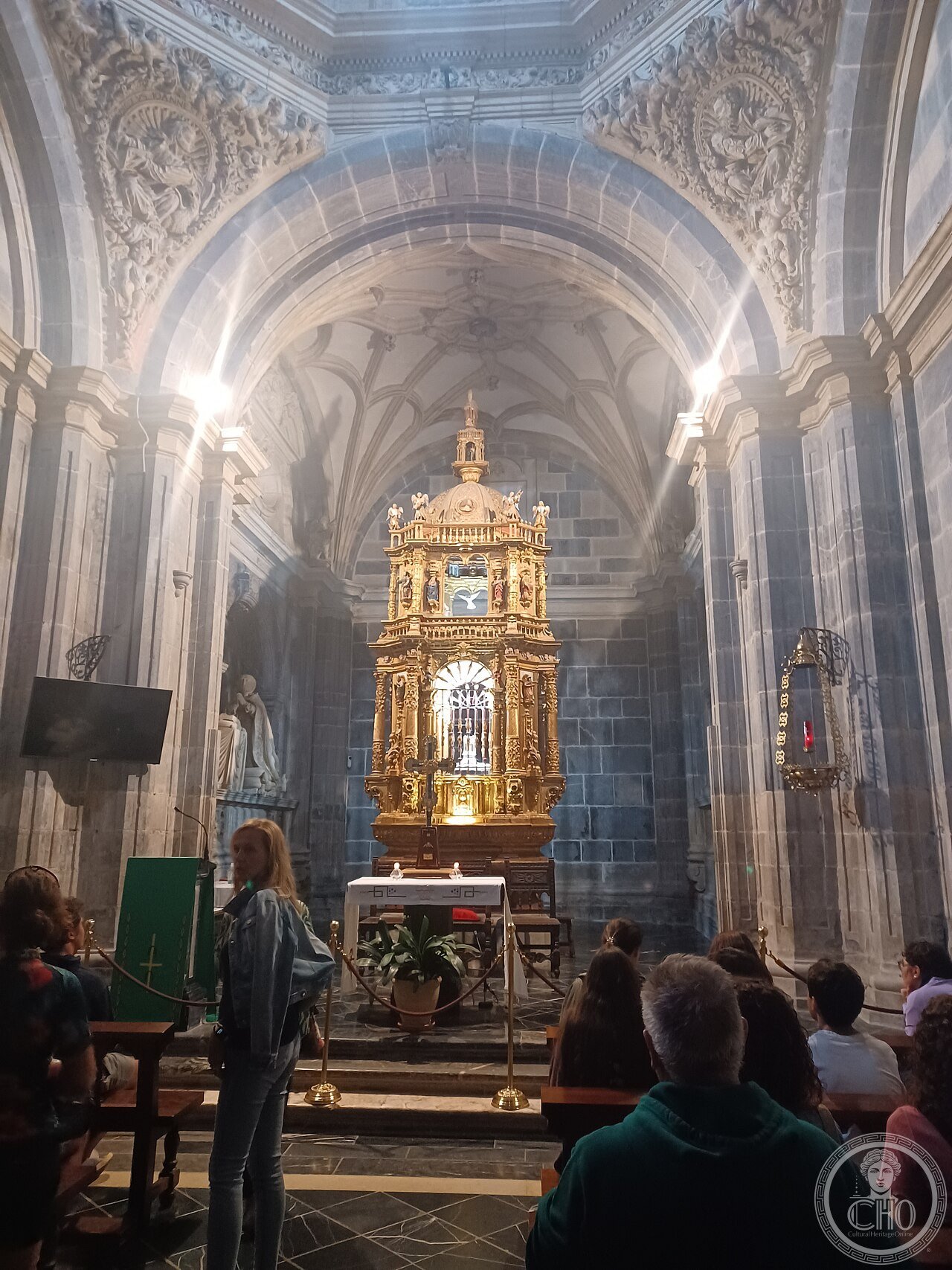
Nel VI secolo, il vescovo Turibio di Astorga portò dalla chiesa del Santo Sepolcro di Gerusalemme un frammento della Vera Croce — oggi considerato il più grande frammento conosciuto al mondo. Nel 1512, papa Giulio II concesse al monastero il privilegio di celebrare il proprio Anno Santo giubilare ogni sette anni, rendendolo uno dei soli cinque luoghi santi della cristianità, insieme a Roma, Gerusalemme, Santiago de Compostela e Caravaca de la Cruz. Nell’VIII secolo, il monaco Beato di Liébana vi scrisse il suo celebre commento all’Apocalisse, che avrebbe ispirato decine di manoscritti miniati in tutta Europa medievale.
About Santo Toribio de Liébana
The origins of Santo Toribio de Liébana trace back to before the 6th century, when the site began as an oratory dedicated to Saint Martin of Tours, founded by a monk who gradually established a Benedictine abbey that would go on to play a significant role in the Christian repopulation efforts of the Reconquista in northern Spain; the monastery only took its present name, honouring Saint Turibius of Liébana, in the 12th century. The site’s greatest religious significance rests on its custody of a fragment of the Lignum Crucis, believed to be the largest surviving piece of the True Cross on which Jesus was crucified, brought to the monastery from the Church of the Holy Sepulchre in Jerusalem by the 6th-century bishop Saint Turibius of Astorga, whose own remains are also buried at the site. On 23 September 1512, Pope Julius II granted the monastery the privilege of celebrating its own Jubilee Year, thereby elevating Santo Toribio de Liébana to the status of one of only five holy places of Christianity permitted to hold a Holy Jubilee — alongside Rome, Jerusalem, Santiago de Compostela, and Caravaca de la Cruz — celebrated every time the feast of the Exaltation of the Holy Cross, 14 September, falls on a Sunday. The monastery’s intellectual significance deepened in the 8th century through its association with Beatus of Liébana, an influential monk and theologian who authored the Commentary on the Apocalypse, a seminal illuminated manuscript whose imagery went on to inspire dozens of medieval copies produced across Europe, some of whose illustrations can still be seen reproduced on the walls of the monastery’s cloister today.
Key facts
- Before 6th century: founded as an oratory dedicated to Saint Martin of Tours
- 6th century: the Lignum Crucis relic brought from Jerusalem by Saint Turibius of Astorga
- 8th century: Beatus of Liébana writes his influential Commentary on the Apocalypse
- 12th century: monastery takes the name of Saint Turibius of Liébana
- 23 September 1512: Pope Julius II grants the monastery its own Jubilee Year privilege
- Five holy places: Rome, Jerusalem, Santiago de Compostela, Caravaca de la Cruz, and Santo Toribio
History
The monastery’s possession of the largest known surviving fragment of the True Cross, and its consequent 1512 elevation to the status of one of only five Christian holy places permitted a jubilee year, gives Santo Toribio de Liébana a rank of devotional importance far exceeding what its remote mountain location in Cantabria might otherwise suggest — placing this small Spanish monastery in the same select category as Rome and Jerusalem themselves. Beatus of Liébana’s 8th-century Commentary on the Apocalypse, produced at the monastery, ranks among the most influential illuminated theological texts of the early medieval period, its distinctive apocalyptic imagery reproduced in dozens of later medieval manuscript copies across Christian Europe, giving the monastery an intellectual legacy extending well beyond its relic-based religious prestige.
The combination of a major relic of the Passion, a jubilee privilege shared with only four other sites worldwide, and a foundational medieval theological text all originating from the same relatively remote mountain monastery makes Santo Toribio de Liébana one of the more disproportionately significant religious sites in the whole of medieval Spanish Christianity.
What you see
The monastery complex preserves its medieval Benedictine core alongside later architectural additions, its cloister walls displaying reproductions of the illuminated imagery associated with Beatus of Liébana’s Commentary on the Apocalypse. The chapel housing the Lignum Crucis relic remains the principal focus of pilgrimage, drawing visitors especially during jubilee years when the 14 September feast of the Exaltation of the Holy Cross falls on a Sunday.
Practical information
- Opening hours: generally open daily with seasonal variation; check current hours before visiting; free or small admission fee
- Address: Turieno, Camaleño, Cantabria, Spain
Getting there
The Monastery of Santo Toribio de Liébana is located near the village of Turieno in Camaleño municipality, in the Liébana region of Cantabria, northern Spain, reachable by road. GPS: 43.1503° N, -4.6540° E.
Nearby
- Picos de Europa National Park — the mountain range surrounding the monastery
- Potes — the nearest town, a common base for visiting Liébana
- Camino Lebaniego — the pilgrimage route connecting to the monastery
Sources
- Wikipedia — “Santo Toribio de Liébana” (en.wikipedia.org)
- Aleteia — “The great monastery of Santo Toribio de Liébana” and “How the True Cross got to Spain” (aleteia.org)
- Camino Lebaniego — “What is the Lignum Crucis?” (caminolebaniego.es)
Find it on the map
See this place and what’s around it →📷 Become a Cultural Heritage Online photographer
Share your photos of places: they stay published under your name as the author. The more they're seen, the more you get noticed — and soon a contest will reward the most appreciated photos.
Log in or sign up free to add a photo