

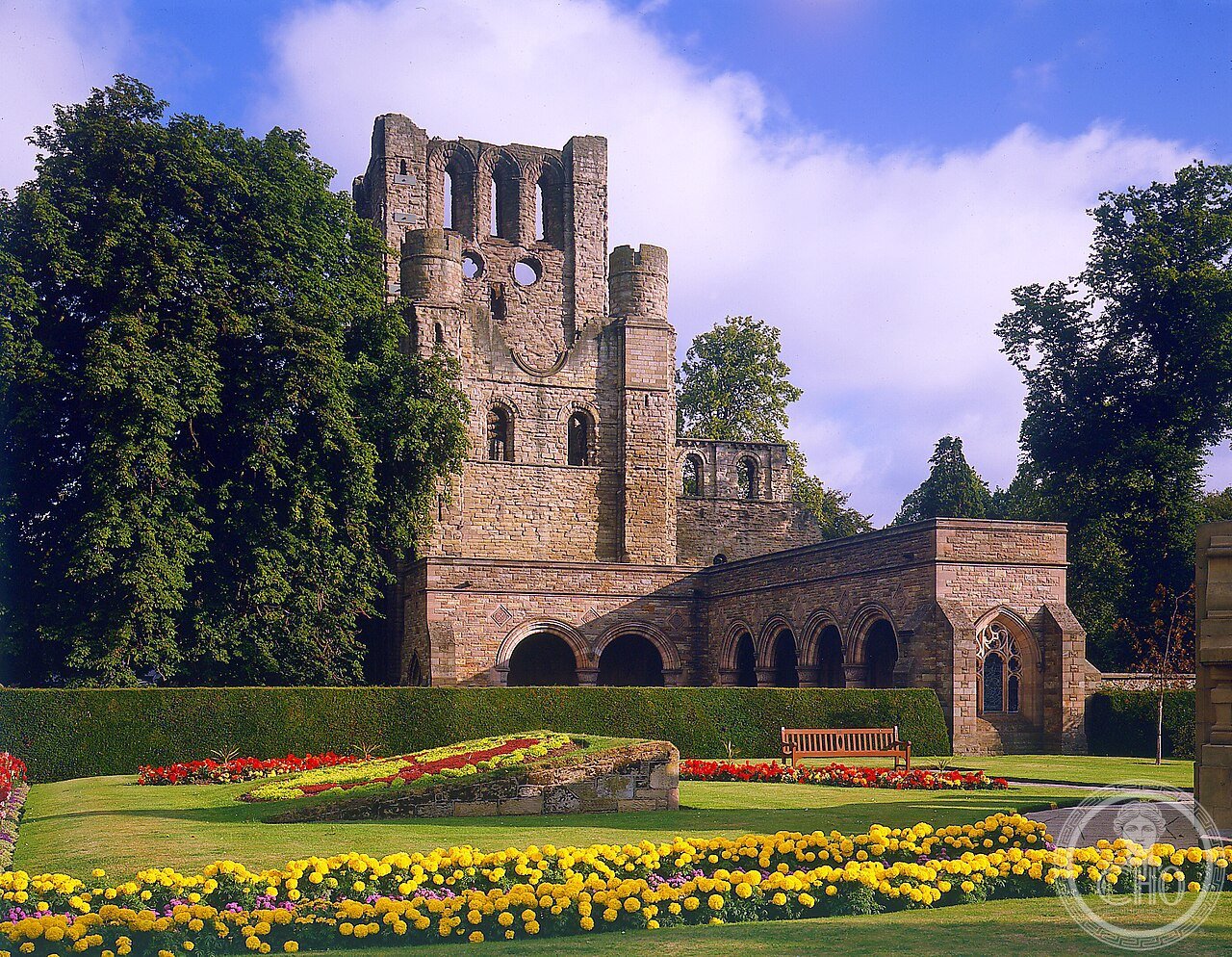
Founded in 1128 at Roxburgh by monks from Tiron in France — the first Tironensians to settle in the British Isles — Kelso Abbey became one of the richest and most powerful in Scotland, with daughter abbeys at Arbroath, Kilwinning and Lindores. In 1460, after his father James II died during the siege of nearby Roxburgh Castle, the young James III was crowned king here. After centuries of English invasions, a last attack in 1545 reduced it to ruin: today only the west tower survives.
About Kelso Abbey
Kelso Abbey was founded at Roxburgh in 1128 by a community of monks belonging to the Tironensian order, originating from Tiron near Chartres in France; these founding monks hold the distinction of being the first reformed Benedictine community of any kind to settle anywhere in the British Isles. Construction began soon after the community’s arrival, and by 1143 work had progressed sufficiently for the abbey to be dedicated to the Blessed Virgin Mary and Saint John. Situated within sight of Roxburgh Castle across the River Tweed, Kelso Abbey grew rapidly into one of the wealthiest and grandest religious houses in Scotland, drawing much of its income from extensive Border-country estates; by the end of the 12th century it had also established several daughter houses, including the abbeys of Arbroath, Kilwinning, and Lindores. In 1460, following the death of King James II at the siege of nearby Roxburgh, the young James III was crowned King of Scots at Kelso Abbey, giving the site a significant place in Scottish royal history. Like the other great Border Abbeys, Kelso suffered severely from repeated English invasions during the 15th and 16th centuries; a final devastating attack in 1545 left the buildings, in the words of a contemporary account, “all put to royen, howsses and towres and styples.” The Scottish Reformation of 1560 brought about the formal disestablishment of monastic life, after which the Tironensian community at Kelso was no longer officially recognised, ending over four centuries of continuous religious life at the site.
Key facts
- 1128: founded by Tironensian monks, the first of their order in Britain
- 1143: dedicated to the Blessed Virgin Mary and Saint John
- Daughter houses: Arbroath, Kilwinning, and Lindores abbeys
- 1460: James III crowned King of Scots at the abbey
- 1545: final devastating English attack destroys the buildings
- 1560: Scottish Reformation ends official monastic recognition
- Surviving structure: the west tower crossing and part of the infirmary
History
Kelso’s status as the first settlement of the Tironensian order anywhere in the British Isles gives the abbey a distinctive place in the history of monastic reform’s spread from continental Europe into medieval Britain, predating the arrival of comparable reformed orders elsewhere in Scotland and England. The 1460 coronation of the young James III, following his father’s death at the nearby siege of Roxburgh, ties Kelso Abbey directly into the volatile succession politics of 15th-century Scotland, a rare instance of a Border abbey serving as the setting for a royal coronation rather than simply a monastic or burial site.
The abbey’s rise to become one of Scotland’s wealthiest religious houses, with three significant daughter foundations, and its subsequent reduction to a single surviving tower after the 1545 attack, together trace an unusually complete arc from monastic pre-eminence to near-total destruction within the space of four centuries — a pattern shared with, but even more severe than, that suffered by the other great Border Abbeys of Jedburgh, Melrose, and Dryburgh.
What you see
The surviving west tower crossing, built in a massive, semi-military Romanesque style, remains the abbey’s most striking feature, its solid construction hinting at the formidable scale of the original building. Alongside the tower, fragments of the infirmary survive, though next to nothing remains of the once-extensive surrounding monastic precinct, making the tower crossing one of the most architecturally significant single surviving elements of medieval Scottish ecclesiastical building.
Practical information
- Opening hours: generally accessible daily; check current hours before visiting; free admission
- Address: Abbey Row, Kelso, Scottish Borders TD5 7JF, United Kingdom
Getting there
Kelso Abbey is located in the centre of the town of Kelso, in the Scottish Borders, easily reachable on foot. GPS: 55.5971° N, -2.4322° E.
Nearby
- Roxburgh Castle — the ruined castle across the Tweed, site of James II’s death
- Floors Castle — a stately home near Kelso
- Jedburgh Abbey and Dryburgh Abbey — two of the other great Border Abbeys, within the same region
Sources
- Wikipedia — “Kelso Abbey” (en.wikipedia.org)
- Historic Environment Scotland — “Kelso Abbey: History” (historicenvironment.scot)
- Fabulous North — “Kelso Abbey In Kelso” (fabulousnorth.com)
Find it on the map
See this place and what’s around it →📷 Become a Cultural Heritage Online photographer
Share your photos of places: they stay published under your name as the author. The more they're seen, the more you get noticed — and soon a contest will reward the most appreciated photos.
Log in or sign up free to add a photo