

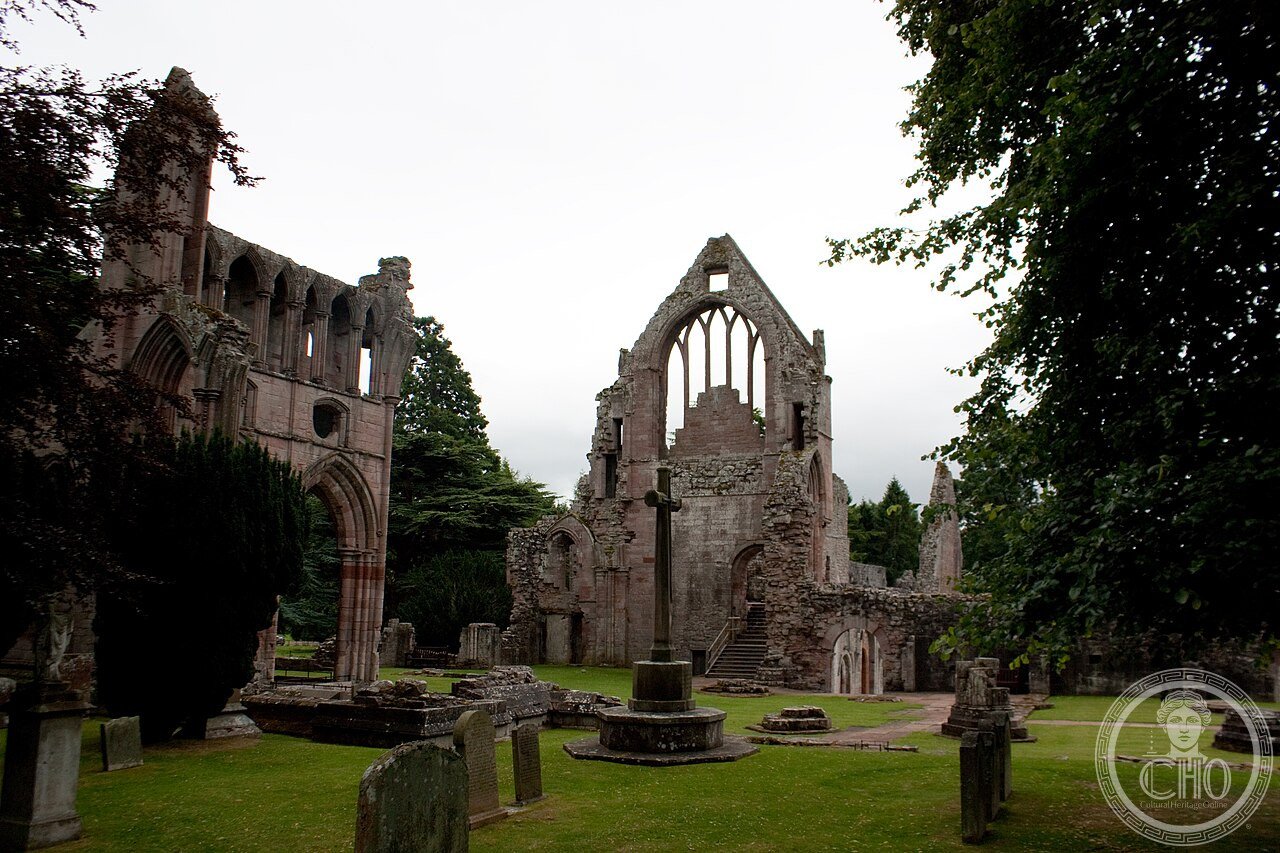
Founded in 1150 for Premonstratensian canons who came from Alnwick in Northumberland, Dryburgh Abbey was set on fire by English troops in 1322, again by Richard II in 1385, and finally destroyed in 1544. Monastic life never recovered after the Scottish Reformation. In 1832 the novelist Sir Walter Scott was buried here, in the north transept he himself called “St Mary’s Aisle”; in 1928 Field Marshal Earl Haig, the British commander of the First World War, was laid beside him.
About Dryburgh Abbey
Dryburgh Abbey, on the banks of the River Tweed in the Scottish Borders, was nominally founded on Martinmas, 10 November 1150, through an agreement between Hugh de Morville, Constable of Scotland, and Premonstratensian canons regular from Alnwick Abbey in Northumberland; the canons themselves, together with their first abbot, Roger, arrived at the site on 13 December 1152. The Premonstratensian order had been founded by Saint Norbert of Xanten at Prémontré in Aisne, France, in 1120, and although Augustinian in its underlying rule, the order was distinguished by its canons’ white habits rather than the black worn by other Augustinian communities. Dryburgh’s position on the Anglo-Scottish border exposed it to repeated destruction: English troops burned the abbey in 1322, King Richard II of England burned it again in 1385, and it was finally destroyed in 1544 during renewed border conflict, though the community survived in diminished form until the Scottish Reformation brought monastic life to an end; the abbey lands were later granted to the Earl of Mar by King James VI of Scotland. In the centuries since its ruin, Dryburgh Abbey has become renowned as a burial site for major figures in Scottish history: the celebrated novelist and antiquarian Sir Walter Scott was buried here on 26 September 1832, his tomb placed within the north transept, an area he himself referred to as “St Mary’s Aisle.” In 1928, Field-Marshal Earl Haig, the British commander during much of the First World War, was interred beside Scott, adding a further layer of national significance to the abbey’s already storied burial ground.
Key facts
- 10 November 1150: abbey founded through agreement with Premonstratensian canons from Alnwick
- 13 December 1152: canons and first Abbot Roger arrive at the site
- 1322: abbey burned by English troops
- 1385: burned again by King Richard II of England
- 1544: abbey finally destroyed amid border conflict
- 26 September 1832: Sir Walter Scott buried in the north transept
- 1928: Field-Marshal Earl Haig interred beside Scott
History
Dryburgh’s repeated destruction across the 14th and 16th centuries places it alongside Jedburgh, Melrose, and Kelso among the four great Border Abbeys whose shared vulnerability to Anglo-Scottish conflict reflects the sustained military instability of the medieval Scottish frontier zone. The abbey’s later transformation into a burial site for Sir Walter Scott — whose historical novels did more than perhaps any other single body of work to shape the modern popular image of Scotland’s medieval and Border past — gives Dryburgh a particular literary resonance, its own ruined stones having likely informed the romantic historical imagination that Scott himself helped popularise.
The pairing of Scott’s grave with that of Earl Haig, buried here in 1928 following his central role commanding British forces during the First World War, situates Dryburgh as a site connecting Scotland’s romantic literary heritage directly to its 20th-century military history, two very different forms of national commemoration sharing the same small stretch of ruined abbey ground.
What you see
The abbey’s substantial ruins, set within a wooded bend of the River Tweed, preserve significant sections of the transept and chapter house, alongside the north transept housing Sir Walter Scott’s and Earl Haig’s graves. The site’s riverside setting, among mature trees, gives Dryburgh a notably picturesque character distinct from the more exposed ruins of some of the other Border Abbeys.
Practical information
- Opening hours: generally open daily with seasonal variation; check current hours before visiting; admission fee applies
- Address: Dryburgh, Scottish Borders TD6 0RQ, United Kingdom
Getting there
Dryburgh Abbey is located on the banks of the River Tweed near St Boswells, in the Scottish Borders, reachable by road. GPS: 55.5772° N, -2.6503° E.
Nearby
- Scott’s View — a celebrated viewpoint over the Tweed valley, associated with Sir Walter Scott
- St Boswells — the nearest village
- Melrose Abbey — another of the great Border Abbeys, nearby
Sources
- Wikipedia — “Dryburgh Abbey” (en.wikipedia.org)
- Historic Environment Scotland — “Dryburgh Abbey: History” (historicenvironment.scot)
- Sacred Destinations — “Dryburgh Abbey” (sacred-destinations.com)
Find it on the map
See this place and what’s around it →📷 Become a Cultural Heritage Online photographer
Share your photos of places: they stay published under your name as the author. The more they're seen, the more you get noticed — and soon a contest will reward the most appreciated photos.
Log in or sign up free to add a photo