
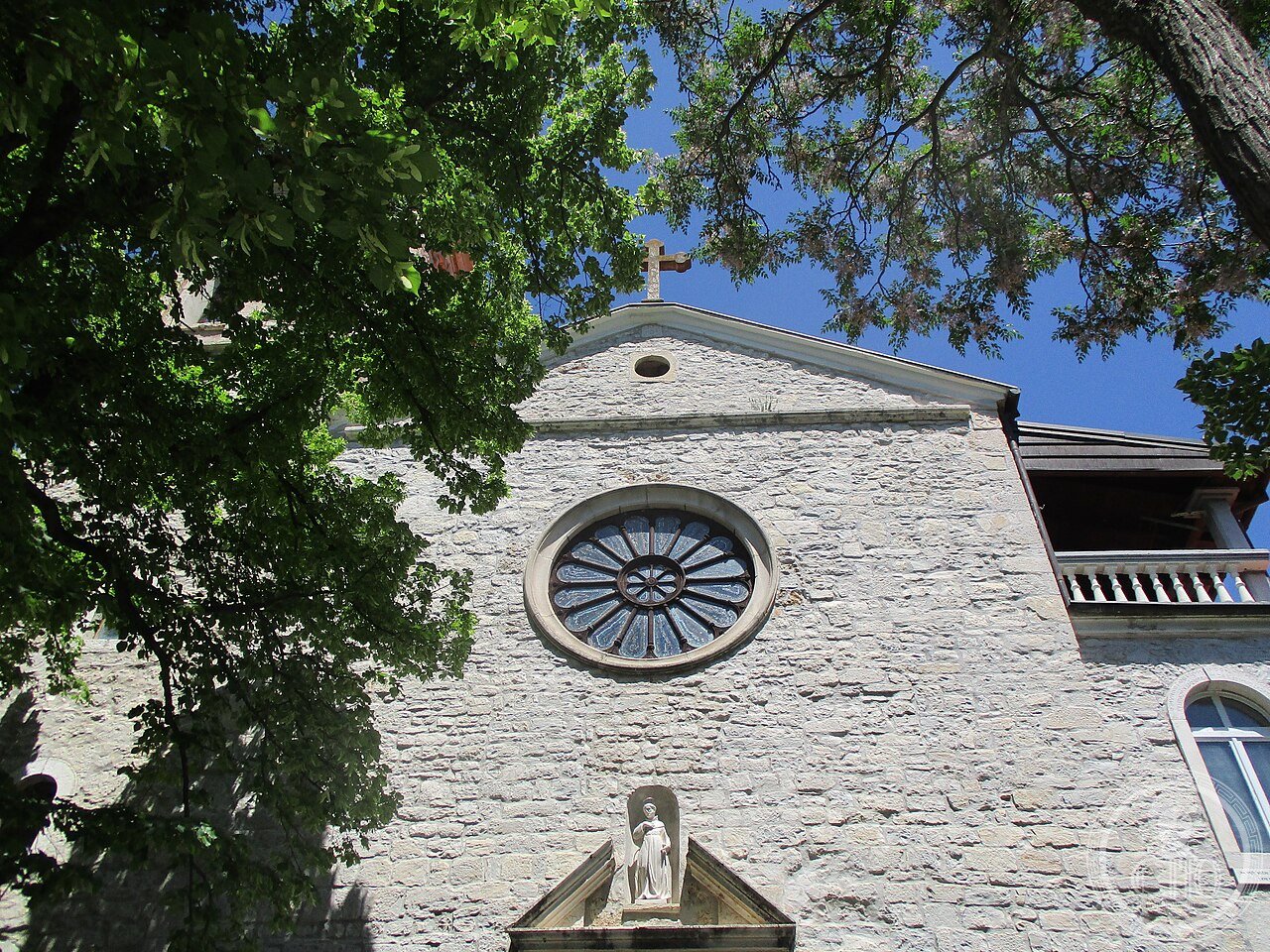
Nel Trecento, eremiti agostiniani costruirono una piccola chiesa su un isolotto in mezzo al fiume Krka. Nel 1445, i francescani, ritiratisi dalla Bosnia dopo l’invasione ottomana, si stabilirono sull’isola e la trasformarono in un centro di scienza e cultura. La loro biblioteca custodisce ancora oggi l’edizione del 1487 delle Favole di Esopo stampata a Brescia dal tipografo ragusano Dobriša Dobričević — una delle sole tre copie sopravvissute al mondo.
About Visovac Monastery
Visovac Monastery, on a small island within the river Krka in what is now Krka National Park, Croatia, was established in the 14th century by hermits of the Augustinian order, who built a small church and monastery on the island dedicated to the Apostle Paul. In 1445, the site was enlarged and adapted by Franciscans, who had withdrawn to the island having retreated from parts of Bosnia following the advancing Ottoman conquest of the region; the Franciscans expanded the island’s usable area and took up scholarly and educational activity, erecting a church and, later, in 1576, a monastery. A new monastery building was subsequently constructed in the 18th century. Over the following centuries, Visovac’s Franciscan community built one of Croatia’s most significant Franciscan libraries, its collection substantially enlarged through donations such as that of Father Ivan Vučić in 1751, later organised and secured by Fra Mijo Bilušić in 1781, and eventually moved to a dedicated hall in the early 20th century. Among the library’s treasures is an exceptionally rare incunabulum: the 1487 edition of Aesop’s Fables, printed in Brescia by the Dubrovnik-born printer Dobriša Dobričević of Lastovo — one of only three copies of this edition known to survive anywhere in the world. The wider collection also includes important early Croatian religious and literary works, among them multiple editions of Matija Divković’s Sermons (1616 and 1704), Mauro Orbini’s Spiritual Mirror (1628), the second edition of Marko Marulić’s Judith (1627), and Benedikt Zborovčić’s Epistles and Gospels (1543). Owing to centuries of devotion focused on the Virgin Mary, Visovac has long been known popularly as the “Island of the Mother of God.”
Key facts
- 14th century: founded by Augustinian hermits, dedicated to the Apostle Paul
- 1445: Franciscans, fleeing Ottoman-conquered Bosnia, settle and expand the island
- 1576: the monastery building erected
- 18th century: a new monastery building constructed
- 1487: the library’s rarest holding — Aesop’s Fables, one of only three surviving copies worldwide
- 1751: library substantially enlarged by Father Ivan Vučić’s donation
- Popular name: the “Island of the Mother of God”
History
The Franciscans’ 1445 arrival at Visovac, driven by their withdrawal from Ottoman-conquered Bosnia, situates the monastery’s expansion within the wider pattern of Balkan Catholic religious communities relocating westward and to defensible island or coastal sites as Ottoman power advanced through the region during the 15th century — a survival strategy that, at Visovac, produced one of Dalmatia’s most significant surviving Franciscan cultural and scholarly institutions. The library’s possession of one of only three surviving copies of the 1487 Aesop’s Fables, printed by a Ragusan printer working in Brescia, situates Visovac within the broader early history of printing in Croatian lands, connecting a small island monastery directly to the first decades of movable-type printing in Europe.
The accumulation of significant early Croatian literary works — Divković’s Sermons, Marulić’s Judith, and others — within the same library gives Visovac an outsized role in preserving the foundational texts of early modern Croatian vernacular literature, a role disproportionate to the monastery’s small physical scale on its modest river island.
What you see
The monastery buildings, largely dating to the 18th-century reconstruction, occupy the small, densely wooded island of Visovac within the Krka river, their bell tower visible above the surrounding cypress trees from the surrounding waterway. The Franciscan library, housed within the complex, preserves its rare incunabula and early manuscripts, including the 1487 Aesop’s Fables, alongside centuries of accumulated Croatian religious and literary works.
Practical information
- Opening hours: generally open daily with seasonal variation; check current hours before visiting; reachable only by boat
- Address: Visovac Island, Krka National Park, Šibenik-Knin County, Croatia
Getting there
Visovac Monastery is located on a small island within the Krka river, reachable only by boat, typically via organised tours from within Krka National Park. GPS: 43.8611° N, 15.9733° E.
Nearby
- Krka Monastery — the Serbian Orthodox monastery elsewhere within the same national park
- Skradinski buk — Krka National Park’s celebrated waterfalls
- Skradin — the nearest town, a common departure point for boat tours
Sources
- Wikipedia — “Visovac Monastery” (en.wikipedia.org)
- Visovac.hr — “Franciscan Monastery of Our Lady of Mercy” (visovac.hr)
- Croatia Traveller — “The Franciscan Monastery at Visovac, Croatia” (croatiatraveller.com)
Find it on the map
See this place and what’s around it →📷 Become a Cultural Heritage Online photographer
Share your photos of places: they stay published under your name as the author. The more they're seen, the more you get noticed — and soon a contest will reward the most appreciated photos.
Log in or sign up free to add a photo