
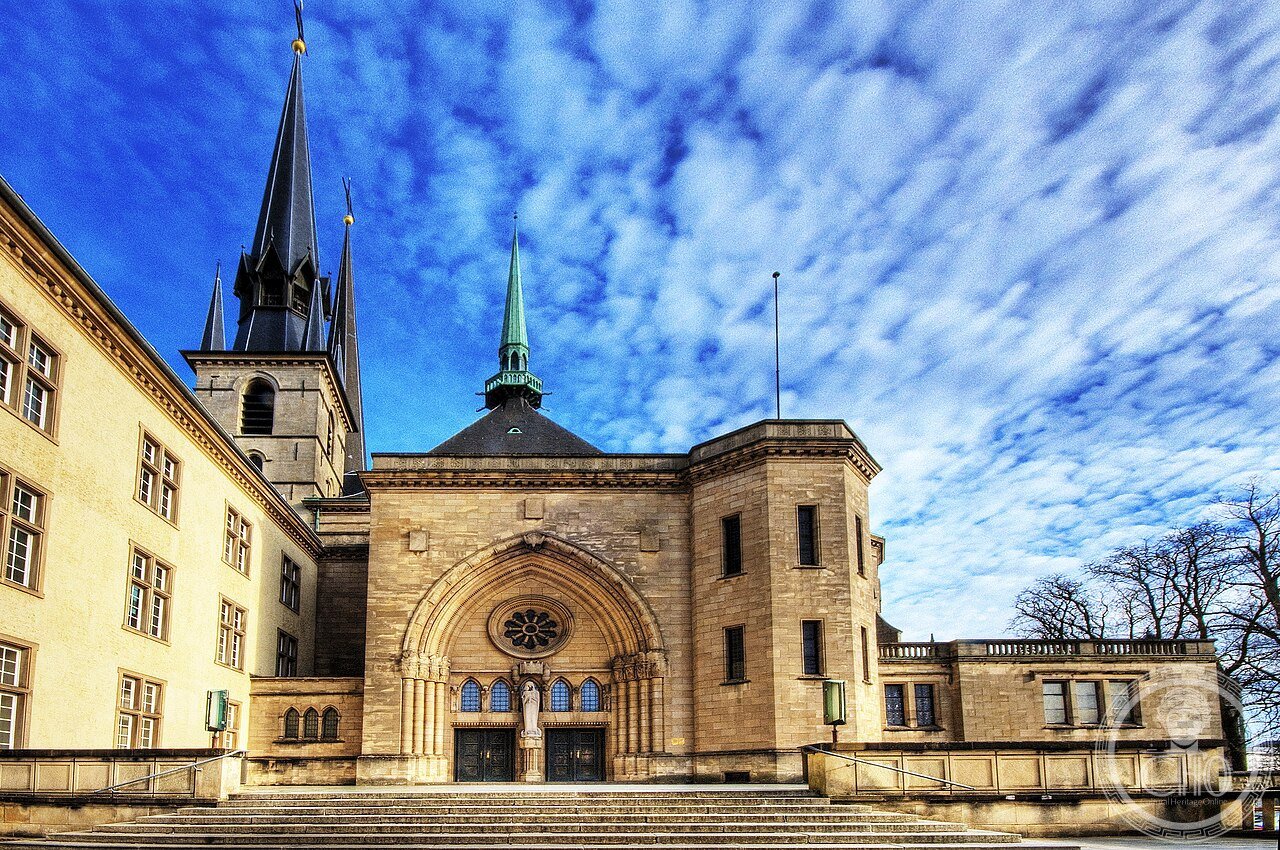
Nella cripta della cattedrale riposano dal 1945 i resti di Giovanni di Boemia, conte di Lussemburgo, che nel 1346, già completamente cieco, si fece legare le briglie del proprio cavallo a quelle dei suoi cavalieri per caricare comunque in prima linea alla battaglia di Crécy — dove morì combattendo. Costruita come chiesa gesuita tra il 1613 e il 1621, la cattedrale divenne sede vescovile solo nel 1870.
About Notre-Dame Cathedral
Jesuit priests from Belgium opened a college in Luxembourg City in 1603, and the cornerstone of their new church was laid on 7 May 1613 under Father François Aldenard, with Ulrich Job of Lucerne as the master builder; the completed church, dedicated to the Immaculate Conception, was consecrated on 17 October 1621, its architecture blending late Gothic form with Renaissance decorative elements, including alabaster early-Baroque angels contributed by the German sculptor Daniel Muller of Freiberg, Saxony. The church housed a venerated statue known as Our Lady, Consoler of the Afflicted (Sancta Maria Consolatricis Afflictorum), which Pope Pius IX ordered pontifically crowned by decree of 24 June 1866, carried out by Cardinal Karl-August von Reisach on 2 July 1866 — the statue remains the focus of Luxembourg’s annual Octave pilgrimage tradition. After the Jesuits were expelled from the city in 1773, Empress Maria Theresa of Austria donated the church to the city of Luxembourg in 1778, and it became the new parish church; it received the name “Notre-Dame” on 31 March 1848, and when Pope Pius IX elevated Luxembourg to a bishopric on 27 June 1870, the church became Notre-Dame Cathedral. Between 1935 and 1938, the architect Hubert Schumacher oversaw a major extension, adding the east and central towers while preserving harmony with the surrounding 17th-century Gothic structure. The cathedral’s crypt holds the remains of Luxembourg’s Grand Dukes and Grand Duchesses, and, since 1945 — when his remains were relocated from Germany — those of John of Bohemia, Count of Luxembourg and King of Bohemia, who died at the Battle of Crécy in 1346: already completely blind, he reportedly had his own horse’s reins tied to those of his knights so that he could still charge into the front line, where he was killed.
Key facts
- 1603: Jesuit college opens in Luxembourg City
- 7 May 1613 – 17 October 1621: church built and consecrated, dedicated to the Immaculate Conception
- 24 June/2 July 1866: the venerated statue Our Lady, Consoler of the Afflicted, pontifically crowned
- 1773/1778: Jesuits expelled; church donated to the city by Empress Maria Theresa
- 31 March 1848: renamed “Notre-Dame”
- 27 June 1870: elevated to cathedral status when Luxembourg becomes a bishopric
- 1935-1938: major extension by architect Hubert Schumacher, adding east and central towers
- 1945: remains of John of Bohemia (d. 1346 at Crécy) relocated to the crypt
History
John of Bohemia’s death at the 1346 Battle of Crécy, charging blind into combat with his reins bound to those of his knights, became one of the most celebrated instances of chivalric conduct in medieval European memory, and his eventual 1945 reburial in Notre-Dame’s crypt — following the relocation of his remains from Germany — gave Luxembourg a direct physical connection to one of its own medieval counts’ most legendary acts, centuries after his death on a French battlefield. The cathedral’s own gradual elevation from a modest Jesuit college church in 1613 to the seat of an independent bishopric in 1870 traces Luxembourg’s broader emergence as a distinct ecclesiastical and, eventually, national entity, no longer dependent on neighbouring dioceses for its religious administration.
The continued annual devotion to Our Lady, Consoler of the Afflicted, formalised by her 1866 papal coronation and sustained through Luxembourg’s Octave pilgrimage tradition, situates the cathedral at the centre of the country’s ongoing Marian religious culture, a practice with roots reaching back to the church’s earliest Jesuit-era decades in the 17th century.
What you see
The cathedral’s late Gothic structure, enriched with Renaissance decorative details and early Baroque alabaster angels by Daniel Muller, was substantially extended between 1935 and 1938 with the addition of east and central towers designed by Hubert Schumacher to harmonise with the 17th-century original. The crypt beneath the cathedral holds the tombs of Luxembourg’s Grand Ducal family alongside that of John of Bohemia, while the statue of Our Lady, Consoler of the Afflicted, remains a central devotional focus within the church.
Practical information
- Opening hours: generally open daily with seasonal variation; check current hours before visiting; free admission
- Address: 7 Rue Notre-Dame, 2240 Luxembourg City, Luxembourg
Getting there
Notre-Dame Cathedral is reachable on foot within Ville-Haute, the historic centre of Luxembourg City. GPS: 49.6098° N, 6.1316° E.
Nearby
- Grand Ducal Palace — the official residence of the Grand Duke, nearby
- Ville-Haute — the UNESCO-listed historic upper town surrounding the cathedral
- Bock Casemates — the fortified underground tunnels of Luxembourg City
Sources
- Wikipedia — “Notre-Dame Cathedral, Luxembourg” (en.wikipedia.org)
- Visit Luxembourg — “Cathedral Notre-Dame” (visitluxembourg.com)
- Unofficial Royalty — “Notre-Dame Cathedral in Luxembourg City, Luxembourg” (unofficialroyalty.com)
Find it on the map
See this place and what’s around it →📷 Become a Cultural Heritage Online photographer
Share your photos of places: they stay published under your name as the author. The more they're seen, the more you get noticed — and soon a contest will reward the most appreciated photos.
Log in or sign up free to add a photo