
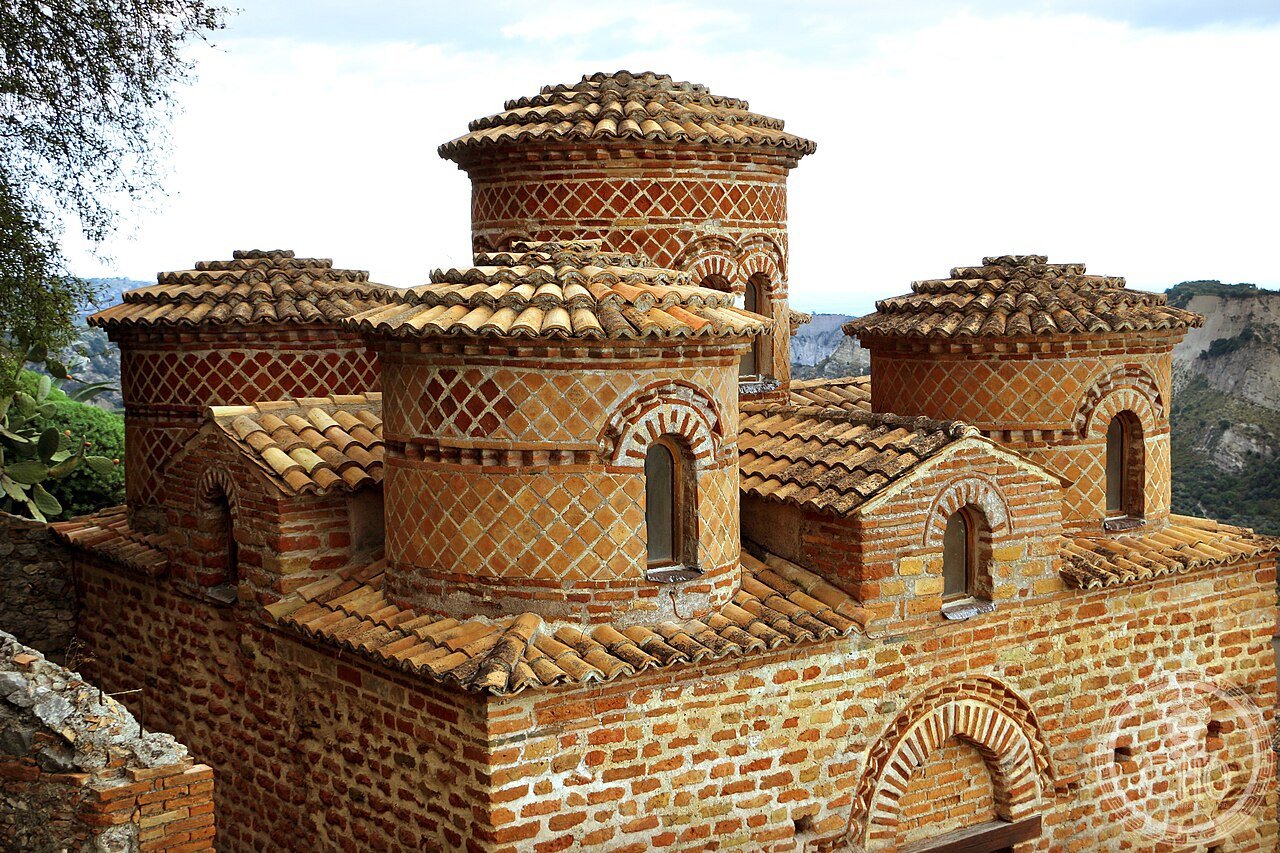
Costruita tra IX e X secolo da monaci orientali stabilitisi ai piedi del monte Consolino, la Cattolica di Stilo prende il nome dal greco “katholikí”, termine riservato alle chiese più importanti di una comunità: era infatti la chiesa madre delle cinque parrocchie del paese, retta da un vicario perpetuo con diritto di sepoltura al suo interno. Le sue cinque piccole cupole cilindriche rivestite di laterizio, disposte a croce greca, ne fanno oggi uno dei migliori esempi di architettura bizantina sopravvissuti in Italia.
About the Cattolica di Stilo
The Cattolica di Stilo is a small Byzantine church built between the 9th and 10th centuries by Eastern monks who settled near Monte Consolino, in what is now the province of Reggio Calabria. Its name derives from the Greek term “katholikì,” used to designate a church equipped with a baptistery or of particular importance to the local community — Stilo’s Cattolica served precisely this role as the mother church among the town’s five parishes, governed by a perpetual vicar (successor to the Byzantine-era protopapas) who held the right of burial within its walls. The church’s most distinctive architectural feature is its set of five small cylindrical domes, clad in brick, arranged around a Greek-cross plan and supported inside by four columns that divide the interior space into nine equal compartments — a design considered one of the finest surviving examples of Byzantine architecture anywhere in Italy. The interior preserves frescoes painted across a long span from the 10th to the 15th centuries, including a Christ Pantocrator in the vault and a Dormitio Virginis on the western wall dated to 1552. The building has undergone various restoration campaigns from the early 20th century to the present day, and since 2006 has formed part of a UNESCO World Heritage designation.
Key facts
- 9th-10th century: built by Eastern monks near Monte Consolino
- Name: from Greek “katholikì” — a church of particular importance, with baptistery rights
- Role: mother church of Stilo’s five parishes, governed by a perpetual vicar with burial rights
- Architecture: Greek-cross plan with five brick-clad cylindrical domes, four interior columns
- Frescoes: painted across the 10th-15th centuries, including a Christ Pantocrator and a 1552 Dormitio Virginis
- 2006: included in a UNESCO World Heritage designation
History
The Cattolica’s five-domed Greek-cross plan, an architectural form directly imported from Byzantine building traditions, situates the church within the broader phenomenon of Eastern monastic settlement across southern Italy during the early medieval period, when Greek-rite monks established communities throughout Calabria and Sicily, carrying with them the liturgical and architectural conventions of the Byzantine world. Its designation as the “katholikì” — mother church — among Stilo’s five parishes, with its own perpetual vicar continuing the role of the earlier Byzantine protopapas, reflects the persistence of Byzantine-derived ecclesiastical administrative structures in this corner of Calabria long after direct Byzantine political control had ended.
The long span of the church’s fresco cycle, from the 10th century through to the 1552 Dormitio Virginis, illustrates how the building continued to serve as an active site of devotional decoration across nearly six centuries, layering Byzantine-Greek and later Latin-rite artistic traditions within the same small sacred space — a visual palimpsest reflecting Calabria’s own long transition from Byzantine to Latin ecclesiastical rite.
What you see
The church’s five small cylindrical domes, clad in brick and arranged in a Greek-cross configuration, remain its most immediately recognisable feature, visible from a considerable distance against the slopes of Monte Consolino. Inside, four columns divide the compact interior into nine equal spaces, creating an intimate, contemplative setting for the surviving fresco cycle, which spans the Christ Pantocrator in the vault and later additions including the 1552 Dormitio Virginis on the western wall.
Practical information
- Opening hours: generally open daily with seasonal variation; check current hours before visiting; admission fee applies
- Address: Via Mansueto Magotti, Criniti, 89049 Stilo, Italy
Getting there
The Cattolica di Stilo is reachable by car from Reggio Calabria (approximately 1.5 hours) in the province of Reggio Calabria, at the foot of Monte Consolino. GPS: 38.4802° N, 16.4683° E.
Nearby
- Stilo — the historic town at the foot of Monte Consolino
- Monte Consolino — the mountain overlooking the church, with further Byzantine hermitages
- Serra San Bruno — a nearby town with its own significant Carthusian charterhouse
Sources
- Scoprilacalabria.com — “Stilo e la cattolica: il gioiello bizantino della Calabria” (scoprilacalabria.com)
- Italiani.it — “La Cattolica di Stilo: una perla bizantina del X secolo” (italiani.it)
- Ministero della Cultura — “Chiesa della Cattolica a Stilo” (catalogo.cultura.gov.it)
Find it on the map
See this place and what’s around it →📷 Become a Cultural Heritage Online photographer
Share your photos of places: they stay published under your name as the author. The more they're seen, the more you get noticed — and soon a contest will reward the most appreciated photos.
Log in or sign up free to add a photo