
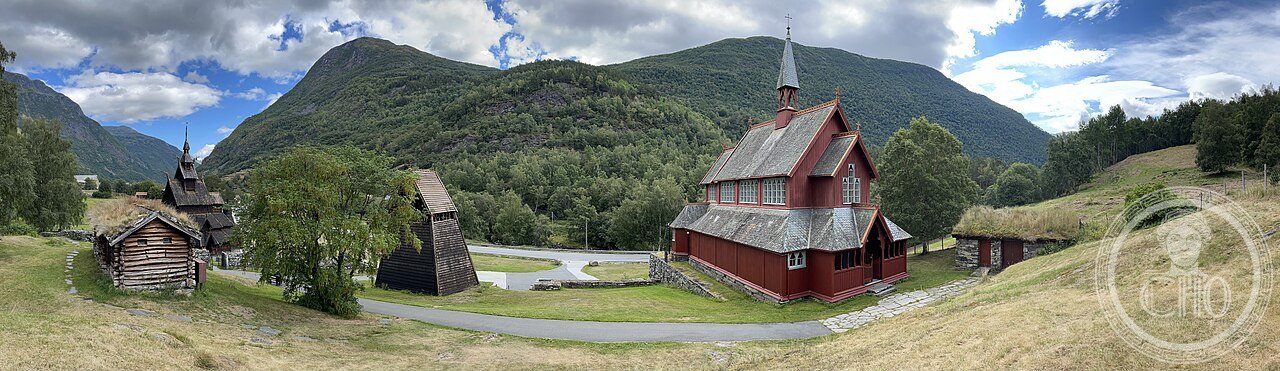
Sulle quattro falde del tetto, teste di drago scolpite si protendono verso l’esterno con la stessa forma delle prue delle navi vichinghe — un’eco pagana sopravvissuta su un edificio cristiano, letta all’epoca come lotta tra bene e male. All’interno, un’iscrizione runica di un certo &Thorn;órir attribuisce le proprie disgrazie alle Norne, le antiche divinità norrene del destino, incisa a pochi passi da un graffito che recita “Ave Maria”.
About Borgund Stave Church
Borgund Stave Church was built as the parish church of Borgund, in the Diocese of Bjørgvin, sometime between 1180 and 1250, with later additions and restorations, and dedicated to the Apostle Andrew. Its construction follows the traditional stave-building method, using vertical wooden boards, or staves, connected by ground sills resting on stone foundations, with interlocking tongued-and-grooved joints and an internal “cube within a cube” structural system in which inner columns support the roof independently of the outer stave walls — techniques drawing directly on Viking-era shipbuilding methods, entirely without the use of nails. On each of its four gables, stylised dragon heads swoop from the carved roof ridge crests, closely resembling the carved dragon-head prows of Norse longships; the church’s west portal is further framed by carvings of dragons biting each other’s necks and tails, their imagery interpreted by medieval Christian authorities as a symbolic struggle between good and evil, the dragon forms themselves believed to carry a protective function despite their pagan origins. Inside, medieval graffiti includes both an “Ave Maria” inscription and a runic carving by a man named Þórir, who blamed the pagan Norse Norns — goddesses of fate — for his misfortunes, evidence of how thoroughly older Norse beliefs continued to coexist with Christian worship centuries after the country’s formal conversion. The church also preserves Norway’s sole surviving stave-built freestanding bell tower. Religious functions were transferred to a newly built Borgund Church nearby in 1868, after which the original stave church was restored and converted into a museum; the Society for the Preservation of Ancient Norwegian Monuments purchased it in 1877 and has maintained it ever since. Today, Borgund is widely regarded as the best-preserved of Norway’s surviving stave churches, retaining most of its original medieval timber.
Key facts
- 1180-1250: construction period, dedicated to the Apostle Andrew
- Construction technique: stave-built, Viking shipbuilding methods, no nails, “cube within a cube” structure
- Dragon-head carvings: on all four gables and the west portal, echoing Viking ship prows
- Runic graffiti: includes both “Ave Maria” and an invocation blaming the pagan Norns
- Bell tower: Norway’s sole surviving stave-built freestanding bell tower
- 1868: religious functions transferred to a new nearby church
- 1877: purchased and preserved as a museum by the Society for the Preservation of Ancient Norwegian Monuments
- Today: the best-preserved of Norway’s surviving stave churches
History
The direct technical continuity between Borgund’s stave construction and Viking-era shipbuilding — the same jointing methods, the same absence of nails, the same dragon-head carving tradition applied to a Christian church rather than a longship’s prow — situates the building at a genuinely fascinating point of craft and cultural transition, where shipwrights’ technical mastery was redirected toward an entirely new devotional purpose without abandoning its distinctive formal vocabulary. The coexistence of an “Ave Maria” inscription alongside another visitor’s runic complaint against the pagan Norns, carved into the same church walls, offers unusually direct written evidence of how long pre-Christian Norse belief persisted in ordinary religious practice even within an actively used medieval Christian building.
Of the estimated many hundreds of stave churches once built across medieval Norway, only around thirty survive today, making Borgund’s status as the best-preserved example a matter of considerable rarity — its 1868 replacement by a new, more practical church, followed by preservation as a museum rather than continued demolition or neglect, reflects the growing 19th-century recognition of the surviving stave churches’ unique cultural and architectural value.
What you see
The church’s tiered, shingle-covered roofs rise in a distinctive stacked profile, each gable crowned with a carved dragon head. The west portal’s elaborate dragon carvings, biting each other’s necks and tails with vine stalks winding upward from flanking dragon heads at the base, remain among the finest surviving examples of Norwegian Romanesque wood carving. Norway’s only surviving freestanding stave-built bell tower stands beside the church, and the interior preserves medieval runic and Latin graffiti carved directly into its ancient timber walls.
Practical information
- Opening hours: generally open daily with seasonal variation; check current hours before visiting; admission fee applies
- Address: Borgund stavkyrkje, Vindhella, 6888 Borgund, Lærdal, Norway
Getting there
Borgund Stave Church is reachable by car from Lærdal (approximately 25 minutes) in Vestland county, western Norway. GPS: 61.0472° N, 7.8123° E.
Nearby
- New Borgund Church — the 1868 red wooden church built to replace it, standing nearby
- Lærdal — approximately 25 minutes away; the nearest town
- Sognefjord — Norway’s longest fjord, in the surrounding region
Sources
- Wikipedia — “Borgund Stave Church” (en.wikipedia.org)
- Stavechurch.com — “Borgund Stave Church” (stavechurch.com)
- The Viking Herald — “Norwegian wood: A deep dive into Borgund Stave Church” (thevikingherald.com)
Find it on the map
See this place and what’s around it →📷 Become a Cultural Heritage Online photographer
Share your photos of places: they stay published under your name as the author. The more they're seen, the more you get noticed — and soon a contest will reward the most appreciated photos.
Log in or sign up free to add a photo