

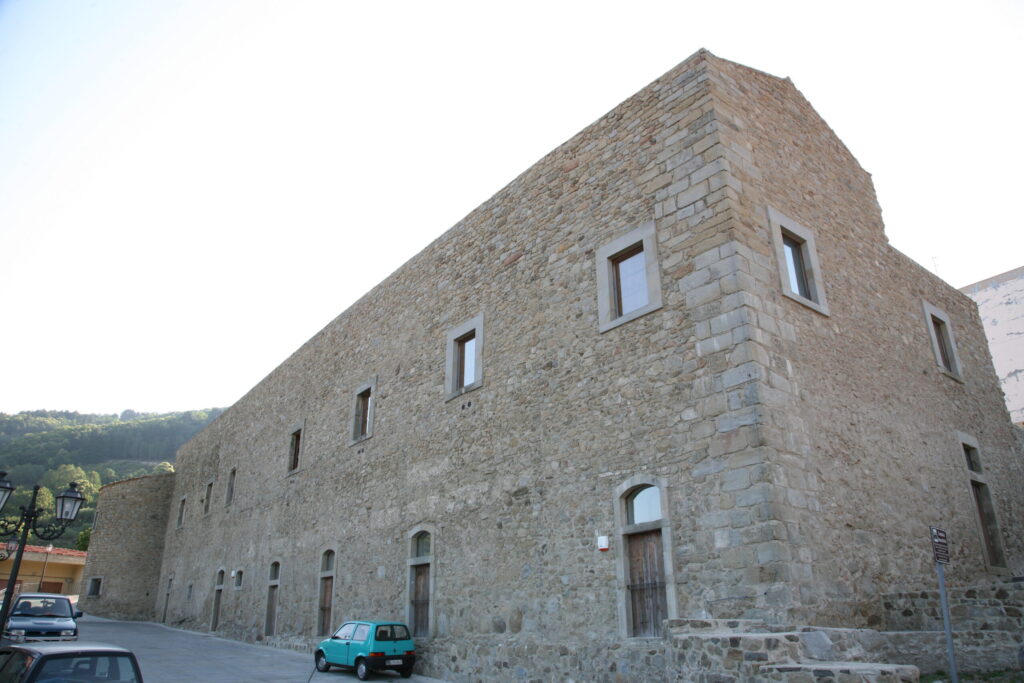
The Branciforti Castle of Raccuja is a feudal fortress-palace rising above the small comune of Raccuja in the Nebrodi Mountains of the Metropolitan City of Messina, approximately 140 kilometres east of Palermo. Built or substantially enlarged by the Branciforti, one of the most prominent baronial families in early-modern Sicily, the castle controlled a highland settlement in the forested interior of northeastern Sicily and today houses the municipal library, having been restored at the end of the twentieth century as the intended seat of the civic museum and of the historical archive.
At a glance
- Type
- Baronial castle ruins
- Period
- Norman, Swabian and Aragonese fabric; Branciforti from 1552
- Style
- Sicilian feudal military architecture
- Location
- Raccuja, Metropolitan City of Messina, Sicily, Italy
- Coordinates
- 38.0563° N, 14.9113° E
Overview
Raccuja is a small hill comune set within the Nebrodi Mountains, part of a chain of inland Sicilian settlements whose identity was shaped by feudal baronial control during the Norman, Swabian, Aragonese, and Spanish periods. The castle that bears the name of the Branciforti family was the administrative and military centre of the local fief, dominating a forested highland landscape that today falls within the boundaries of the Parco dei Nebrodi. The comune is located approximately 60 kilometres west of Messina and attracts visitors seeking the quieter heritage of inland Sicily.
History
The Branciforti were a powerful Sicilian aristocratic family of probable Genoese origin who accumulated vast land holdings across Sicily from the 14th century onward, becoming one of the most influential dynasties of the island under Spanish rule. Raccuja formed part of their feudal network in the Nebrodi highlands, and the castle was expanded and maintained as a seat of baronial administration during the period of their greatest power in the 16th and 17th centuries. After the end of feudalism in 1812 the castle passed to the State and from 1860, with Italian unification, was turned into a judicial prison; it fell into ruin only from the 1960s and was restored at the end of the twentieth century.
What you see
The surviving fabric of the castle consists principally of sections of curtain wall and the lower courses of towers constructed in local stone, integrated into the urban fabric of Raccuja’s historic centre. The remains offer a characteristic example of the compact feudal fortresses of the Nebrodi region, where the castle and the village formed a single defended unit rather than separate entities. The surrounding landscape of oak and beech forests, river gorges, and the Nebrodi highland plateau provides a scenic context that complements the historic remains.
Cultural significance
The Branciforti Castle of Raccuja documents the feudal organisation of inland Sicily under Spanish Bourbon administration, a period that shaped the social and architectural landscape of dozens of small Sicilian comuni in the Nebrodi and Madonie mountains. The castle’s integration within the village fabric illustrates the distinctively Sicilian pattern of the castello-paese, where baronial fortress and inhabited centre coexisted and mutually reinforced each other over centuries.
Practical information
- Address
- Historic centre, Raccuja, ME 98070, Sicily, Italy
- Access
- Open-air ruins freely accessible within the village; no formal admission
Getting there
Raccuja is accessible by car via the A20 Messina–Palermo motorway, exiting at Falcone and continuing south into the Nebrodi Mountains through Galati Mamertino. The nearest railway station is at Sant’Agata di Militello on the Tyrrhenian coast, approximately 25 kilometres away, with connecting bus services into the Nebrodi interior. The drive from Messina takes approximately 90 minutes.
The cylindrical towers belong to the Swabian phase, and after 1552 the Branciforti rebuilt the great hall with a lunette ceiling on carved corbels, two fireplaces and a new entrance bearing the family’s marble coat of arms.
Sources
Castello di Raccuja — Città Metropolitana di Messina — Portale Turismo e Cultura
Find it on the map
See this place and what’s around it →
Advertisement. Pictured, from the Cleveland Museum of Art (CC0) and not for sale: a parure of about 1850, a Lalique brooch, a Castellani bangle. How we handle this
📷 Become a Cultural Heritage Online photographer
Share your photos of places: they stay published under your name as the author. The more they're seen, the more you get noticed — and soon a contest will reward the most appreciated photos.
Log in or sign up free to add a photoIs this page about you?
This page is read by travellers and heritage enthusiasts who find it on Google. Tell us how you are connected to this place and we will take it from there.
This entry stays online and free either way — and a free account lets you add to it yourself.