
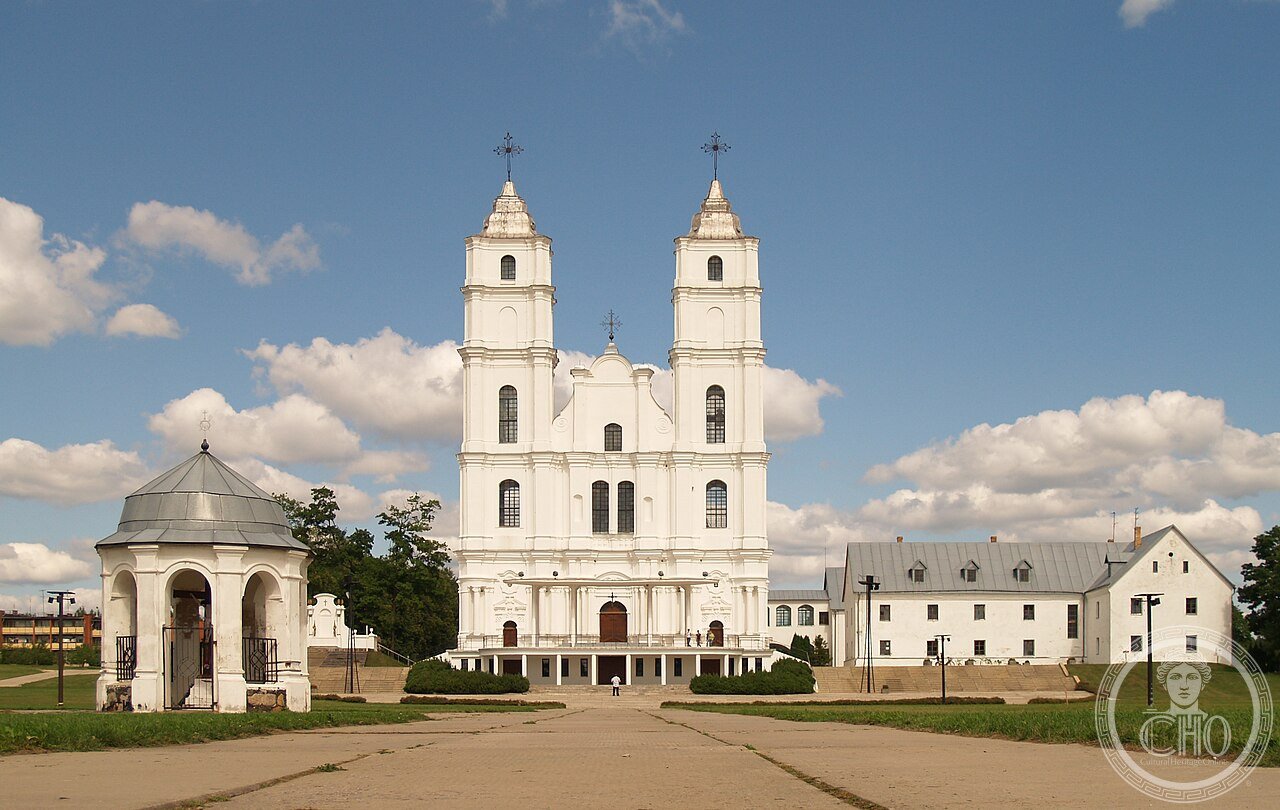
Custodita nella basilica domenicana di Aglona, l’icona seicentesca “Nostra Signora Miracolosa di Aglona” viene mostrata al pubblico solo durante le celebrazioni religiose. Ogni 15 agosto, per la festa dell’Assunzione, circa trecentomila pellegrini provenienti da Lettonia, Lituania, Polonia e altri paesi europei convergono su questo santuario — uno degli otto riconosciuti a livello internazionale dalla Santa Sede — che papa Giovanni Paolo II visitò personalmente nel settembre 1993.
About Aglona Basilica
The Dominican presence at Aglona began in 1697, when the local Polish noblewoman Jeta-Justina Sastodicka, supported by Livonian Bishop Mikolaj Poplawski, invited Dominican friars from Vilnius to establish a monastery and school in the town; Father Remigius Mosokowsky, prior of the Vilnius Dominican Monastery, had already arrived in 1688 to select the building site. A first wooden church was built and consecrated on 10 September 1751, but after this structure burned down, a new brick church was constructed between 1768 and 1780 in Italian Baroque style, with two 60-metre-high towers decorated in Rococo ornament, cross vaults, arches, and columns throughout its interior; the completed basilica was consecrated in 1800 by Bishop Jan Benisławski. Among the artworks preserved within is the venerated 17th-century icon known as “Our Miraculous Lady of Aglona,” believed to possess healing powers and unveiled to the public only during religious celebrations. Local tradition recounts miracles attributed to the icon, including the rescue of a drowning child after a desperate peasant’s prayer to the Lady of Aglona. Every year on 15 August, the feast of the Assumption of the Blessed Virgin Mary, pilgrims from Latvia, Lithuania, Poland, and across Europe converge on Aglona in numbers estimated at around 300,000, making it one of the largest annual religious gatherings in the Baltic states. In 1980, Pope John Paul II granted the church the title of Basilica minoris, and he personally visited Aglona in September 1993, shortly after Latvia had regained its independence. The basilica ranks among only eight shrines worldwide formally recognised as international pilgrimage sites by the Holy See.
Key facts
- 1688-1697: Dominican friars from Vilnius invited to establish a monastery and school at Aglona
- 10 September 1751: first wooden church consecrated
- 1768-1780: present Baroque brick church built, with twin 60-metre towers
- 1800: basilica consecrated by Bishop Jan Benisławski
- The icon: “Our Miraculous Lady of Aglona,” 17th century, unveiled only during celebrations
- 1980: Pope John Paul II grants the title Basilica minoris
- September 1993: Pope John Paul II visits in person
- Annual pilgrimage: around 300,000 pilgrims gather on 15 August each year
- Status: one of only eight shrines worldwide formally recognised by the Holy See as an international pilgrimage site
History
The Aglona icon’s tradition of remaining veiled outside of formal religious celebrations, unveiled only for specific liturgical occasions, situates the devotional practice surrounding it within a broader Catholic tradition of miraculous images whose restricted visibility itself reinforces their perceived sacred power — a practice paralleled at other major Marian shrines across Europe, but rare among the smaller number of Baltic pilgrimage sites of comparable historical depth. The Holy See’s formal recognition of Aglona as one of only eight international pilgrimage shrines worldwide places this relatively small Latvian basilica within an extremely select global category, reflecting the sustained, cross-border pilgrimage tradition — drawing Latvians, Lithuanians, and Poles together annually — that the site has maintained since the 18th century.
Pope John Paul II’s September 1993 visit, arriving within roughly two years of Latvia regaining independence from the Soviet Union, mirrors his visit to Lithuania’s Hill of Crosses that same month, situating both stops within a single papal itinerary explicitly recognising the role Catholic devotional sites played in sustaining Baltic national and religious identity through decades of Soviet suppression.
What you see
The basilica’s Italian Baroque facade, built between 1768 and 1780, is flanked by two 60-metre towers decorated with Rococo ornament, among the tallest church towers in the Baltic region. Its interior combines cross vaults, arches, and columns typical of the style, housing the venerated icon of Our Miraculous Lady of Aglona alongside other paintings and sculptures. The surrounding complex, including the former Dominican monastery buildings, reflects the site’s long history as a centre of religious education as well as pilgrimage.
Practical information
- Opening hours: generally open daily with seasonal variation; check current hours before visiting; free admission
- Address: Aglonas Bazilika, Ciriša iela 8, Aglona, LV-5304, Latvia
Getting there
Aglona is reachable by car from Daugavpils (approximately 40 minutes) in the Preiļi district, southeastern Latvia. GPS: 56.1270° N, 27.0155° E.
Nearby
- Lake Ciriša — the lake beside which the basilica stands
- Daugavpils — approximately 40 minutes away; the second-largest city in Latvia
- Latgale region — the surrounding historical region of southeastern Latvia
Sources
- Wikipedia — “Basilica of the Assumption, Aglona” (en.wikipedia.org)
- Latvia.travel — “Aglona Basilica” (latvia.travel)
- Catholic Shrine Basilica — “Basilica of the Assumption, Aglona, Latvia” (catholicshrinebasilica.com)
Find it on the map
See this place and what’s around it →📷 Become a Cultural Heritage Online photographer
Share your photos of places: they stay published under your name as the author. The more they're seen, the more you get noticed — and soon a contest will reward the most appreciated photos.
Log in or sign up free to add a photo