
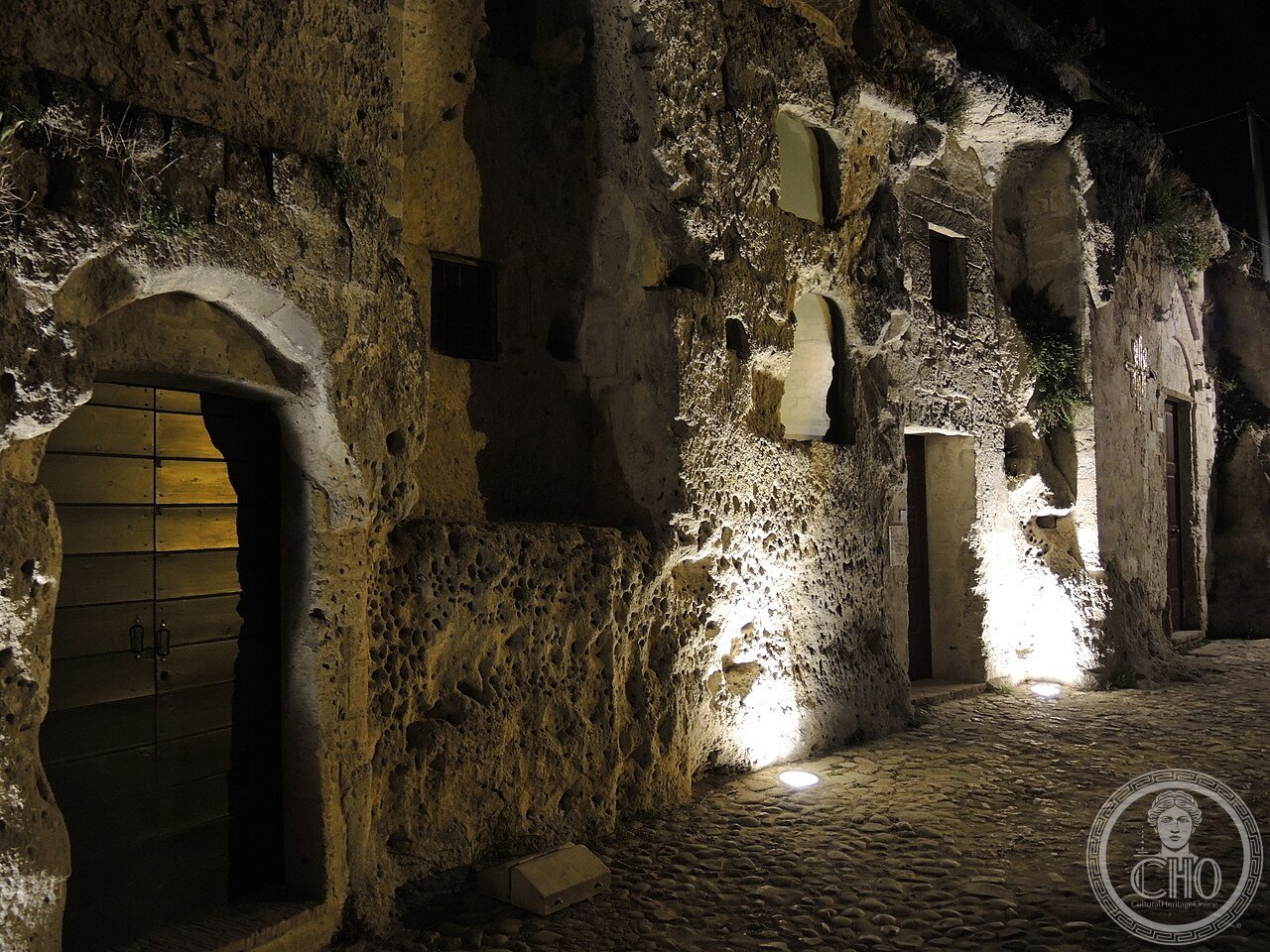
Founded in the eighth century as the city’s first Benedictine monastic settlement for women, the convent of Santa Lucia alle Malve was led by Abbess Eugenia until 1093. Dedicated originally to Saint Agatha, the church took the name of Saint Lucy between 1217 and 1267; the nuns stayed until 1525, when they moved first to Santa Lucia alla Civita and then to Santa Lucia al Piano — an unbroken community for more than a thousand years, across three successive homes.
About Santa Lucia alle Malve
Santa Lucia alle Malve is regarded as the first female Benedictine monastic settlement in Matera, with origins tracing to the 8th century — the most historically significant such foundation in the city’s monastic history. The community’s Benedictine nuns are recorded under the leadership of the abbess Eugenia, who directed the monastery until 1093. Initially dedicated to Saint Agatha, the church was rededicated to Santa Lucia sometime between 1217 and 1267; the church’s facade still bears three carved chalices symbolising Santa Lucia’s martyrdom. The nuns remained at this rock-cut site until 1525, when the community relocated first to the monastery of Santa Lucia alla Civita, and later to Santa Lucia al Piano — sustaining a continuous monastic presence across three successive locations for over a millennium of Matera’s history. The church itself is almost entirely carved directly into the rock, with only its entrance doorways completed in dressed tuff blocks, and measures approximately 16 by 13.5 metres. Its interior preserves a remarkable cycle of frescoes, many rediscovered during restoration work in 1977 and dating substantially to the 12th and 13th centuries, including a depiction of the Archangel Gabriel trampling a dragon (dated 1250), a Madonna del Latte (Madonna of the Milk, 1270), and figures of Saint Nicholas, Saint Benedict, John the Baptist, and Saint Scholastica. A necropolis of rock-cut tombs lies directly above the church. Today only the right nave, following restoration, remains open to the public, with Mass celebrated there annually on 13 December, Santa Lucia’s feast day; the remaining sections of the complex now serve as private residences.
Key facts
- 8th century: founded as the first female Benedictine monastic settlement in Matera, originally dedicated to Saint Agatha
- To 1093: led by the abbess Eugenia
- 1217-1267: rededicated to Santa Lucia
- 1525: the nuns relocate, eventually to Santa Lucia alla Civita and then Santa Lucia al Piano
- Dimensions: approximately 16 by 13.5 metres, almost entirely rock-cut
- 1977: restoration uncovers major frescoes, including a 1250 Archangel Gabriel and a 1270 Madonna del Latte
- Today: right nave open to the public; Mass held annually on 13 December; remaining sections used as private homes
History
The unbroken continuity of a single Benedictine female religious community across more than a millennium and three successive physical locations — from this 8th-century rock-cut foundation, through Santa Lucia alla Civita after 1525, to Santa Lucia al Piano — makes Santa Lucia alle Malve’s monastic lineage one of the longest continuously documented in Matera’s entire religious history, surviving the transition from rock-cut cave monasticism to conventional built architecture as the city itself evolved. The abbess Eugenia’s recorded leadership of the community until 1093 situates the monastery’s early institutional life within a period when female monastic authority, though constrained by the broader ecclesiastical hierarchy, could nonetheless be documented and preserved across the following centuries of Matera’s own historical record.
The rediscovery of the church’s major fresco cycle only during restoration work in 1977, after the site had presumably suffered the same decades of neglect affecting much of the depopulated Sassi district, reflects how much of Matera’s medieval rock-church heritage remained genuinely obscured from scholarly and public knowledge until the broader mid-to-late-20th-century rehabilitation of the Sassi began recovering it.
What you see
The church’s facade, completed in dressed tuff blocks around its rock-cut entrance doorways, bears three carved chalices symbolising Santa Lucia’s martyrdom. Inside, the 12th-13th-century fresco cycle rediscovered in 1977 includes the Archangel Gabriel trampling a dragon (1250), the Madonna del Latte (1270), and figures of Saint Nicholas, Saint Benedict, John the Baptist, and Saint Scholastica, across a rock-cut interior measuring roughly 16 by 13.5 metres. A necropolis of rock-cut tombs sits directly above the church, connected to the site’s long history as a monastic burial ground.
Practical information
- Opening hours: the right nave is generally open daily with seasonal variation; check current hours before visiting; admission fee applies
- Address: Rione Malve, Sassi di Matera, 75100 Matera, Italy
Getting there
Santa Lucia alle Malve is reachable on foot within the Sassi di Matera, in the Sasso Caveoso district, near Santa Maria de Idris. GPS: 40.6632° N, 16.6125° E.
Nearby
- Santa Maria de Idris — a nearby rock church, reached via the same staircase
- San Pietro Caveoso — the main parish church of the Sasso Caveoso district
- Casa Grotta — nearby cave-house museums showing traditional Sassi domestic life
Sources
- Wikipedia — “Chiesa di Santa Lucia alle Malve” (it.wikipedia.org)
- I Sassi di Matera — “Santa Lucia alle Malve: affreschi e storia della Chiesa Rupestre” (isassidimatera.com)
- Basilicatanet — “Santa Lucia alle Malve Chiesa Rupestre nei Sassi di Matera” (basilicatanet.com)
Find it on the map
See this place and what’s around it →📷 Become a Cultural Heritage Online photographer
Share your photos of places: they stay published under your name as the author. The more they're seen, the more you get noticed — and soon a contest will reward the most appreciated photos.
Log in or sign up free to add a photo