
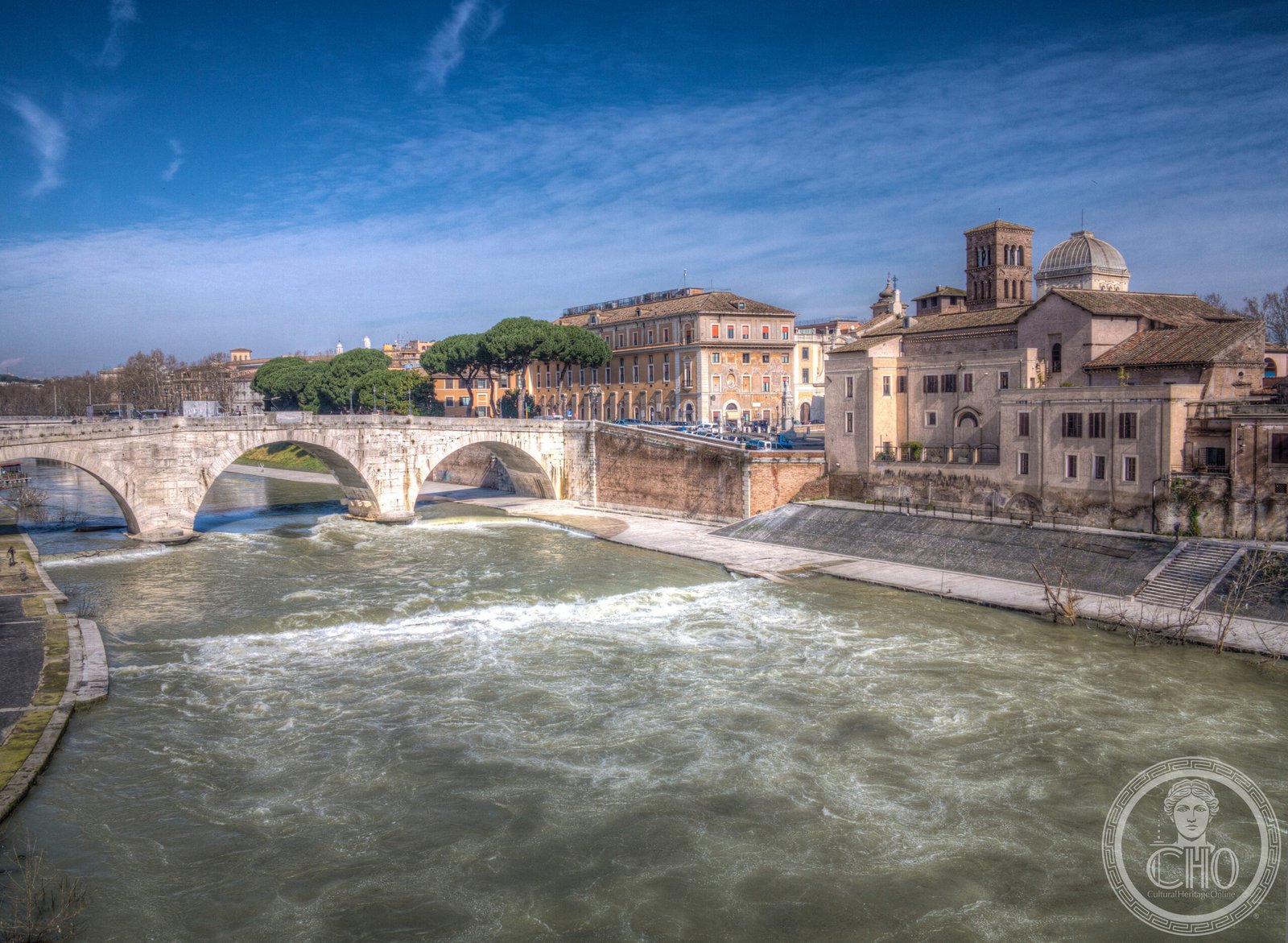
Tiber Island (Isola Tiberina) is the only natural island in the section of the Tiber that flows through Rome, situated in the river’s southern bend between the Trastevere and the Jewish Ghetto districts. Shaped like a boat — a form the ancient Romans emphasised by sheathing the island’s tip in travertine — it has been associated with healing since at least 291 BC, when a temple to Aesculapius, the god of medicine, was established there following a plague epidemic. The island’s 2,000-year medical vocation continues unbroken today in the Fatebenefratelli Hospital, one of Rome’s principal clinical centres.
At a glance
- Type
- Natural river island; ancient sacred site; hospital island
- Period
- Documented use from 291 BC; continuous occupation to the present
- Style
- Ancient Roman, medieval and baroque architectural layers
- Location
- Tiber River, Rome, Lazio, Italy
- Coordinates
- 41.8906° N, 12.4777° E
Overview
The Tiber Island is the only river island in the part of the Tiber that runs through Rome, located in the river’s southern bend. Measuring approximately 270 metres in length and 67 metres at its widest, the island is small enough to cross on foot in a few minutes, yet dense with layers of history spanning more than two millennia. It is connected to both banks by two ancient bridges — the Pons Fabricius (62 BC) and the Pons Cestius (46 BC, substantially rebuilt) — both still in use today.
History
According to ancient sources, the island’s association with healing began in 291 BC when the Romans, struck by plague, sent an embassy to Epidaurus in Greece to bring back the cult of Aesculapius. A sacred snake, symbol of the healing god, supposedly leapt from the embassy ship onto the island, indicating the site for the new temple. The Temple of Aesculapius was duly built and became a renowned sanctuary where the sick came to seek cures. In the medieval period the Church of San Bartolomeo all’Isola was erected over or near the ancient temple foundations, preserving the island’s sacred character. The Fatebenefratelli Hospital, founded in 1584 by the Order of Saint John of God, replaced the medieval hospital that had itself succeeded the ancient sanctuary, making the island’s 2,300-year history of medical care one of the longest in the world.
What you see
The island’s most prominent feature from the riverbanks is the Romanesque bell tower of San Bartolomeo all’Isola, which rises above the medieval church built largely with material from the ancient temple. The travertine prow at the southern tip of the island, carved to resemble the bow of a Roman galley with a serpent (the symbol of Aesculapius) coiling along its flank, is one of Rome’s most unusual ancient survivals. The Pons Fabricius on the eastern side is the oldest intact Roman bridge in the city, its two arches and a central pier essentially unchanged since 62 BC. A smaller piazza on the island offers shaded seating and views of the river, the Trastevere waterfront and the Ghetto synagogue across the water.
Cultural significance
Tiber Island holds a unique place in Roman history as both the oldest medical site in the city and one of the best preserved examples of continuous use of an ancient sacred precinct. The survival of two Republican-era bridges linking it to opposite banks, combined with the unbroken tradition of healing from pagan sanctuary to medieval hospital to modern clinical centre, makes it an exceptional document of Rome’s urban and religious continuity across two and a half millennia.
Practical information
The island is freely accessible at all hours via the Pons Fabricius from the Ghetto side (Via del Portico d’Ottavia) or the Pons Cestius from Trastevere. The Church of San Bartolomeo all’Isola is open for visits; check current hours at the parish office. The Fatebenefratelli Hospital is an active medical facility and is not open for tourism. In summer, the island hosts the Estate Isola del Cinema open-air film festival.
Getting there
Tiber Island is centrally located in Rome and easily reached on foot from Trastevere (5 minutes) or the Jewish Ghetto (5 minutes). By metro: the nearest stations are Circo Massimo (line B, 15-minute walk) or Repubblica (line A, 25-minute walk). Tram line 8 stops at Largo di Torre Argentina, a 10-minute walk away. No dedicated parking on the island; park in Trastevere or the Ghetto area.
Sources & resources
See the place
Find it on the map
See this place and what’s around it →Historical events at this place (5)
📷 Become a Cultural Heritage Online photographer
Share your photos of places: they stay published under your name as the author. The more they're seen, the more you get noticed — and soon a contest will reward the most appreciated photos.
Log in or sign up free to add a photo