
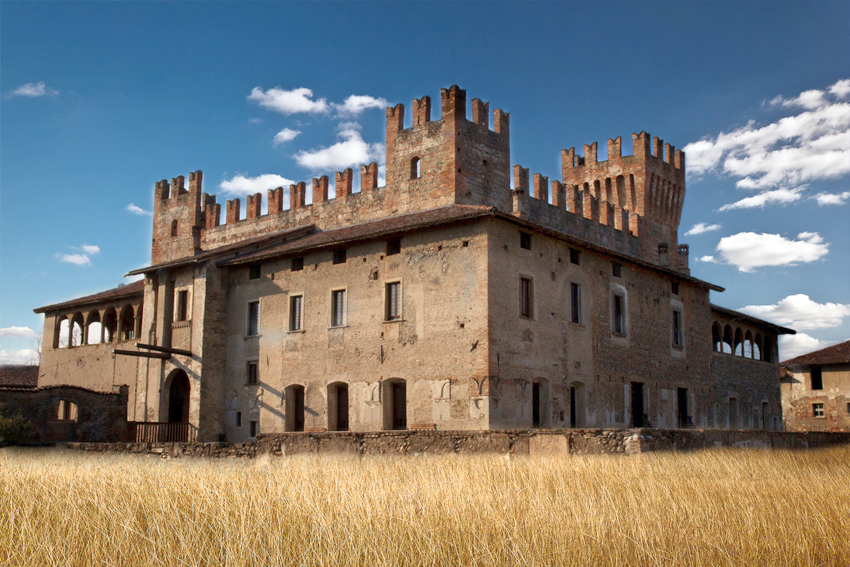
The Castello di Malpaga is a fourteenth-century castle in the communal territory of Cavernago, a village in the Province of Bergamo in northern Italy, celebrated primarily for the cycle of Renaissance frescoes by the Brescian painter Girolamo Romanino covering its main hall. Originally a strategic fortification on the Venetian–Milanese frontier, the castle became the personal residence and trophy of the condottiere Bartolomeo Colleoni, who acquired it in 1456 and transformed it from a fortress into a refined late-Gothic country seat while retaining its martial character. The painted hall — frescoed around 1520 — depicts with exceptional documentary detail the visit of the King of Denmark Christian I to Colleoni’s court, and constitutes one of the most vivid records of fifteenth-century courtly life in northern Italy.
At a glance
- Type
- Medieval castle / fortified residence
- Period
- 14th century (foundation); major works under Bartolomeo Colleoni after 1456; frescoes c. 1520
- Style
- Late Gothic Lombard military architecture; interior Renaissance fresco decoration
- Location
- Cavernago, Province of Bergamo, Lombardy, Italy
- Coordinates
- 45.6173° N, 9.7558° E
Overview
Malpaga Castle stands on the low plain south of Bergamo, on land that marked the contested border zone between the territories of Venice and Milan during the era of the condottieri. The castle’s fame rests on two things: its association with Bartolomeo Colleoni, the greatest mercenary captain of fifteenth-century Italy, and the frescoes painted by Il Romanino shortly after Colleoni’s death that immortalised the castle’s heyday. The building today retains its moat, towers, and courtyard, and the fresco cycle in the main hall is considered one of Romanino’s finest achievements outside of Brescia.
History
The castle was built in the fourteenth century as a military outpost on the volatile Venetian–Milanese frontier, changing hands repeatedly as political control of the Bergamo territory shifted. Bartolomeo Colleoni — born near Bergamo in 1400 and renowned as a commander of unprecedented military skill and diplomatic cunning — purchased Malpaga in 1456 after accumulating enormous wealth in the service of Venice, whose Captain-General he became in 1455. Colleoni spent the last decades of his life at Malpaga, receiving ambassadors, foreign dignitaries, and in 1474 the King of Denmark and Norway Christian I on a famous ceremonial visit. After Colleoni’s death in 1475 the castle passed to his heirs and subsequently to various noble families; the Romanino frescoes were commissioned around 1520, likely by his grandson-in-law.
What you see
The castle presents a roughly quadrangular plan enclosed by a water-filled moat, with corner towers and a central keep rising above the curtain wall. The principal hall on the piano nobile is covered by Romanino’s fresco cycle, which depicts hunting scenes, courtly banquets, military parades, and the visit of Christian I with a vividness and narrative complexity that has no parallel in Lombard painting of the period. The courtyard preserves Late Gothic arcading, and the chapel retains early painted decoration. The exterior brick construction, with its mixture of military austerity and residential refinement, is characteristic of the Bergamo castles of the Colleoni era.
Cultural significance
Malpaga Castle is significant on two levels: as the home of the most celebrated condottiere of the Italian Renaissance, whose equestrian statue by Verrocchio dominates the Campo di Santi Giovanni e Paolo in Venice, and as the site of frescoes that offer an unmatched visual document of fifteenth-century court culture, costume, and ceremonial in northern Italy. Together, castle and paintings represent an exceptional convergence of military history, patronage, and Renaissance art.
Practical information
- Address
- Cavernago, Province of Bergamo, Lombardy
- Hours
- Open for guided visits; check the castle’s official website for current schedule and booking
- Admission
- Entry fee applies; check official website for current prices
Getting there
Cavernago is approximately 10 km south of Bergamo. By car, take the SS42 or SP120 south from Bergamo towards Treviglio; the castle is signposted from the village. The nearest railway station is Bergamo (on the Milano–Venezia line), with onward bus or taxi connection. Bergamo Orio al Serio airport is approximately 15 km away.
Sources & resources
Find it on the map
See this place and what’s around it →📷 Become a Cultural Heritage Online photographer
Share your photos of places: they stay published under your name as the author. The more they're seen, the more you get noticed — and soon a contest will reward the most appreciated photos.
Log in or sign up free to add a photo