
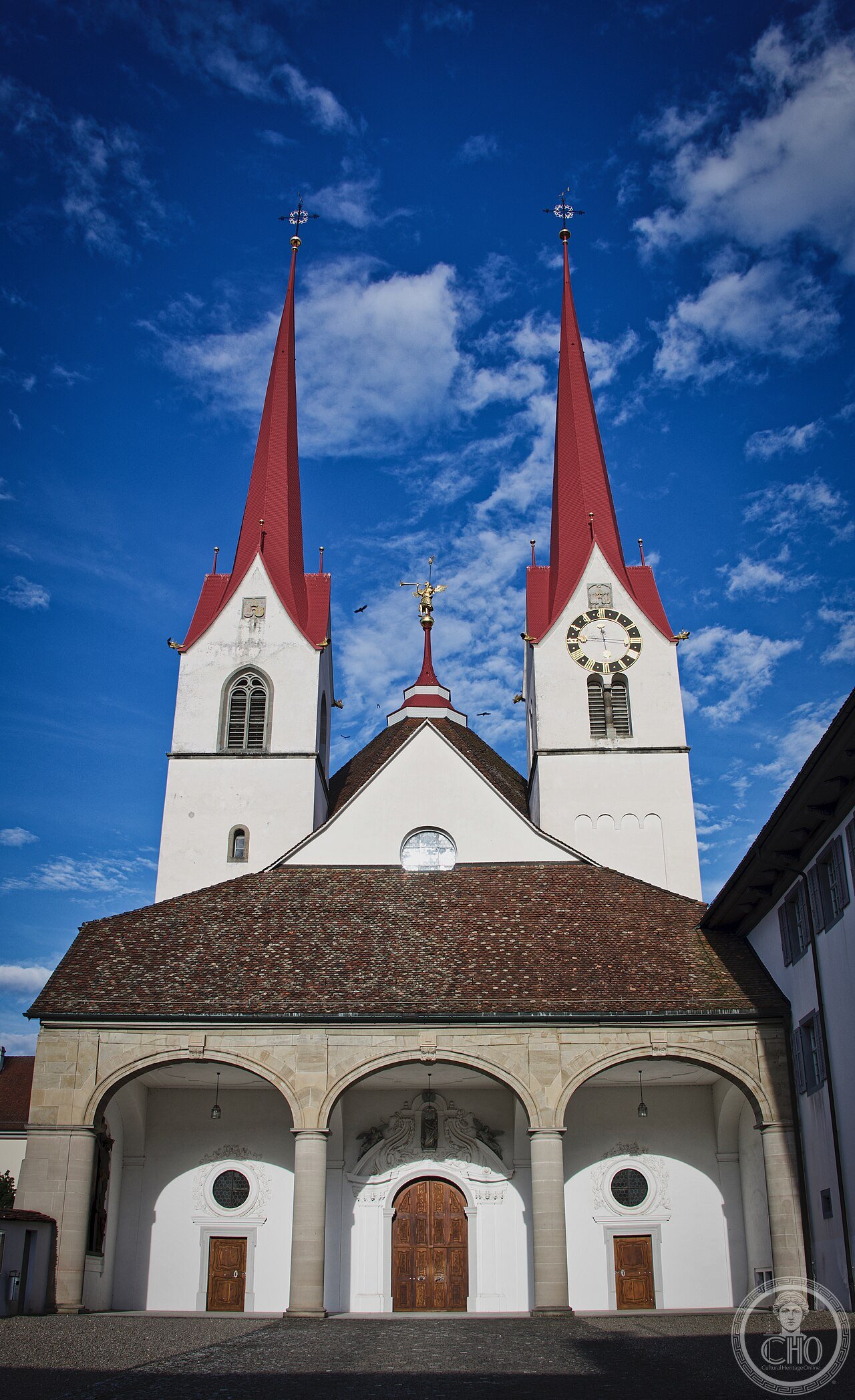
Fondata nel 1027 da Radbot, conte d’Asburgo, l’abbazia di Muri fu per secoli il luogo di sepoltura prediletto della dinastia. Nel 1971, i cuori dell’ultima coppia imperiale regnante — Carlo I d’Austria e sua moglie Zita di Borbone-Parma — furono trasferiti nella cripta di famiglia della Cappella di Loreto, insieme ai corpi dei loro figli Rodolfo e Felice.
About Muri Abbey
The monastery of Saint Martin of Tours at Muri, in the canton of Aargau, was founded in 1027 by Radbot, Count of Habsburg — one of the direct progenitors of the House of Habsburg — as a proprietary abbey closely tied to the dynasty from its very foundation, initially settled by monks from Einsiedeln Abbey. The monastery flourished through the 13th century before becoming entangled in the conflict between the Habsburgs and the expanding Swiss Confederation, ultimately falling under Swiss overlordship in 1415. Despite this political shift away from direct Habsburg control, the dynastic connection endured: in 1705, Emperor Leopold I, who held a keen appreciation for his family’s history, elevated his ancestors’ foundation to the status of a princely abbey. Muri had long served as a favoured Habsburg burial site, holding the family’s oldest surviving burial place within the abbey church. In the 20th century, this connection was dramatically renewed: the hearts of Karl I, the last reigning Emperor of Austria (now venerated as Blessed Charles of Austria, 1887-1922), and his consort Empress Zita of Bourbon-Parma (1892-1989, a Servant of God), were placed in the family crypt in the Loreto Chapel, alongside the bodies of their sons Rudolf and Felix — the present family tomb itself was relocated to the abbey church in 1971. In 1841, amid anticlerical measures by the radical liberal government of Aargau, the abbey was forcibly dissolved, its monks expelled by armed force and its properties seized by cantonal authorities; the displaced community relocated to Gries Abbey in Bolzano, South Tyrol, founding what became Muri-Gries Abbey.
Key facts
- Foundation: 1027, by Radbot, Count of Habsburg, a direct progenitor of the House of Habsburg
- 1415: came under Swiss overlordship amid Habsburg-Swiss Confederation conflict
- 1705: elevated to princely abbey status by Emperor Leopold I
- Habsburg burial place: the dynasty’s oldest surviving burial site, in the abbey church
- Loreto Chapel crypt: holds the hearts of Emperor Karl I and Empress Zita, and the bodies of their sons Rudolf and Felix; family tomb relocated here in 1971
- 1841 dissolution: forcibly suppressed by the Aargau cantonal government; community relocated to Bolzano, founding Muri-Gries Abbey
History
Radbot of Habsburg’s 1027 foundation of Muri places the abbey at the literal origin point of one of European history’s most consequential ruling dynasties, the House of Habsburg, whose descendants would go on to rule Austria, Spain, the Holy Roman Empire, and vast additional territories across nearly a millennium — making Muri’s connection to the dynasty’s earliest documented ancestor a matter of genuine foundational significance rather than merely incidental patronage. The abbey’s 1415 transfer to Swiss overlordship, occurring amid the broader Swiss Confederation’s successful territorial expansion at Habsburg expense, reflects the historical irony of the dynasty’s own ancestral foundation ending up under the political control of the very confederation that had displaced Habsburg power from its original Swiss homeland.
The 1971 relocation of the family tomb and the continued presence of Emperor Karl I’s and Empress Zita’s hearts in the Loreto Chapel crypt demonstrate the Habsburg family’s continuing 20th-century commitment to Muri as an active dynastic memorial site, long after the empire itself had ceased to exist following the 1918 collapse of Austria-Hungary — Karl I’s subsequent beatification by the Catholic Church in 2004 gives this connection an additional devotional dimension extending well beyond purely dynastic commemoration. The abbey’s own forcible 1841 dissolution by Aargau’s anticlerical liberal government, followed by the community’s displacement to Bolzano, situates Muri within the broader 19th-century pattern of Swiss cantonal secularisation measures targeting Catholic monastic institutions during a period of significant confessional and political tension within the Swiss Confederation.
What you see
The Loreto Chapel crypt, holding the hearts of Emperor Karl I and Empress Zita alongside their sons’ remains, is the abbey’s most significant destination for visitors interested in Habsburg dynastic history, offering a direct connection to the family’s final reigning generation. The abbey church, containing the dynasty’s oldest surviving burial site, gives visitors a physical link spanning nearly a millennium of Habsburg family history. The abbey complex’s architecture reflects its long institutional history, from its 1027 foundation through its 1705 elevation to princely status and its eventual 1841 suppression.
Practical information
- Opening hours: generally open daily, check current hours before visiting; free admission to the church
- Address: Klosterhof, 5630 Muri, Switzerland
Getting there
Muri has direct rail connections from Zurich (approximately 1 hour) and Lucerne (approximately 45 minutes). By car, Muri sits in the canton of Aargau, reachable via regional roads. GPS: 47.2751° N, 8.3380° E.
Nearby
- Habsburg Castle — the dynasty’s original ancestral castle, within the same canton of Aargau
- Lucerne — approximately 45 minutes away; historic city on Lake Lucerne
- Zurich — approximately 1 hour away; Switzerland’s largest city
Sources
- Wikipedia — “Muri Monastery” (en.wikipedia.org)
- Die Welt der Habsburger — “The Habsburg crypt in the Loreto chapel at Muri Abbey” (habsburger.net)
- Switzerland Tourism — “Muri Abbey and the Habsburg burial place” (myswitzerland.com)
Find it on the map
See this place and what’s around it →📷 Become a Cultural Heritage Online photographer
Share your photos of places: they stay published under your name as the author. The more they're seen, the more you get noticed — and soon a contest will reward the most appreciated photos.
Log in or sign up free to add a photo