
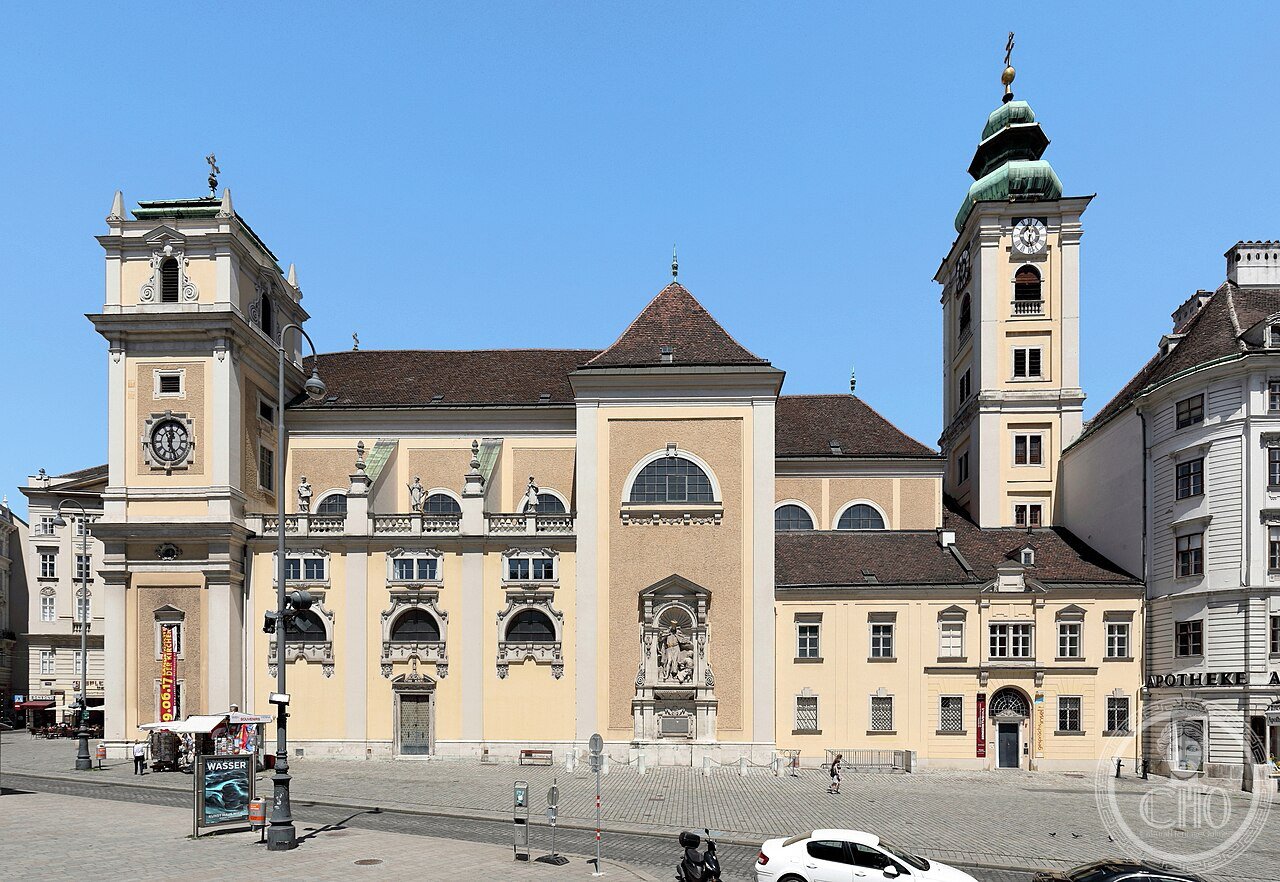
In 1155 Henry II of Austria brought monks to Vienna not from Scotland but from Ireland, by way of the monastery of the Scoti in Regensburg. In medieval Latin, Ireland was called “Scotia Major”: hence the name “Schotten” (Scots) given to the Irish monks, and still borne today by the oldest Benedictine monastery in the centre of Vienna.
About the Schottenstift
The Schottenstift (Abbey of Our Dear Lady of the Scots) is a Catholic monastery founded in Vienna in 1155, when Duke Henry II of Austria brought Irish monks to the city — not directly from Ireland, but from the Scots Monastery (Schottenkloster) in Regensburg, Germany. The “Scots” name derives from a specific medieval Latin terminology quirk: Ireland was known in Latin as “Scotia Major,” so Irish monks were called “Schotten” (Scots) or “Iroschotten” in German. Henry II’s own foundation documents specified the monastery was to be occupied exclusively by these Irish monks, using the phrase “Solos elegimus Scottos” (“We have chosen only Scots”). Construction of the first monastery began in 1160, and the church was consecrated in 1200; the monks also built a hospice serving pilgrims and crusaders who frequently passed through Vienna en route to Jerusalem. Henry II himself was buried at the abbey upon his death in 1177. A fire in 1276 destroyed the cloister along with much of the surrounding city. In 1418, Duke Albert V seized the monastery as part of the Melk Reform, an effort to restore original Benedictine monastic discipline, replacing the Irish community with reformed Benedictine monks. The abbey has belonged to the Austrian Congregation since 1625, itself part of the wider Benedictine Confederation since 1893. The building’s present appearance reflects later renovations: architect Josef Kornhäusel redesigned the Freyung-facing structures in Classicist style between 1826 and 1832, and Heinrich Ferstel’s 1880 renovation introduced Neo-Renaissance elements.
Key facts
- Foundation: 1155, by Duke Henry II of Austria, with Irish monks brought via the Scots Monastery in Regensburg
- Name origin: “Schotten” (Scots) — medieval Latin term for Ireland, “Scotia Major,” applied to Irish monks
- Construction: begun 1160, church consecrated 1200; included a pilgrim/crusader hospice
- Henry II’s burial: 1177, at the abbey he founded
- 1276 fire: destroyed the cloister and much of surrounding Vienna
- 1418 Melk Reform: Duke Albert V replaced the Irish community with reformed Benedictine monks
- Later renovations: Classicist facade by Josef Kornhäusel (1826-1832); Neo-Renaissance elements by Heinrich Ferstel (1880)
- Congregation membership: Austrian Congregation since 1625, Benedictine Confederation since 1893
History
The Schottenstift’s founding via Irish monks recruited from the existing Scots Monastery in Regensburg, rather than directly from Ireland, reflects the broader medieval network of “Schottenklöster” (Scots monasteries) that Irish Benedictine monks had already established across German-speaking Central Europe by the 12th century — Vienna’s foundation represents an extension of an already-functioning Irish monastic network rather than a wholly new missionary initiative. Duke Henry II’s explicit insistence in the foundation charter that the monastery be staffed exclusively by Irish monks (“Solos elegimus Scottos”) reflects the specific prestige and reputation Irish monastic scholarship and piety carried across contemporary Central Europe, a legacy of Ireland’s earlier “Golden Age” of monastic learning during the early medieval period.
The 1418 Melk Reform’s replacement of the original Irish community with reformed Benedictine monks situates the Schottenstift’s institutional history within a broader 15th-century movement to restore stricter observance of the Benedictine rule across Central European monasteries whose original discipline had, by this point, often loosened considerably over the preceding centuries — the Irish community’s specific removal reflecting particular concerns about its state of observance by the early 15th century rather than any rejection of its Irish origins per se. The building’s subsequent Classicist and Neo-Renaissance renovations under Kornhäusel and Ferstel reflect the broader 19th-century pattern of major Viennese religious buildings receiving substantial stylistic updating during the same period that reshaped much of the city’s historic centre.
What you see
The Schottenkirche’s present Classicist and Neo-Renaissance exterior, product of the 1826-1832 and 1880 renovations, gives visitors a 19th-century architectural shell over the much older 1155-1200 foundation. Henry II’s tomb connects directly to the monastery’s ducal founder. The Black Madonna (1825) by Peter Nobile and the Jasomirgott Fountain (1651) on the Freyung square add further layers of decorative and civic history to the abbey precinct.
Practical information
- Opening hours: generally open daily, check current hours before visiting; free admission to the church
- Address: Freyung 6, 1010 Vienna
Getting there
The Schottenstift stands on the Freyung in Vienna’s Innere Stadt, a short walk from Herrengasse U-Bahn station (U3). GPS: 48.2126° N, 16.3640° E.
Nearby
- Freyung square — the historic square in front of the abbey, with the Austria Fountain
- Hofburg Palace — a short walk away; the former imperial Habsburg residence
- St. Stephen’s Cathedral — a short walk through Vienna’s historic centre
Sources
- Wikipedia — “Schottenstift” (en.wikipedia.org)
- Schotten Wien — official portal, “The Schottenstift” (schotten.wien)
- SpottingHistory — heritage documentation (spottinghistory.com)
Find it on the map
See this place and what’s around it →📷 Become a Cultural Heritage Online photographer
Share your photos of places: they stay published under your name as the author. The more they're seen, the more you get noticed — and soon a contest will reward the most appreciated photos.
Log in or sign up free to add a photo