
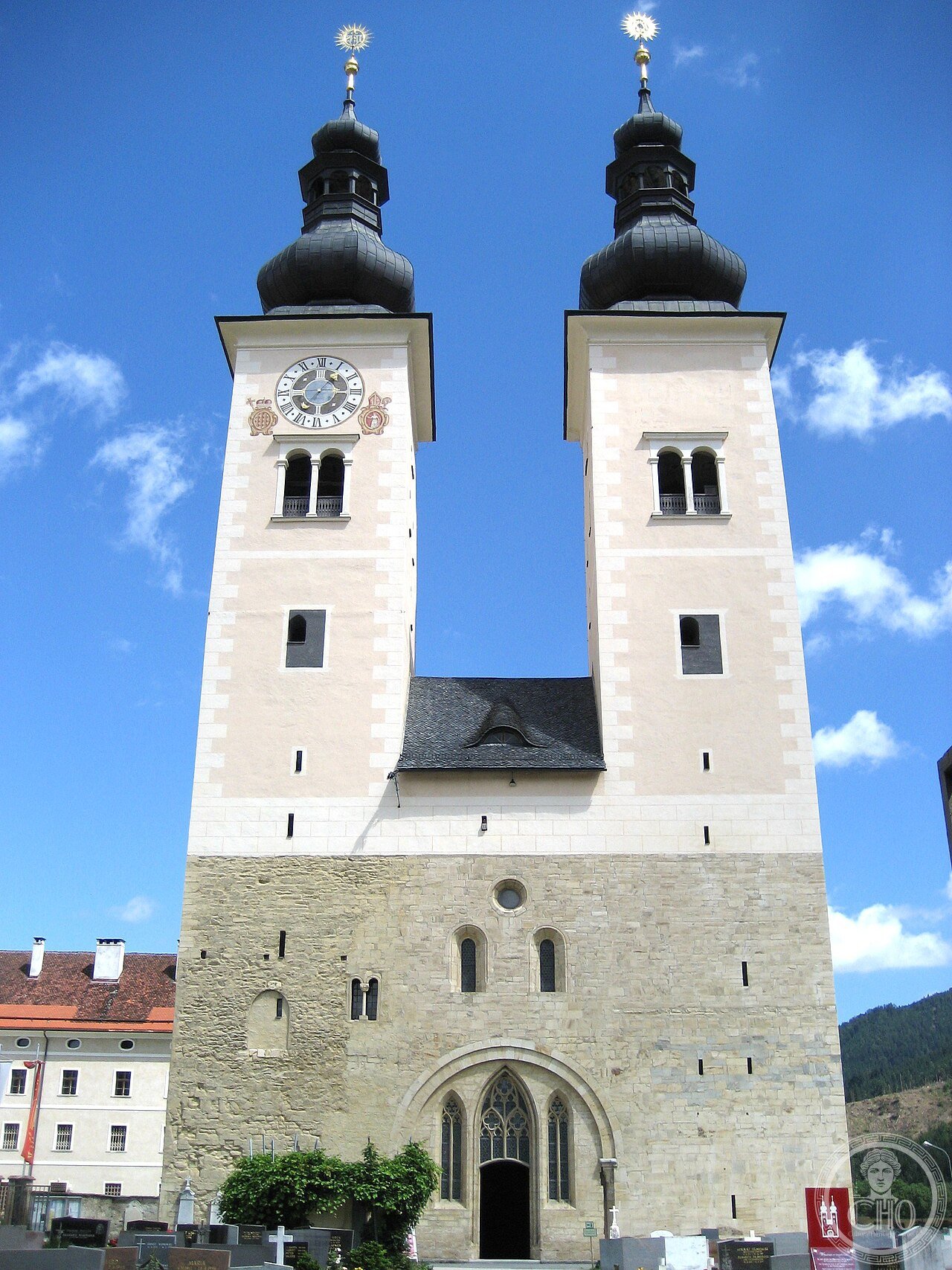
Around 1070 Archbishop Gebhard of Salzburg dissolved the Benedictine convent for women founded in 1043 by Emma of Gurk, in order to fund the new diocese and the building of the cathedral. At the consecration of 1174 the tomb of the founder was moved here, above the hundred-column crypt that visitors still call “the stone forest”.
About Gurk Cathedral
Gurk Cathedral, a Romanesque pillar basilica in the Carinthian town of Gurk, is widely considered the most important Romanesque building in Austria. Built between 1140 and 1200, it served as the cathedral of the Catholic Diocese of Gurk and remains its co-cathedral today. The cathedral’s oldest part is its remarkable crypt, resting on roughly one hundred columns — ninety-six slender shafts plus two paired columns before the apse — together with six rectangular piers, carrying a steep cross-groin vault; each column’s capital is individually carved, depicting biblical scenes alongside intricate foliage motifs in a distinctive blend of narrative and purely ornamental Romanesque sculpture. Often called the “forest of stone,” the crypt is widely regarded as one of the most beautiful in Europe. The cathedral’s 1174 consecration is directly connected to Saint Hemma of Gurk: her grave was relocated here from the former Gurk Abbey, a Benedictine nunnery she had founded in 1043, which Archbishop Gebhard of Salzburg dissolved around 1070-72 specifically to fund the newly established Gurk diocese and the construction of this cathedral.
Key facts
- Construction: 1140-1200; consecrated 1174
- Significance: the most important Romanesque building in Austria
- Crypt: roughly 100 columns (96 slender shafts plus 2 paired columns) and 6 piers, cross-groin vault, individually carved capitals depicting biblical scenes and foliage; known as the “forest of stone”
- Saint Hemma of Gurk: founded a Benedictine nunnery here in 1043; dissolved c. 1070-72 by Archbishop Gebhard of Salzburg to fund the new diocese and cathedral; her grave relocated to the cathedral at its 1174 consecration
- Facade sculpture: Romanesque work from c. 1180, including a tympanum depicting Samson wrestling a lion
- Current status: co-cathedral of the Diocese of Gurk
History
Archbishop Gebhard of Salzburg’s dissolution of Hemma’s Benedictine nunnery specifically to fund the new Gurk diocese and cathedral represents a striking, well-documented instance of one woman’s religious foundation being repurposed — not destroyed but reallocated — into an entirely new and more institutionally significant ecclesiastical structure, with the founder’s own remains eventually returning to consecrate the new building that had, in a real sense, been built on her original foundation’s resources. Hemma of Gurk’s subsequent canonisation and enduring status as one of Carinthia’s most venerated regional saints gives the cathedral’s connection to her a genuinely continuous devotional significance from the 11th century into the present, her pilgrimage cult remaining active at Gurk today.
The crypt’s hundred individually carved column capitals, each depicting distinct biblical scenes or ornamental foliage rather than a single repeated design, represent an exceptionally labour-intensive sculptural programme even by the standards of major Romanesque ecclesiastical building projects, reflecting the substantial resources the new diocese commanded in its foundational decades. The crypt’s popular nickname, the “forest of stone,” while a modern rather than medieval description, captures accurately the specific visual and spatial effect of moving through a dense, low-vaulted underground space supported by such an unusually large number of slender columns — an architectural experience genuinely distinct from the sparser column arrangements typical of most contemporary European crypts.
What you see
The crypt, with its hundred individually carved columns supporting a cross-groin vault, is the cathedral’s essential single destination, offering an architectural and sculptural experience with few direct parallels among European Romanesque crypts. The facade’s c. 1180 Romanesque sculpture, including the Samson-and-lion tympanum, rewards close attention before entering. Saint Hemma’s grave, relocated here at the 1174 consecration, extends the site’s devotional significance directly into the present as an active regional pilgrimage destination.
Practical information
- Opening hours: generally open daily, check current hours before visiting; crypt and cathedral typically have combined admission
- Address: Domplatz 1, 9342 Gurk, Austria
Getting there
Gurk is reachable by regional bus from Klagenfurt (approximately 1 hour) or St. Veit an der Glan. By car, Gurk sits on the B93/B317 road network in Carinthia. The cathedral stands at the centre of the small town. GPS: 46.8748° N, 14.2933° E.
Nearby
- Strassburg Castle — a nearby former bishop’s residence, a short drive from Gurk
- Klagenfurt — approximately 1 hour away; Carinthia’s state capital
- Gurktal Alps — the surrounding mountain range, popular for hiking
Sources
- Wikipedia — “Gurk Cathedral” (en.wikipedia.org)
- Ancient History Sites — “Gurk Cathedral: A Romanesque Cathedral and Diocesan Seat in Carinthia” (ancient-history-sites.com)
- Sacred Destinations — “Gurk Cathedral” (sacred-destinations.com)
Find it on the map
See this place and what’s around it →📷 Become a Cultural Heritage Online photographer
Share your photos of places: they stay published under your name as the author. The more they're seen, the more you get noticed — and soon a contest will reward the most appreciated photos.
Log in or sign up free to add a photo