
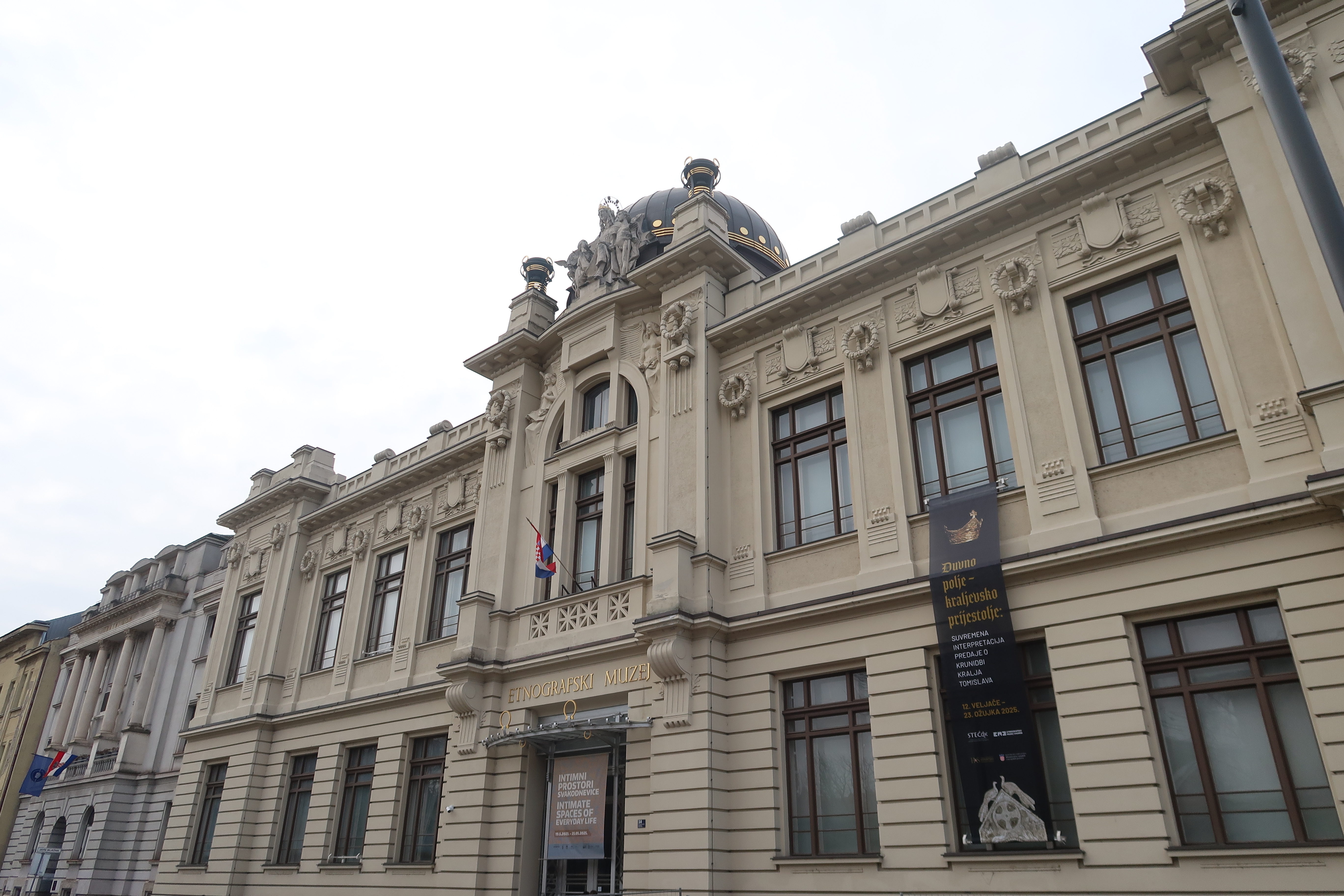
A repository of Croatian folk life housed in a 1903 Secession masterpiece, its 80,000 artifacts span three cultural zones and illuminate centuries of tradition across the Pannonian, Dinaric, and Adriatic regions.
At a glance
The museum occupies the former Trades Hall, a Secession building designed by Vjekoslav Bastl with sculptures by Rudolf Valdec and interior frescoes by Oton Iveković. Founded in 1919 by Salamon Berger, it presents approximately 2,800 items from a collection of 80,000, spanning Croatian ethnographic heritage and non-European cultures.
History
Salamon Berger established the museum in 1919, recognizing the urgency of documenting Croatia’s vanishing folk traditions. The institution found its permanent home in 1903’s Trades Hall, a striking example of early-twentieth-century Central European architecture. The building itself became as significant as its contents.
What you see
The Secession façade commands attention through Valdec’s sculptural work at its center. Inside, Iveković’s frescoes ornament the cupola, framing displays of embroidered costumes, ceremonial dress, and traditional implements. Two interconnected buildings house permanent exhibitions recreating Ottoman-era interiors, including rooms of birth and death, alongside jewelry, pottery, and weaponry. The museum also contains substantial collections from Latin America, Central Africa, India, Melanesia, Polynesia and Australia.
Cultural significance
The collection divides Croatian heritage into three distinct zones, each reflecting regional identity and practice. Exhibits illuminate the daily rhythms of farmers and fishermen through reconstructed domestic spaces and tools. The Ljeposav Perinić collection of dressed dolls preserves costume traditions for future generations. The museum’s thematic focus on birth, life, death and heritage positions ethnography as a circle rather than linear narrative.
Key facts
- Location: 14 Ivan Mažuranić Square, Donji grad, Zagreb, Croatia
- Coordinates: 45.808°N, 15.967°E
- Founded: 1919 by Salamon Berger
- Building: 1903 Secession structure designed by Vjekoslav Bastl
- Collection size: 80,000 items; approximately 2,800 on display
- Organized by three cultural zones: Pannonian, Dinaric, Adriatic
Practical information & getting there
The museum is located in central Zagreb’s Donji grad district at 14 Ivan Mažuranić Square. English-speaking guides are available to enhance your visit with deeper context and interpretation of the collections and regional history.
Sources & resources
Find it on the map
See this place and what’s around it →📷 Become a Cultural Heritage Online photographer
Share your photos of places: they stay published under your name as the author. The more they're seen, the more you get noticed — and soon a contest will reward the most appreciated photos.
Log in or sign up free to add a photoIs this page about you?
This page is read by travellers and heritage enthusiasts who find it on Google. Tell us how you are connected to this place and we will take it from there.