
Nel 1534, durante il dominio anabattista sulla città, l’orologio astronomico originale del 1408 fu distrutto insieme a numerose immagini sacre. Riconquistata Münster nel 1535, il capitolo del duomo fece installare tra il 1540 e il 1542 il nuovo orologio rinascimentale che ancora oggi scorre in senso antiorario, seguendo il percorso apparente del sole.
About Münster Cathedral
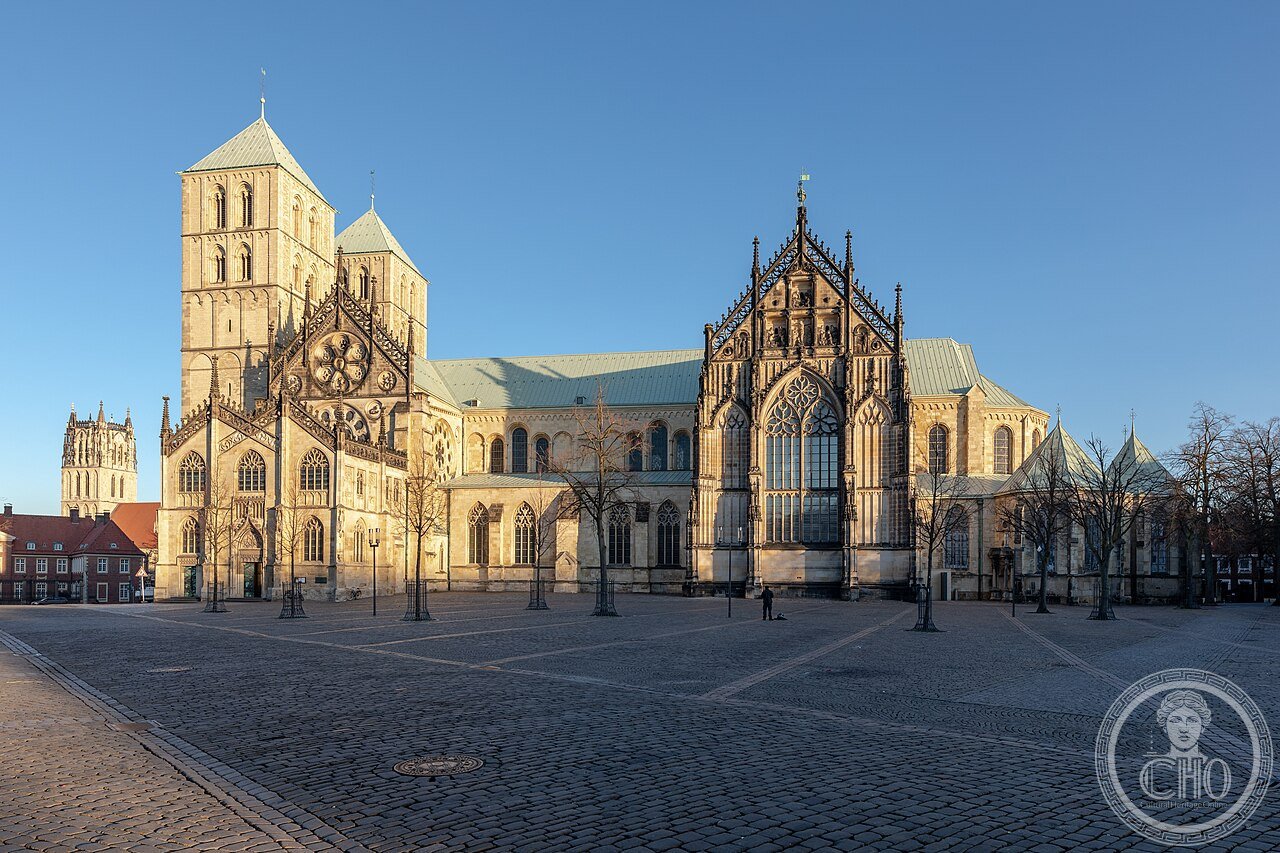
Münster Cathedral (St.-Paulus-Dom) has been the seat of the Diocese of Münster since its founding in 805, and the present building is the third cathedral on this site. Its Romanesque westwerk, with twin towers, was constructed around 1192 and incorporated directly into the later Gothic structure; the foundation stone for the third and current cathedral was laid in 1225, and the building was completed and consecrated on 30 September 1264 after nearly four decades of construction. The result is a domed basilica with double transepts in Gothic style, roughly 109 metres long with a 28.3-metre-wide nave, surrounded at the choir by a ring of chapels, its two west towers — the north 57.7 metres tall, the south 55.5 metres — each containing stacked chapels. During the radical Anabaptist takeover of Münster in 1534-1535, when Jan van Leiden and his followers sought to establish a millennialist “New Jerusalem” in the city, iconoclastic destruction swept through the cathedral, destroying numerous images and figures including the original astronomical clock of 1408. Prince-Bishop Franz von Waldeck besieged the city for sixteen months before retaking it in June 1535, with the Anabaptist leaders executed in 1536. Between 1540 and 1542, a new Renaissance astronomical clock was installed on the cathedral’s west wall: a 24-hour dial that runs counter-clockwise, following the sun’s apparent path, with automata figures of Death and Chronos chiming every quarter hour and the Three Magi processing around the Virgin and Child at noon. Severely damaged by WWII bombing, the cathedral was restored between 1946 and 1956.
Key facts
- Diocesan seat: since 805; present building is the third cathedral on the site
- Romanesque westwerk: built c. 1192, twin towers, incorporated into the later Gothic structure
- Third cathedral: foundation stone 1225, consecrated 30 September 1264
- Dimensions: c. 109 m long, 28.3 m nave width; north tower 57.7 m, south tower 55.5 m
- 1534-1535 Anabaptist rule: iconoclasm destroyed the cathedral’s 1408 astronomical clock and numerous images; city retaken by Prince-Bishop Franz von Waldeck after a 16-month siege, leaders executed 1536
- Astronomical clock: new Renaissance clock installed 1540-1542; 24-hour counter-clockwise dial, automata of Death and Chronos, noon procession of the Three Magi
- WWII and restoration: severely damaged by bombing; restored 1946-1956
History
The 1534-1535 Anabaptist episode that damaged the cathedral was one of the most dramatic and violent religious upheavals of the Reformation era: Jan van Leiden’s attempt to establish a communal, polygamous “New Jerusalem” governed by Old Testament law provoked a sixteen-month siege by Prince-Bishop Franz von Waldeck’s combined Catholic and Lutheran forces, ending in the city’s brutal recapture and the public execution of the movement’s leaders, whose bodies were subsequently displayed in iron cages hung from the tower of Münster’s nearby Lambertikirche — cages that remain visible today as one of the city’s most macabre historical memorials, distinct from the cathedral itself but part of the same episode’s physical legacy across Münster.
The 1540-1542 replacement astronomical clock, commissioned in the immediate aftermath of this trauma, represents a deliberate act of institutional restoration and renewed civic-religious confidence following the Anabaptist interlude, its elaborate counter-clockwise mechanism and automata figures reflecting the same broader European Renaissance fascination with astronomical clockwork visible at comparable installations in Prague, Strasbourg, and elsewhere — monumental public timepieces that combined genuine astronomical science with didactic religious allegory (Death’s chime, the Magi’s procession) intended to reassert both scientific sophistication and orthodox Christian meaning after a period of radical doctrinal upheaval.
What you see
The Renaissance astronomical clock, on the cathedral’s west wall, is the essential single destination for visitors, its counter-clockwise 24-hour dial and quarter-hourly automata rewarding a timed visit around the hour to catch the mechanism in motion. The Romanesque westwerk, dating to around 1192 and incorporated into the later Gothic body, offers a legible architectural seam between the cathedral’s earliest and latest medieval building phases. The ring of chapels surrounding the choir, and the double transepts of the Gothic plan, extend the building’s spatial complexity well beyond a typical single-nave church.
Practical information
- Opening hours: generally open daily, check current hours before visiting; free admission
- Address: Domplatz 28, 48143 Münster
Getting there
Münster has direct rail connections from Dortmund (approximately 45 minutes) and Osnabrück (approximately 35 minutes). By car, Münster sits on the A1/A43 motorway network. The cathedral stands on Domplatz in the historic centre. GPS: 51.9631° N, 7.6258° E.
Nearby
- St. Lambert’s Church (Lambertikirche) — a short walk away; the three iron cages of the executed Anabaptist leaders still hang from its tower
- Münster Rathaus — the historic town hall, site of the 1648 Peace of Westphalia negotiations
- Münster old town — surrounding Domplatz, a well-preserved historic centre known for its cycling culture
Sources
- Wikipedia — “Münster Cathedral” and “Münster astronomical clock” (en.wikipedia.org)
- The Catholic Travel Guide — “Münster Cathedral (St.-Paulus-Dom)” (thecatholictravelguide.com)
- From Place to Place — “St. Paul’s Cathedral and the astronomical clock” (fromplacetoplace.travel)
Find it on the map
See this place and what’s around it →📷 Become a Cultural Heritage Online photographer
Share your photos of places: they stay published under your name as the author. The more they're seen, the more you get noticed — and soon a contest will reward the most appreciated photos.
Log in or sign up free to add a photo