
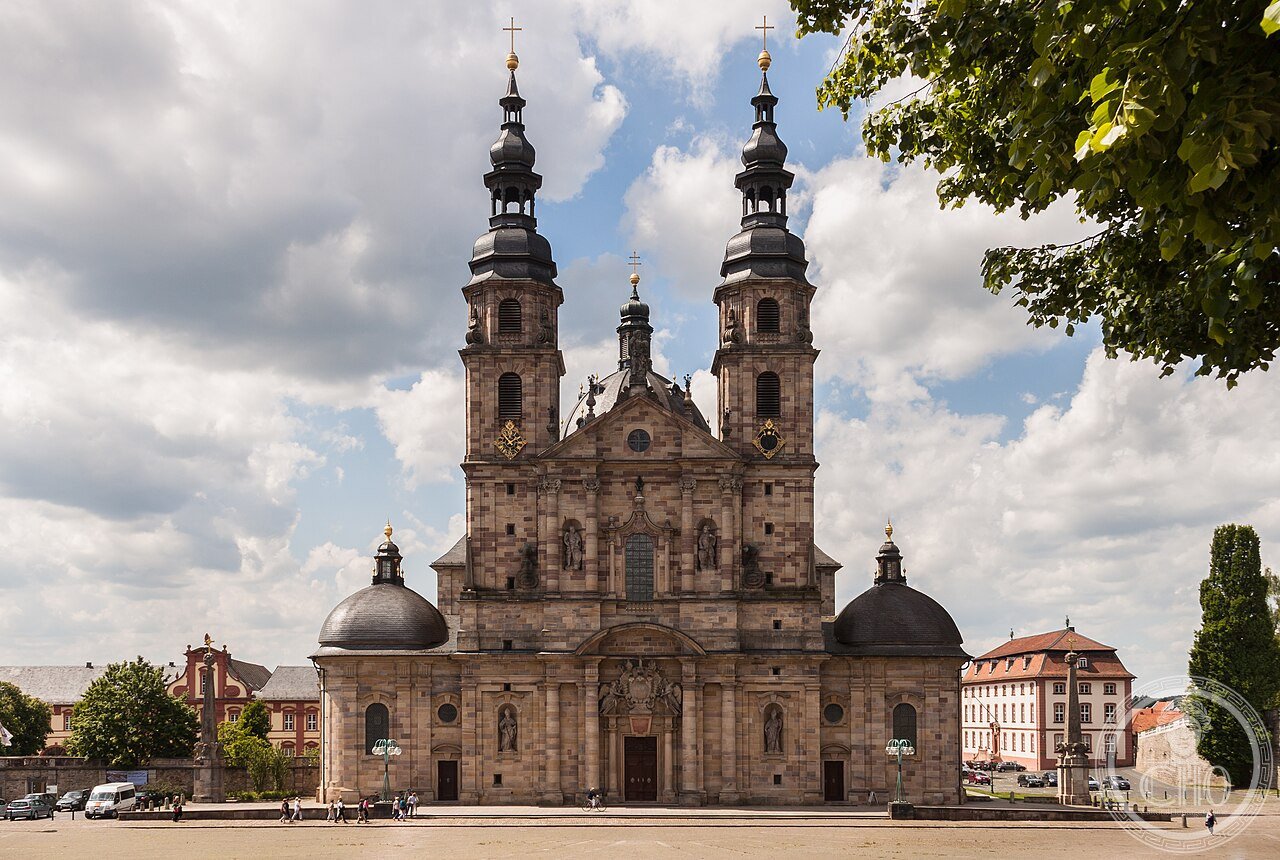
When pagan Frisians killed the missionary Boniface in 754, his companions carried his body to the monastery he had himself founded a decade earlier, in the great forest of Buchonia. On the site of Ratgar’s ancient basilica — once the largest north of the Alps — stands today the Baroque cathedral built by Johann Dientzenhofer between 1704 and 1712, still the keeper of the saint’s tomb.
About Fulda Cathedral
Fulda Cathedral (Dom St. Salvator) stands on the site of the Ratgar Basilica, once the largest basilica north of the Alps and the original burial place of Saint Boniface, the “Apostle of the Germans,” and the church of Fulda Abbey. When Boniface was martyred by pagan Frisians in 754, his companions carried his body to the monastery he had founded a decade earlier in the great forest of Buchonia. Construction of the present Baroque cathedral began on 23 April 1704 to plans by Johann Dientzenhofer, one of the greatest German Baroque architects, commissioned by Prince-Abbot Adalbert von Schleifras; the building’s shell was complete by 1707, its roof by 1708, and the interior by 1712, when the new abbey church was dedicated on 15 August of that year. Like its predecessor, the new Baroque building served both as abbey church and as the burial shrine of Saint Boniface, and in 1752 it was elevated to cathedral status upon the creation of the Diocese of Fulda. Today, the Boniface Chapel in the crypt houses the saint’s remains in a sarcophagus with relief carving and an antependium by Johann Neudecker, and the cathedral remains the high point of Fulda’s Baroque district and a defining symbol of the town.
Key facts
- Predecessor: Ratgar Basilica, once the largest basilica north of the Alps, original burial site of Saint Boniface
- Saint Boniface: “Apostle of the Germans,” martyred by pagan Frisians in 754; body carried by his companions to the Fulda monastery he had founded a decade earlier
- Baroque construction: begun 23 April 1704, architect Johann Dientzenhofer, commissioned by Prince-Abbot Adalbert von Schleifras; shell complete 1707, roof 1708, interior and dedication 15 August 1712
- Cathedral status: conferred 1752 with the creation of the Diocese of Fulda
- Boniface Chapel crypt: houses the saint’s sarcophagus, with relief carving and antependium by Johann Neudecker
- Architectural role: the high point of Fulda’s Baroque district, a defining symbol of the town
History
Boniface’s 754 martyrdom by Frisian pagans, and the immediate decision by his companions to carry his body back to the Fulda monastery he had founded around 744, established the site’s enduring significance as a pilgrimage destination centuries before the present Baroque building existed — the original Ratgar Basilica’s status as the largest basilica north of the Alps reflecting the sheer scale of veneration Boniface’s cult attracted across the early medieval German Church, given his central historical role in converting and organising Christianity across much of Germany during the 8th century. The complete replacement of that early medieval basilica with an entirely new Baroque structure in the early 18th century, rather than incremental modification, reflects the considerable wealth and architectural ambition Fulda Abbey commanded under Prince-Abbot Adalbert von Schleifras, whose commission of Johann Dientzenhofer — a member of the prolific Dientzenhofer family of Baroque architects active across Bohemia and Franconia — secured one of the era’s most accomplished designers for the project.
The cathedral’s 1752 elevation to full cathedral status, formalising a diocese around an institution whose religious significance long predated any formal episcopal structure, exemplifies a broader pattern in which major medieval pilgrimage and monastic sites gradually acquired more formal ecclesiastical administrative status as their practical religious importance was retrospectively recognised through official diocesan reorganisation. Boniface’s continuing physical presence in the crypt throughout this architectural transformation — from Ratgar Basilica through Baroque rebuilding to modern cathedral status — gives Fulda an unusually continuous, nearly 1,300-year unbroken chain of pilgrimage veneration centred on a single, precisely identified burial site.
What you see
The Boniface Chapel crypt, with its sarcophagus, relief carving, and antependium by Johann Neudecker, is the cathedral’s essential destination for visitors specifically interested in the saint’s burial site and its centuries of continuous veneration. Dientzenhofer’s Baroque design, complete with its characteristic period ornamentation and spatial ambition, offers a striking architectural counterpoint to the vanished early medieval Ratgar Basilica it replaced. The cathedral’s position at the heart of Fulda’s Baroque quarter situates it within one of Germany’s more architecturally coherent 18th-century urban ensembles.
Practical information
- Opening hours: generally open daily, check current hours before visiting; free admission
- Address: Domplatz 1, 36037 Fulda
Getting there
Fulda has direct ICE rail connections from Frankfurt (approximately 1 hour) and Berlin (approximately 2.5 hours). By car, Fulda sits on the A7/A66 motorway network. The cathedral stands on Domplatz in Fulda’s Baroque historic centre. GPS: 50.5541° N, 9.6719° E.
Nearby
- Fulda Baroque quarter — surrounding Domplatz; the Stadtschloss (city palace) and Orangerie form part of the same ensemble
- Michaelskirche — a short walk away; a Carolingian rotunda church, one of the oldest surviving buildings in Germany
- Rhön Biosphere Reserve — a UNESCO biosphere reserve within easy reach of Fulda
Sources
- Wikipedia — “Fulda Cathedral” (en.wikipedia.org)
- The Catholic Travel Guide — “Fulda: The Fulda Cathedral” (thecatholictravelguide.com)
- SpottingHistory — heritage documentation (spottinghistory.com)
Find it on the map
See this place and what’s around it →Events here — now on & upcoming
- Feast of Saint Boniface — June 505 Jun 2027See the event →
📷 Become a Cultural Heritage Online photographer
Share your photos of places: they stay published under your name as the author. The more they're seen, the more you get noticed — and soon a contest will reward the most appreciated photos.
Log in or sign up free to add a photo