
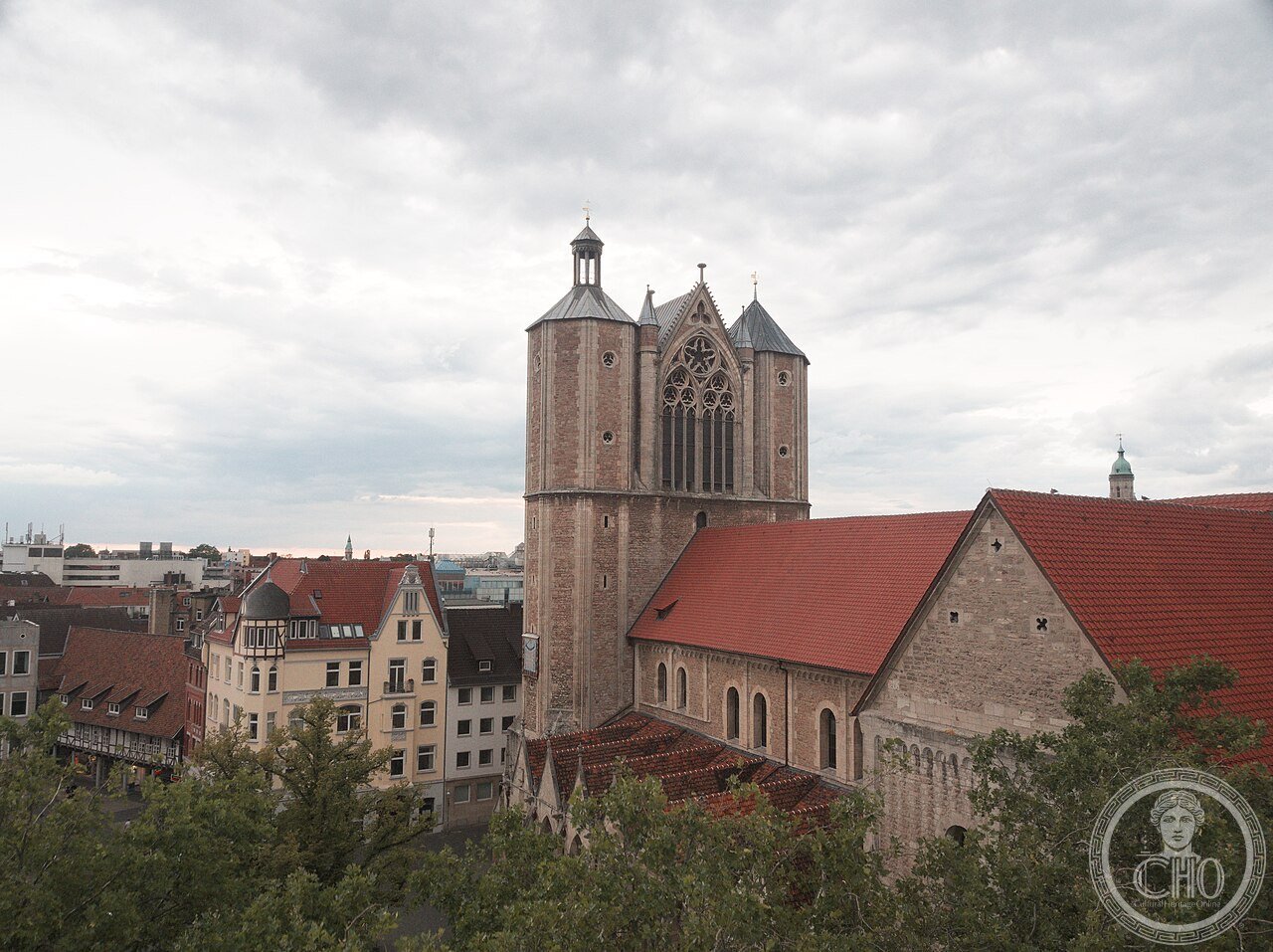
Enrico il Leone, duca di Sassonia e Baviera, fondò questa chiesa collegiata come segno del proprio potere. I lavori, avviati nel 1173, furono ripetutamente interrotti dai suoi esili politici: Enrico e la moglie Matilde di Sassonia furono sepolti in una chiesa ancora incompiuta, consacrata solo nel 1226, ben dopo la loro morte.
About Brunswick Cathedral
Brunswick Cathedral (Dom St. Blasii), a large Romanesque basilica on Burgplatz adjacent to Dankwarderode Castle in Braunschweig, was founded by Henry the Lion, Duke of Saxony and Bavaria, as a collegiate church built between 1173 and 1195 and dedicated to Saints Blaise, John the Baptist, and Thomas Becket. Construction was disrupted several times during Henry the Lion’s various political exiles, so severely that he and his consort Matilda, Duchess of Saxony, were both ultimately buried in a still-unfinished church — the building was not formally consecrated until 1226, years after their deaths. Among its most significant surviving treasures are a wooden crucifix carved by Master Imervard in the second half of the 12th century, one of very few surviving large bronze seven-armed candlesticks from around the 1170s, and the Altar of the Virgin Mary, consecrated at the end of the 12th century and considered one of the oldest surviving parts of the building. Directly outside, on Burgplatz, stands a replica of the celebrated Brunswick Lion, the bronze monument Henry the Lion commissioned in the 12th century as a public sign of his ducal power and jurisdiction — the original is preserved inside neighbouring Dankwarderode Castle.
Key facts
- Foundation: collegiate church founded by Henry the Lion, Duke of Saxony and Bavaria; built 1173-1195; consecrated 1226
- Dedication: Saints Blaise, John the Baptist, and Thomas Becket
- Ducal tomb: Henry the Lion and his consort Matilda, Duchess of Saxony, buried here before the church’s consecration
- Imervard Crucifix: wooden crucifix carved by Master Imervard, second half of the 12th century
- Bronze seven-armed candlestick: one of very few surviving examples of its kind, c. 1170s
- Altar of the Virgin Mary: consecrated late 12th century; one of the oldest surviving parts of the building
- Brunswick Lion: replica bronze monument by Henry the Lion on Burgplatz outside the cathedral; the 12th-century original is in Dankwarderode Castle
History
Henry the Lion’s foundation of this collegiate church as a deliberate statement of ducal power situates the building directly within the broader pattern of his territorial and ecclesiastical self-assertion across Saxony during the same period that saw him refound the episcopal seat of Ratzeburg and sponsor numerous other churches and towns across northern Germany. The repeated construction disruptions caused by his political exiles — including his prolonged 1180s banishment following his refusal to support Emperor Frederick Barbarossa’s Italian campaigns, a conflict that cost Henry much of his territorial power — meant that the church he founded as a monument to his authority remained unfinished at the time of his own death and burial within it, a genuinely poignant historical irony given the building’s original commemorative and self-glorifying purpose.
The eventual 1226 consecration, decades after construction began and years after Henry the Lion’s 1195 death, reflects how major medieval ecclesiastical building projects frequently outlived their founders, with successor patrons and church authorities completing work according to evolving means and priorities rather than a single unified original vision. The cathedral’s surviving 12th-century treasures — the Imervard Crucifix, the bronze candlestick, and the Altar of the Virgin Mary — collectively represent a remarkably intact body of Romanesque ecclesiastical art surviving from the church’s earliest decades, giving Brunswick Cathedral an unusually rich material record of its founding period despite the building’s own troubled construction history.
What you see
The tomb of Henry the Lion and Matilda, at the heart of the cathedral, is the essential destination for visitors specifically interested in the building’s ducal founding history, its continuing prominence within the church a direct physical reminder of the unfinished state in which the couple were originally buried. The Imervard Crucifix, the bronze seven-armed candlestick, and the Altar of the Virgin Mary together offer a dense concentration of well-preserved 12th-century Romanesque ecclesiastical art rarely found together in a single building. Outside on Burgplatz, the replica Brunswick Lion — with the original viewable in adjacent Dankwarderode Castle — extends the site’s connection to Henry the Lion beyond the cathedral’s own walls.
Practical information
- Opening hours: generally open daily, check current hours before visiting; free admission
- Address: Burgplatz 7, 38100 Braunschweig
Getting there
Braunschweig has direct rail connections from Hanover (approximately 35 minutes) and Berlin (approximately 1.5 hours). By car, Braunschweig sits on the A2/A39 motorway network. The cathedral stands on Burgplatz in the historic centre, beside Dankwarderode Castle. GPS: 52.2642° N, 10.5239° E.
Nearby
- Dankwarderode Castle — directly adjacent, former residence of Henry the Lion, housing the original Brunswick Lion bronze
- Braunschweig historic centre — surrounding Burgplatz; extensive half-timbered architecture and the Altstadtmarkt
- Hanover — approximately 35 minutes by train; Lower Saxony’s state capital
Sources
- Wikipedia — “Brunswick Cathedral” (en.wikipedia.org)
- Places of Germany — “Brunswick Cathedral St. Blasii: Romanesque beauty and royal tomb” (placesofgermany.de)
- Places of Germany — “Braunschweig Lion Monument” (placesofgermany.de)
Find it on the map
See this place and what’s around it →📷 Become a Cultural Heritage Online photographer
Share your photos of places: they stay published under your name as the author. The more they're seen, the more you get noticed — and soon a contest will reward the most appreciated photos.
Log in or sign up free to add a photo