
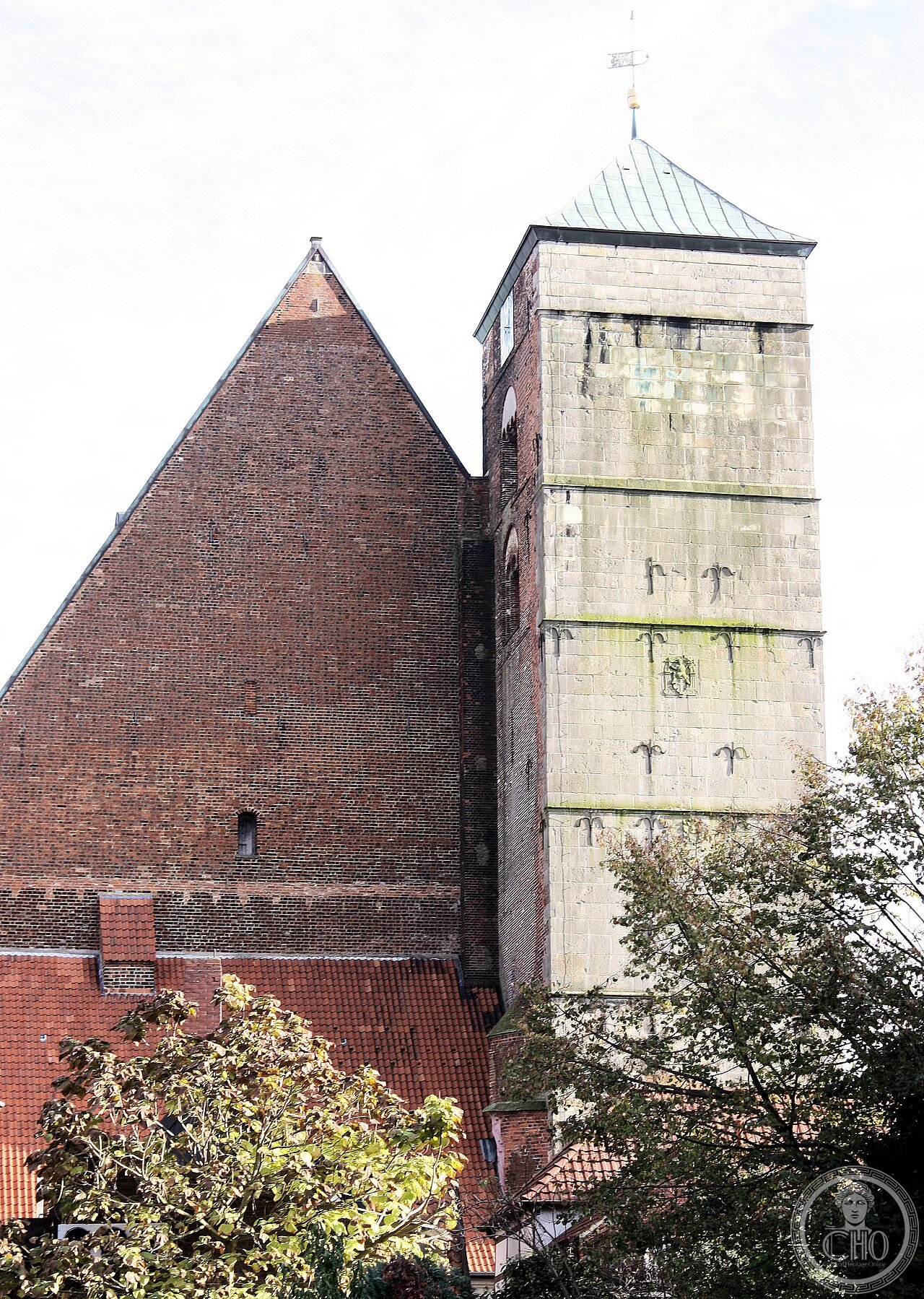
Una chiesa carolingia sorgeva qui già nell’814, sede vescovile dall’849. Distrutta da un incendio nel 1268 insieme al chiostro, fu ricostruita a partire dal 1290 come sala gotica a deambulatorio — probabilmente il più antico in Germania — con lavori interrotti per 150 anni e completati solo tra il 1474 e il 1490.
About Verden Cathedral
Verden Cathedral (Dom St. Maria und Cäcilia) traces its origins to a Carolingian church built in 814, which became an episcopal seat under Bishop Walter in 849. That Romanesque basilica was destroyed, together with its cloister, by fire in 1268. Reconstruction began in 1290 as a High Gothic hall church with what is probably the oldest ambulatory choir in Germany, its first building phase (1290-1323) completing the hall ambulatory choir, transept, and first nave bay. Construction then slowed dramatically: only a provisional structure existed by 1326, after which building work paused for roughly 150 years before finally being completed between 1474 and 1490. The result is the first Gothic cathedral in Lower Saxony and the only Gothic episcopal church in the state, its design drawing architecturally on both Reims Cathedral and Minden Cathedral, and today combining Romanesque, early Gothic, and late Gothic elements within a single brick structure now used by a Protestant-Lutheran cathedral parish.
Key facts
- Earliest church: Carolingian church built 814; episcopal seat from 849 under Bishop Walter
- 1268 fire: destroyed the Romanesque basilica and cloister
- Gothic reconstruction: begun 1290; first phase (hall ambulatory choir, transept, first nave bay) completed 1323; work paused c. 1326-1474; final completion 1474-1490
- Architectural significance: first Gothic cathedral in Lower Saxony, only Gothic episcopal church in the state; probably the oldest ambulatory choir in Germany; modelled architecturally on Reims and Minden cathedrals
- Current status: Protestant-Lutheran cathedral parish, formerly Roman Catholic
- Nearby history: Verden an der Aller is the site of the 782 Massacre of Verden, in which Charlemagne ordered the execution of 4,500 rebelling Saxons
History
Verden’s 814 Carolingian church and 849 episcopal establishment place the site within the same broad Frankish Christianisation of Saxony that produced, just three decades earlier in 782, the notorious Massacre of Verden, in which Charlemagne ordered the execution of 4,500 rebelling Saxons following renewed uprisings led by the Saxon chieftain Widukind — one of the more brutal episodes of the three-decade Saxon Wars (772-804) waged to conquer Saxony and impose Christianity by force. The cathedral’s own foundation, arriving within a generation of this violence, situates Verden’s Christian institutional history directly within the aftermath of Charlemagne’s often coercive religious-political programme across Saxon territory, even though the specific 814 church and 849 bishopric represent a distinct, more settled phase of institutional consolidation rather than the active military conquest of the 780s.
The nearly two-century gap in the Gothic reconstruction’s building history — a vigorous first phase from 1290 to 1323, followed by roughly 150 years of near-total pause before final completion between 1474 and 1490 — reflects the kind of prolonged, interrupted construction timeline common to major medieval cathedral projects, where shifting finances, changing episcopal priorities, and periods of regional instability could stall even well-advanced building campaigns for generations before eventual completion. The cathedral’s architectural debt to both Reims Cathedral, one of French Gothic architecture’s most influential models, and the more regionally proximate Minden Cathedral, illustrates how German Gothic ecclesiastical architecture of this period drew simultaneously on prestigious French precedent and closer North German building traditions.
What you see
The hall ambulatory choir, probably the oldest surviving example of its type in Germany, is the cathedral’s single most architecturally significant feature, rewarding visitors with a direct encounter with an unusually early instance of a choir design later widespread across German Gothic church architecture. The building’s visible combination of Romanesque, early Gothic, and late Gothic elements offers a legible record of its interrupted, nearly two-century-long construction history. The brick Gothic exterior, characteristic of North German ecclesiastical building where stone was scarce, gives the cathedral its distinctive material character.
Practical information
- Opening hours: generally open daily, check current hours before visiting; free admission
- Address: Domgeistlichenhaus 8, 27283 Verden (Aller)
Getting there
Verden (Aller) has direct rail connections from Bremen (approximately 25 minutes) and Hanover (approximately 1 hour). By car, Verden sits on the B215/A27 road network. The cathedral stands in Verden’s historic centre. GPS: 52.9171° N, 9.2288° E.
Nearby
- Sachsenhain — a 1935 memorial grove of 4,500 stones commemorating the victims of the 782 Massacre of Verden, a short distance from the town
- German Horse Museum (Deutsches Pferdemuseum) — in Verden’s historic centre, reflecting the town’s long equestrian tradition
- Bremen — approximately 25 minutes by train; its own UNESCO World Heritage Rathaus and Roland statue
Sources
- Domgemeinde Verden — official parish history, “Der Verdener Dom” (dom-verden.de)
- SIMsKultur — “Verden Cathedral” (simskultur.eu)
- Wikipedia — “Massacre of Verden” (en.wikipedia.org); “Dom zu Verden” (de.wikipedia.org)
Find it on the map
See this place and what’s around it →📷 Become a Cultural Heritage Online photographer
Share your photos of places: they stay published under your name as the author. The more they're seen, the more you get noticed — and soon a contest will reward the most appreciated photos.
Log in or sign up free to add a photo