
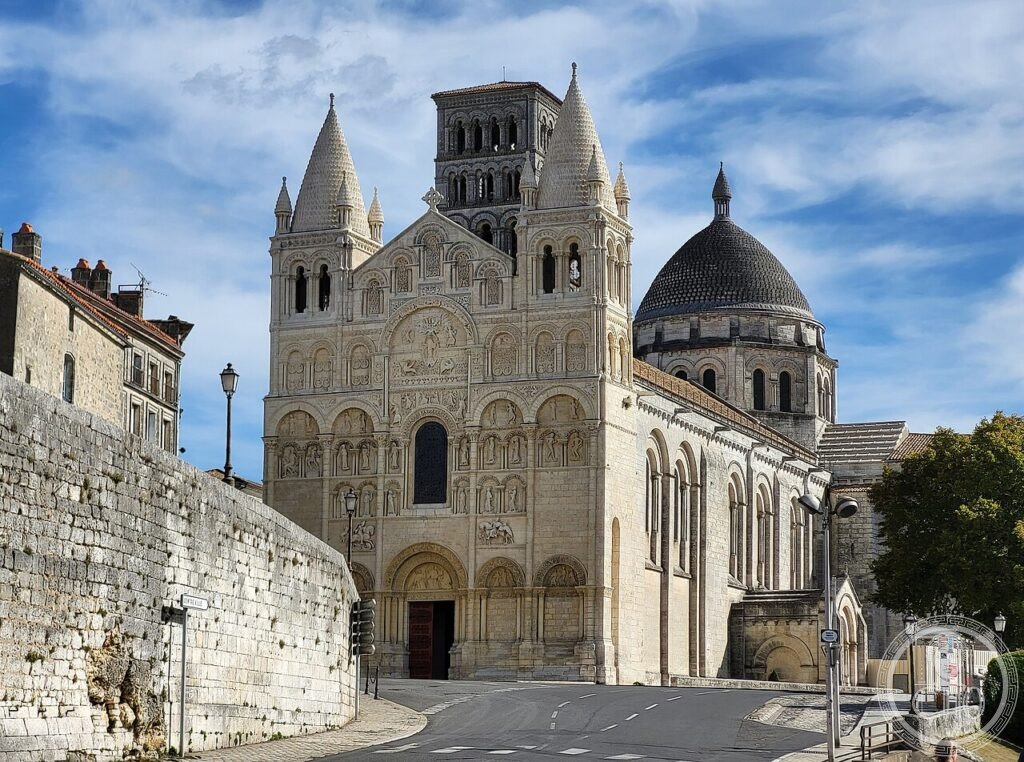
Alta circa venti metri, la facciata a schermo della cattedrale di Angoulême è un capolavoro della scultura romanica del Sud-Ovest francese: undici apostoli e la Vergine guardano verso l’Ascensione di Cristo che domina l’insieme. Nell’Ottocento fu Paul Abadie — lo stesso architetto del Sacré-Cœur di Montmartre — a restaurarla, rimuovendo le cappelle aggiunte nei secoli e rifacendo il campanile.
At a glance
Angoulême Cathedral (Cathédrale Saint-Pierre) is the work of Bishop Girard de Blaye, a powerful early-12th-century prelate who intended the building as a showcase and symbol of his own episcopal ambitions; construction ran from 1110 until Girard’s death in 1136. The cathedral’s defining feature is its west screen facade, roughly twenty metres high, articulated with arcades and populated by several dozen carved figures — a masterpiece of Romanesque sculpture from southwestern France, whose rich decorative programme is devoted to Christ triumphant and the Last Judgment: eleven apostles and the Virgin look upward toward a depiction of the Ascension of Christ that dominates the composition. In the 19th century, the cathedral owed its survival in recognisable form to architect Paul Abadie fils (1812-1884) — later renowned as the architect of the Sacré-Cœur Basilica in Montmartre, Paris — who directed a major restoration campaign from 1852 to 1875, working with Bishop Cousson’s support to return the building to its hypothesised original state by removing later chapel additions, entirely rebuilding the bell tower, and restoring the interior.
Key facts
- Construction: 1110-1136, under Bishop Girard de Blaye, who intended the cathedral as a showcase of his episcopal ambition
- West screen facade: approximately 20 metres high, arcaded, with several dozen carved figures — a masterpiece of Romanesque sculpture from southwestern France, depicting Christ triumphant and the Last Judgment
- Facade iconography: eleven apostles and the Virgin looking upward toward the Ascension of Christ, which dominates the composition
- Paul Abadie restoration: 1852-1875, architect Paul Abadie fils (later architect of the Sacré-Cœur Basilica, Montmartre), supported by Bishop Cousson; removed later chapel additions, entirely rebuilt the bell tower, restored the interior
- Restoration approach: Abadie worked to return the building to what he understood as its hypothetical original medieval state, a characteristic 19th-century Gothic/Romanesque Revival restoration philosophy
History
Bishop Girard de Blaye’s early-12th-century cathedral project reflected the broader pattern of ambitious ecclesiastical patrons across Romanesque-era France using major church-building commissions to project personal and institutional authority, and the sheer scale and sculptural richness of Angoulême’s resulting west facade — considerably more elaborate than a purely functional cathedral entrance would require — supports the specific characterisation of the project as a deliberate showcase of episcopal ambition rather than only a practical response to liturgical need. The facade’s iconographic programme, centred on Christ’s triumphant Ascension witnessed by the apostles and the Virgin, situates the building within the broader tradition of Romanesque sculptural facades across southwestern France that used monumental relief carving to communicate core theological narratives directly and legibly to a largely non-literate medieval public approaching the church from the street.
Paul Abadie’s mid-19th-century restoration campaign, running from 1852 to 1875, exemplifies both the considerable scale of intervention that major French Gothic and Romanesque Revival restoration projects of the period often involved and the specific reputational trajectory such restoration work could bring an architect: Abadie’s work at Angoulême, undertaken years before his most famous later commission, the Sacré-Cœur Basilica overlooking Paris from Montmartre, established him as a leading figure in French ecclesiastical restoration and completion practice, working in the tradition — associated above all with Eugène Viollet-le-Duc — of restoring historic buildings not merely to arrest further decay but to an actively reconstructed, idealised version of their presumed original medieval state, including the wholesale rebuilding of elements, like Angoulême’s bell tower, that 19th-century architects judged to have departed too far from their historic form.
What you see
The west screen facade remains the cathedral’s essential single artwork, its densely populated sculptural programme — the Ascension of Christ at the summit, apostles and the Virgin arranged below in attitudes of upward attention, framed within the facade’s arcaded structure — rewarding slow, deliberate viewing from the square below. The bell tower, entirely rebuilt under Abadie’s 19th-century restoration, gives the cathedral’s silhouette its present form, a direct product of his particular restoration philosophy rather than a survival of the original 12th-century structure. Inside, the building’s Romanesque nave and later restoration work together present a coherent, if partly 19th-century-reconstructed, medieval architectural character.
Practical information
- Opening hours: open daily, generally 9:00-18:00 (check current hours, particularly given any ongoing restoration work)
- Admission: free
- Address: Rue du Minage, 16000 Angoulême
Getting there
Angoulême has direct TGV rail connections from Paris (approximately 2 hours) and Bordeaux (approximately 45 minutes). By car, Angoulême sits on the A10 motorway (Paris-Bordeaux). The cathedral stands in the historic upper town (rempart), walkable from Angoulême station via a funicular or the town’s public lift system connecting the lower and upper town. GPS: 45.6490° N, 0.1515° E.
Nearby
- Remparts d’Angoulême — encircling the upper town around the cathedral; a walkable historic rampart circuit with views over the Charente valley
- Cité internationale de la bande dessinée et de l’image — in Angoulême; a major comic-art museum reflecting the city’s status as host of the annual Angoulême International Comics Festival
- Cognac — approximately 40 minutes by car; the historic centre of Cognac brandy production, with major distillery visits
Sources
- Angoulême Tourisme — official visitor portal, cathedral history (angouleme-tourisme.com)
- Ministère de la Culture — “Restauration de la façade occidentale de Saint-Pierre d’Angoulême” (culture.gouv.fr)
- Inventaire du patrimoine, Poitou-Charentes — “Monuments romans: Angoulême, cathédrale Saint-Pierre” (decouverte.inventaire.poitou-charentes.fr)
- Wikipedia — “Cathédrale Saint-Pierre d’Angoulême” (fr.wikipedia.org)
Find it on the map
See this place and what’s around it →📷 Become a Cultural Heritage Online photographer
Share your photos of places: they stay published under your name as the author. The more they're seen, the more you get noticed — and soon a contest will reward the most appreciated photos.
Log in or sign up free to add a photoIs this page about you?
This page is read by travellers and heritage enthusiasts who find it on Google. Tell us how you are connected to this place and we will take it from there.