
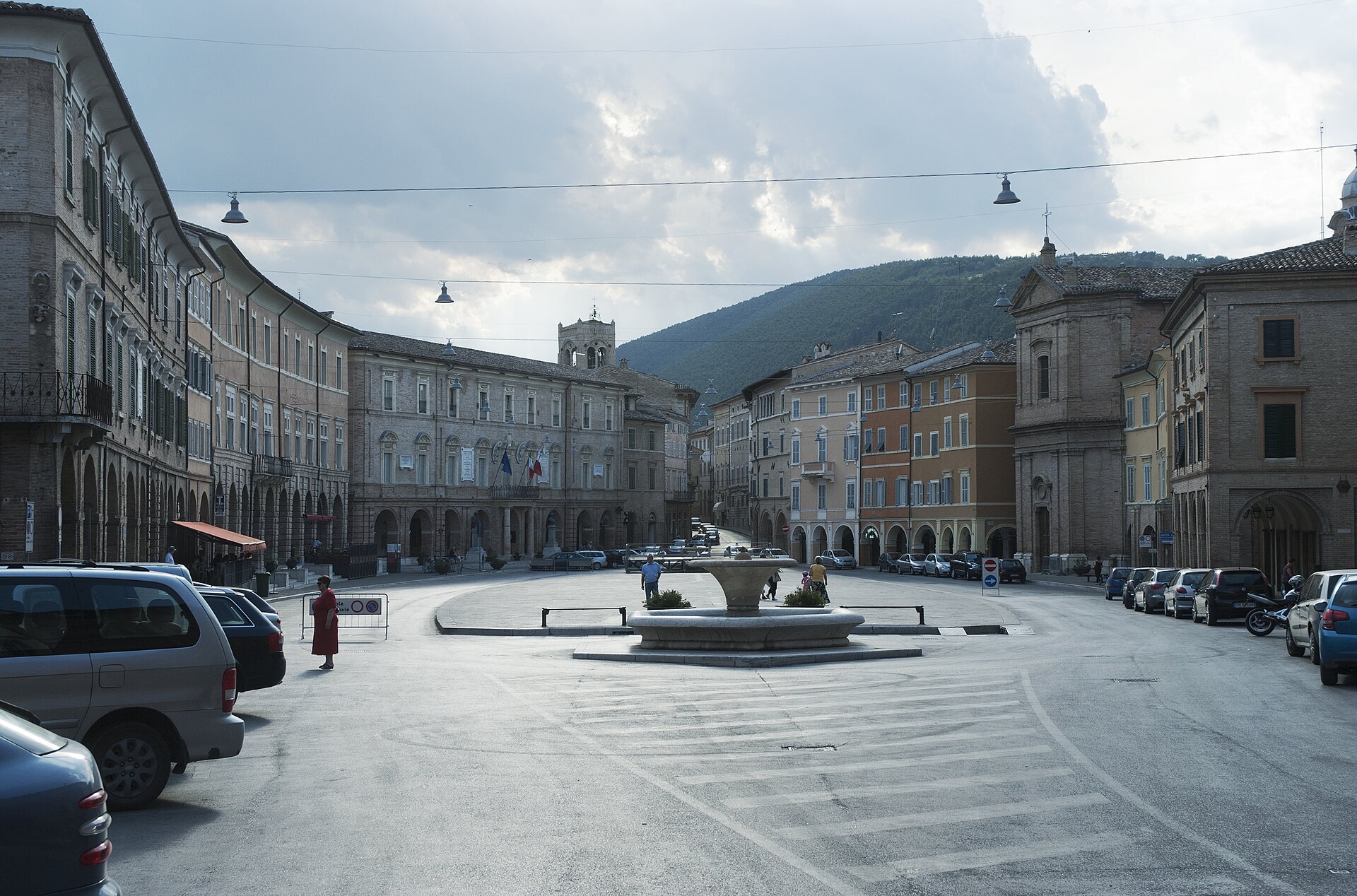
A noble palace of 1524 on Piazza del Popolo in San Severino Marche, with a frescoed family chapel, a ballroom and the founder’s Latin inscription on its front.
At a glance
Palazzo Gentili is a sixteenth-century noble palace on Piazza del Popolo in San Severino Marche, province of Macerata. The national heritage catalogue lists it as Palazzo Gentili di Rovellone, a protected private building. It now holds suites and hosts weddings.
History
A Latin inscription above the windows of the main front records its founding: FRANCISCUS DE GENTILIBUS SIBI POSTERISQUE MDXXIIII. Francesco Gentili built the palace in 1524, for himself and his descendants. According to the owners’ description, he had moved his family here from the area around Fabriano. The national catalogue credits the work to local sixteenth-century builders.
The family chapel is dedicated to Blessed Camilla Gentili, killed by her husband Battista Santucci and beatified by Pope Gregory XVI in 1841. The palace went through a ten-year restoration, four years of it on the frescoes. It ran as a hotel and wellness centre from 2016 to 2021; in 2024 the Ciriaci family, its owners, marked its 500th year with a plaque.
What you see
Built mainly of brick, the palace meets the square with a portico on pilasters, and a public passage runs beneath it under a brick barrel vault. The arched main door is framed by masks by the local artist Venanzio Bigioli. A short flight of steps between four columns leads to the main stairs and the inner courtyard.
The salons of the piano nobile keep decorated ceilings and frescoed walls. The ballroom retains its tall wall mirrors and wrought-iron balcony, and upstairs the chapel is frescoed throughout by Bigioli.
Key facts
- Built: 1524, for Francesco Gentili (dated inscription on the main front)
- Protection: listed in the national catalogue of cultural heritage as Palazzo Gentili di Rovellone; private property under the Soprintendenza for Ascoli Piceno, Fermo and Macerata
- Materials: mainly brick; cross and barrel vaults, decorated ceilings on the piano nobile
- Today: suites and apartments; exclusive hire for weddings and events
- Address: Piazza del Popolo 33, 62027 San Severino Marche (MC), Italy
- GPS: 43.228975, 13.178364 · Open in Google Maps
- Website: palazzogentili.it
Practical information
Palazzo Gentili is a private residence and events venue, not a museum with regular opening hours. The interiors, chapel and ballroom are seen by guests and at booked events. Contact the owners through the official website before visiting.
Getting there
The palace stands on Piazza del Popolo, the long arcaded square at the heart of San Severino Marche, and is reached on foot from anywhere in the town centre.
See the place
Sources
- Catalogo generale dei Beni Culturali, Palazzo Gentili di Rovellone
- Il Settempedano, Piazza del Popolo, il Palazzo Gentili compie cinquecento anni (16 February 2024)
- Palazzo Gentili, official website
- Wikipedia, Camilla Gentili
Find it on the map
See this place and what’s around it →📷 Become a Cultural Heritage Online photographer
Share your photos of places: they stay published under your name as the author. The more they're seen, the more you get noticed — and soon a contest will reward the most appreciated photos.
Log in or sign up free to add a photoIs this page about you?
This page is read by travellers and heritage enthusiasts who find it on Google. Tell us how you are connected to this place and we will take it from there.