
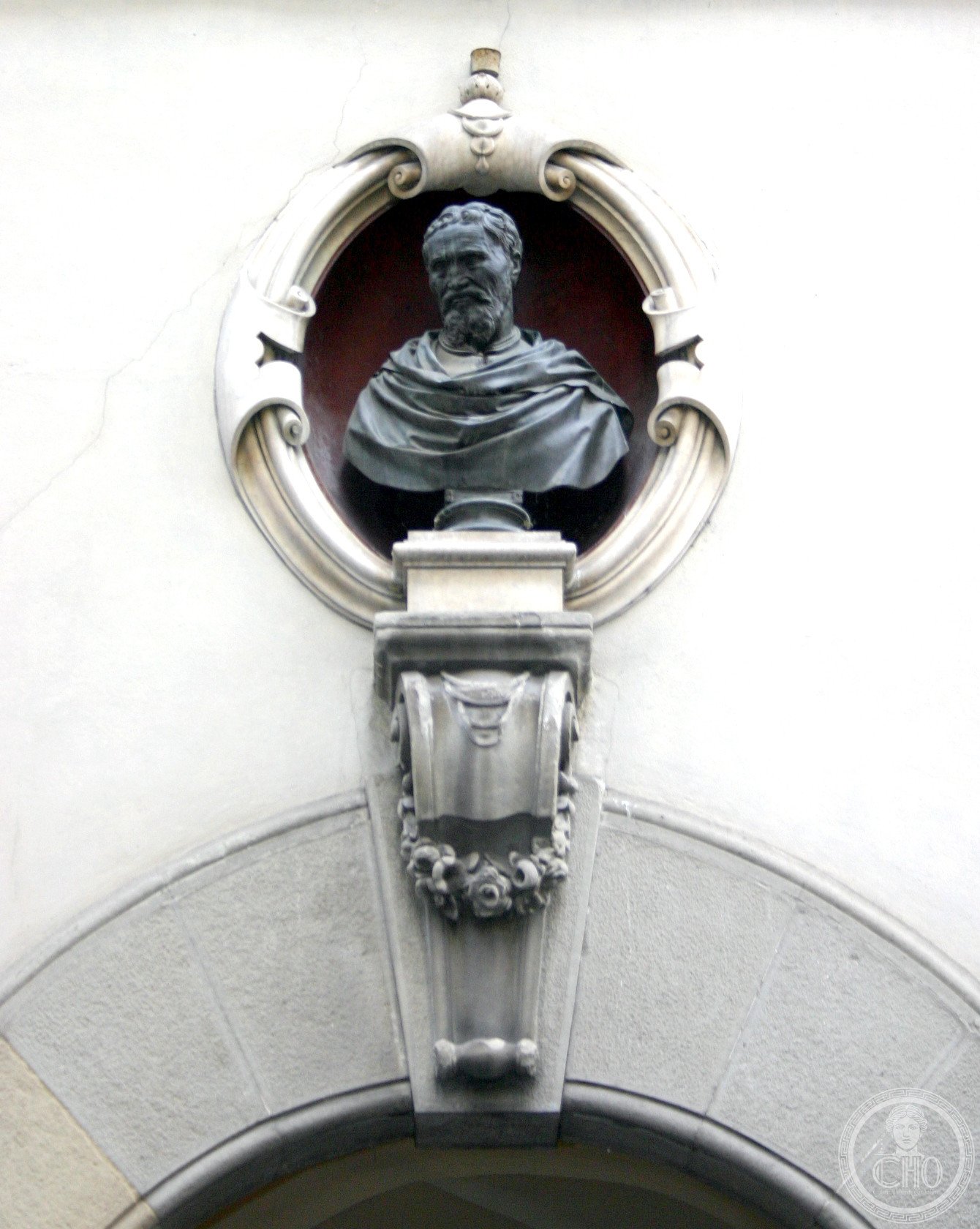
Casa Buonarroti is a museum in Florence occupying the building that Michelangelo Buonarroti purchased in 1508 and left to his heirs, which was subsequently transformed into a monument to his memory by his grandnephew Michelangelo the Younger in the early seventeenth century. The museum preserves two of Michelangelo’s earliest surviving sculptures — the Battle of the Centaurs and the Madonna of the Stairs, both carved in the 1490s while he was in the household of Lorenzo de’ Medici — alongside drawings, models, and documents that illuminate the master’s formation and working methods. A virtual tour experience now makes the collection accessible online.
At a glance
- Type
- House-museum and art museum
- Period
- Building purchased by Michelangelo in 1508; transformed into museum c.1612–1640
- Style
- Florentine Baroque interiors (Apartment of the Night, Gallery rooms)
- Location
- Via Ghibellina 70, Florence, Tuscany, Italy
Overview
Michelangelo never actually lived in the house on Via Ghibellina — he spent most of his adult life in Rome — but he bought the property and paid taxes on it for decades, and his descendants made it the physical monument of his legacy. The collection it houses is exceptional in art-historical terms: the two marble reliefs from the 1490s are among the very few uncontested early works by Michelangelo, offering direct evidence of his sculptural thinking before the commissions that made him famous. The museum also holds the wooden model for the façade of San Lorenzo — the great project of the 1510s that was never executed — and a significant group of drawings.
History
Michelangelo Buonarroti acquired the property on Via Ghibellina in 1508 as an investment and family seat, though he remained based in Rome. After his death in 1564, the property passed to his nephew Leonardo and then to Michelangelo the Younger (1568–1647), the artist’s grandnephew, who transformed the upper floor into a series of rooms celebrating his ancestor’s genius between approximately 1612 and 1640, commissioning decorative paintings from the leading Florentine painters of the day. The house became a public museum in 1859 when the last Buonarroti heir bequeathed it to the city of Florence.
What you see
The museum’s principal treasures are the two marble reliefs: the Madonna of the Stairs (c. 1490–92), a shallow relief in stiacciato technique showing the Virgin enthroned in profile, and the Battle of the Centaurs (c. 1491–92), a turbulent high-relief composition of interlocking figures that Michelangelo reportedly kept all his life and considered unfinished. The upper floor rooms retain the Baroque decorative cycle commissioned by Michelangelo the Younger, with painted ceilings and friezes celebrating episodes from the artist’s life. The wooden model for the San Lorenzo façade and a collection of drawings and prints complete the permanent display.
Cultural significance
Casa Buonarroti holds an irreplaceable position in the study of Michelangelo’s early development, housing works made before his canonical masterpieces and providing evidence of his formation in the Medici circle. For scholars of Florentine art of the 1490s, the two marble reliefs are primary documents of a formative moment in the history of Italian sculpture.
Practical information
- Address
- Via Ghibellina 70, 50122 Firenze FI, Italy
- Coordinates
- 43.7699° N, 11.2636° E
- Opening hours
- Check official website: casabuonarroti.it
- Admission
- Paid entry; reductions available; virtual tour accessible online
Getting there
Casa Buonarroti is a 15-minute walk from Florence Santa Maria Novella railway station, in the Santa Croce neighbourhood. The nearest bus stops are on Via dell’Agnolo (lines C3 and 14). From Piazza Santa Croce, walk east along Via dei Bentaccordi and Via Ghibellina.
Sources & resources
- Casa Buonarroti — Wikipedia
- Official website — casabuonarroti.it
- Cultural Heritage Online — more Italian heritage places
See the place
Find it on the map
See this place and what’s around it →📷 Become a Cultural Heritage Online photographer
Share your photos of places: they stay published under your name as the author. The more they're seen, the more you get noticed — and soon a contest will reward the most appreciated photos.
Log in or sign up free to add a photoIs this page about you?
This page is read by travellers and heritage enthusiasts who find it on Google. Tell us how you are connected to this place and we will take it from there.