
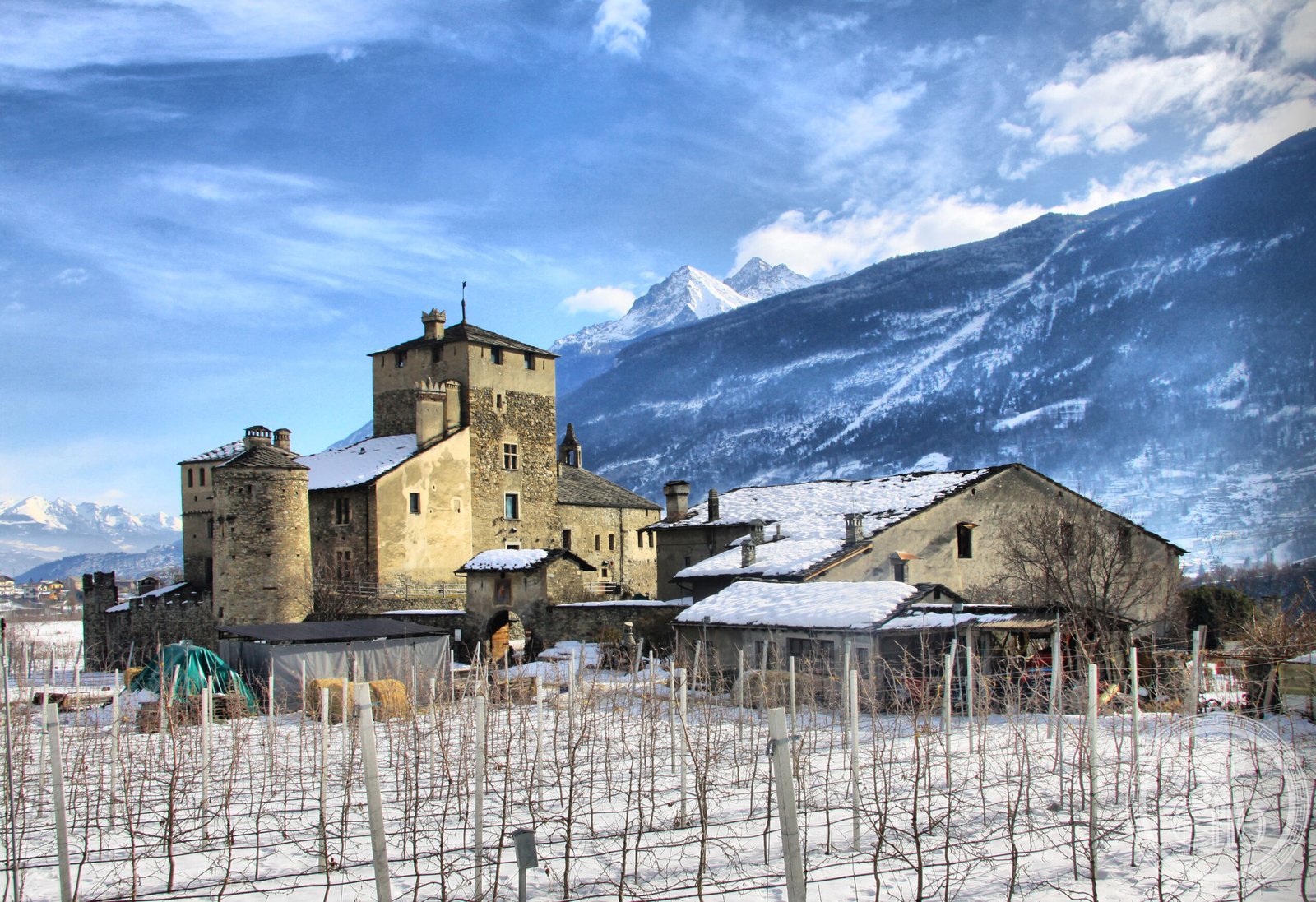
Castello Sarriod de La Tour is a medieval fortified residence in the Aosta Valley, situated in the municipality of Saint-Pierre at an elevation commanding the central valley. Built by the noble Sarriod de La Tour family from the 13th century, the castle is celebrated for its exceptional late-Gothic chapel decorated with a remarkable carved stone frieze depicting animals and hybrid creatures — one of the finest examples of medieval decorative sculpture surviving in the Alps. The castle is managed by the Aosta Valley regional government and is open to the public.
At a glance
- Type
- Medieval castle and noble residence
- Period
- 13th–15th century, with later modifications
- Style
- Alpine Gothic; Savoyard military architecture
- Location
- Saint-Pierre, Aosta Valley (Valle d’Aosta), Italy
- Coordinates
- 45.7060° N, 7.2229° E
Overview
Castello Sarriod de La Tour stands on a rocky promontory above the Dora Baltea river in the central Aosta Valley, part of the remarkable concentration of medieval castles that makes this Alpine region one of Europe’s richest for medieval heritage. The Aosta Valley — a bilingual autonomous region where French and Italian are both official languages — preserves over 70 medieval fortifications along its single main valley, a density unmatched in Italy. The Sarriod de La Tour castle is distinguished among these by the exceptional quality of its carved decoration, particularly the zoomorphic frieze in its chapel.
History
The castle takes its name from the Sarriod de La Tour, a noble family prominent in Aosta Valley history from the 13th century, vassals of the Counts (later Dukes) of Savoy who controlled the valley from the 11th century onward. The core of the fortification dates from this early medieval period, with the residential wing and chapel added and embellished during the 14th and 15th centuries. The family produced several notable figures in regional ecclesiastical and civil life. Like many Aosta Valley castles, it passed through various hands before being acquired by the regional administration in the 20th century and restored for public access.
What you see
The castle comprises a residential tower, baronial hall and the Gothic chapel whose carved frieze constitutes its principal artistic treasure. The frieze, running along the cornice of the chapel interior, depicts a procession of real and fantastical animals — lions, deer, bears, griffins and hybrid creatures — carved with exceptional naturalistic detail characteristic of late-Gothic Alpine workshops. The tower commands sweeping views across the Aosta Valley toward the Gran Paradiso massif. The castle interiors preserve period furnishings, tapestries and archaeological finds from regional excavations.
Cultural significance
The zoomorphic frieze of the Sarriod de La Tour chapel is regarded as one of the masterworks of medieval decorative sculpture in the Alpine arc, comparable in quality to contemporary work in Burgundy and Savoy. The castle contributes to the UNESCO-recognised cultural landscape of the Aosta Valley and to Italy’s national heritage inventory. It is listed among the protected monuments managed by the Aosta Valley regional government’s cultural heritage directorate.
Practical information
- Address
- Località Sarriod, Saint-Pierre, 11010 Aosta Valley, Italy
- Management
- Région Autonome Vallée d’Aoste / Regione Autonoma Valle d’Aosta
- Hours
- Check official website for seasonal opening hours and guided visit schedule
- Admission
- Check official website for current ticket prices
Getting there
Saint-Pierre lies on the SS26 main road through the Aosta Valley, approximately 8 km west of Aosta. By rail, trains on the Turin–Aosta line stop at Aosta; local bus services connect Aosta with Saint-Pierre. By road, take the A5 motorway from Turin to the Saint-Pierre/Aymavilles exit. The nearest airports are Turin Caselle (approximately 120 km) and Geneva International (approximately 130 km via the Mont Blanc tunnel).
Sources & resources
- Sarriod de La Tour Castle — Wikipedia
- Castelli della Valle d’Aosta — Regional Government
- Cultural Heritage Online
Find it on the map
See this place and what’s around it →📷 Become a Cultural Heritage Online photographer
Share your photos of places: they stay published under your name as the author. The more they're seen, the more you get noticed — and soon a contest will reward the most appreciated photos.
Log in or sign up free to add a photo