
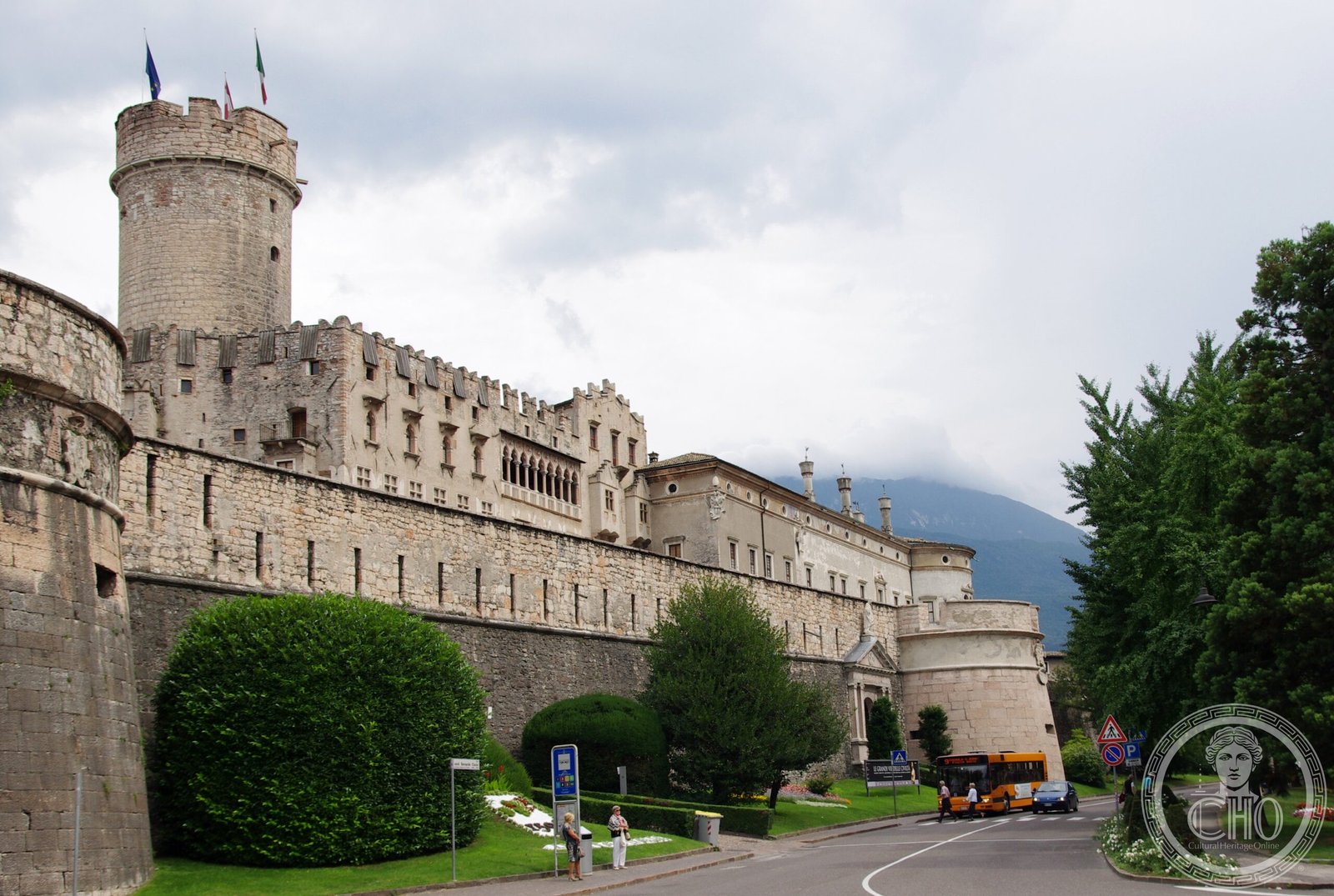
The Museo del Castello del Buonconsiglio is the principal art and history museum of Trentino, housed in the Castello del Buonconsiglio — one of the largest and most important medieval and Renaissance castle complexes in northern Italy. Seat of the prince-bishops of Trento from the 13th century until 1796, the castle is celebrated for its extraordinary Cycle of the Months fresco series (c. 1400–1407), a masterwork of International Gothic painting that ranks among the finest secular fresco ensembles surviving in Europe. The museum complex encompasses the original Castelvecchio tower, the Magno Palazzo Renaissance residence, and the Giunta Albertiana wing.
At a glance
- Type
- Castle complex and regional art and history museum
- Period
- 13th–16th century; museum established in the 20th century
- Style
- Medieval (Castelvecchio); Gothic (Torre d’Augusto); Renaissance (Magno Palazzo)
- Location
- Via Bernardo Clesio 5, 38122 Trento, Autonomous Province of Trento, Italy
- Coordinates
- 46.0716° N, 11.1244° E
Overview
The Castello del Buonconsiglio stands at the northeastern edge of Trento’s historic centre, against the rocky cliff that borders the Adige river valley. For more than five centuries it served as the residence and administrative centre of the prince-bishops of Trento, who governed the city and surrounding territory as an ecclesiastical principality of the Holy Roman Empire. The castle’s art collections, frescoes, and architectural spaces document the intersection of Italian, German and Central European cultural traditions that has defined Trento’s history at the heart of the Alpine crossroads. Today the complex is managed as the Museo del Castello del Buonconsiglio, one of the most visited cultural sites in the Italian Alps.
History
The origins of the castle date to the 13th century, when the prince-bishops of Trento — who had held secular power over the city since 1027 — began constructing a permanent fortified residence to replace their earlier cathedral precinct. The core Castelvecchio with its circular Torre d’Augusto dates from this period. The castle reached its greatest splendour under Bishop Bernardo Clesio (1514–1539), who commissioned the Magno Palazzo — a Renaissance residence of Italianate architecture and decoration, filled with frescoes and antiquities — as an expression of humanist culture and imperial ambition. The prince-bishops’ temporal power ended with Napoleon’s suppression of the ecclesiastical principalities in 1796; the castle subsequently served as a Habsburg prison and barracks before becoming a museum. Cesare Battisti, the Italian irredentist leader, was imprisoned and executed in the castle moat in 1916.
What you see
The museum’s greatest treasure is the Cycle of the Months (Ciclo dei Mesi) in the Torre dell’Aquila — a series of twelve fresco lunettes painted around 1400–1407 depicting aristocratic and peasant life month by month in extraordinary naturalistic detail, a rare document of late-medieval daily life and one of the earliest major secular fresco cycles in Italy. The Magno Palazzo contains richly frescoed halls by Romanino, Dosso Dossi and other leading painters of the 16th-century northern Italian school. The museum’s permanent collections include medieval sculpture, goldsmith work, archaeological material from the region, and historical documents relating to the Council of Trent (1545–1563), held partly in Trento’s cathedral.
Cultural significance
The Buonconsiglio Castle is listed among Italy’s national heritage monuments of exceptional importance and is proposed as part of the potential UNESCO World Heritage extension of the Council of Trent sites. The Cycle of the Months is internationally recognised as a landmark of International Gothic painting, reproduced extensively in art-history scholarship and preserved with extraordinary colour and detail. The castle’s historical associations — with the Council of Trent, with Cesare Battisti and Italian irredentism, and with the Austro-Hungarian period — make it the central monument of Trentino’s complex identity.
Practical information
- Address
- Via Bernardo Clesio 5, 38122 Trento TN, Italy
- Phone
- +39 0461 233770
- Hours
- Tuesday–Sunday 10:00–18:00 (June–October); 09:30–17:00 (November–May); closed Mondays
- Admission
- Charged; reduced for students, seniors and Trentino Card holders
Getting there
The Castello del Buonconsiglio is a 10-minute walk from Trento railway station, one of the main stops on the Verona–Brenner railway line (Trenitalia and ÖBB services). By road, Trento is served by the A22 Autostrada del Brennero; take the Trento Centro or Trento Nord exit and follow centre signs. Parking is available near the historic centre. By bus, regular services connect the railway station with the castle area. The nearest airports are Verona Villafranca (approx. 100 km south) and Innsbruck (approx. 100 km north).
Sources & resources
- Buonconsiglio Castle — Wikipedia
- Museo del Castello del Buonconsiglio — Official Website
- Cultural Heritage Online
Find it on the map
See this place and what’s around it →📷 Become a Cultural Heritage Online photographer
Share your photos of places: they stay published under your name as the author. The more they're seen, the more you get noticed — and soon a contest will reward the most appreciated photos.
Log in or sign up free to add a photoIs this page about you?
This page is read by travellers and heritage enthusiasts who find it on Google. Tell us how you are connected to this place and we will take it from there.