
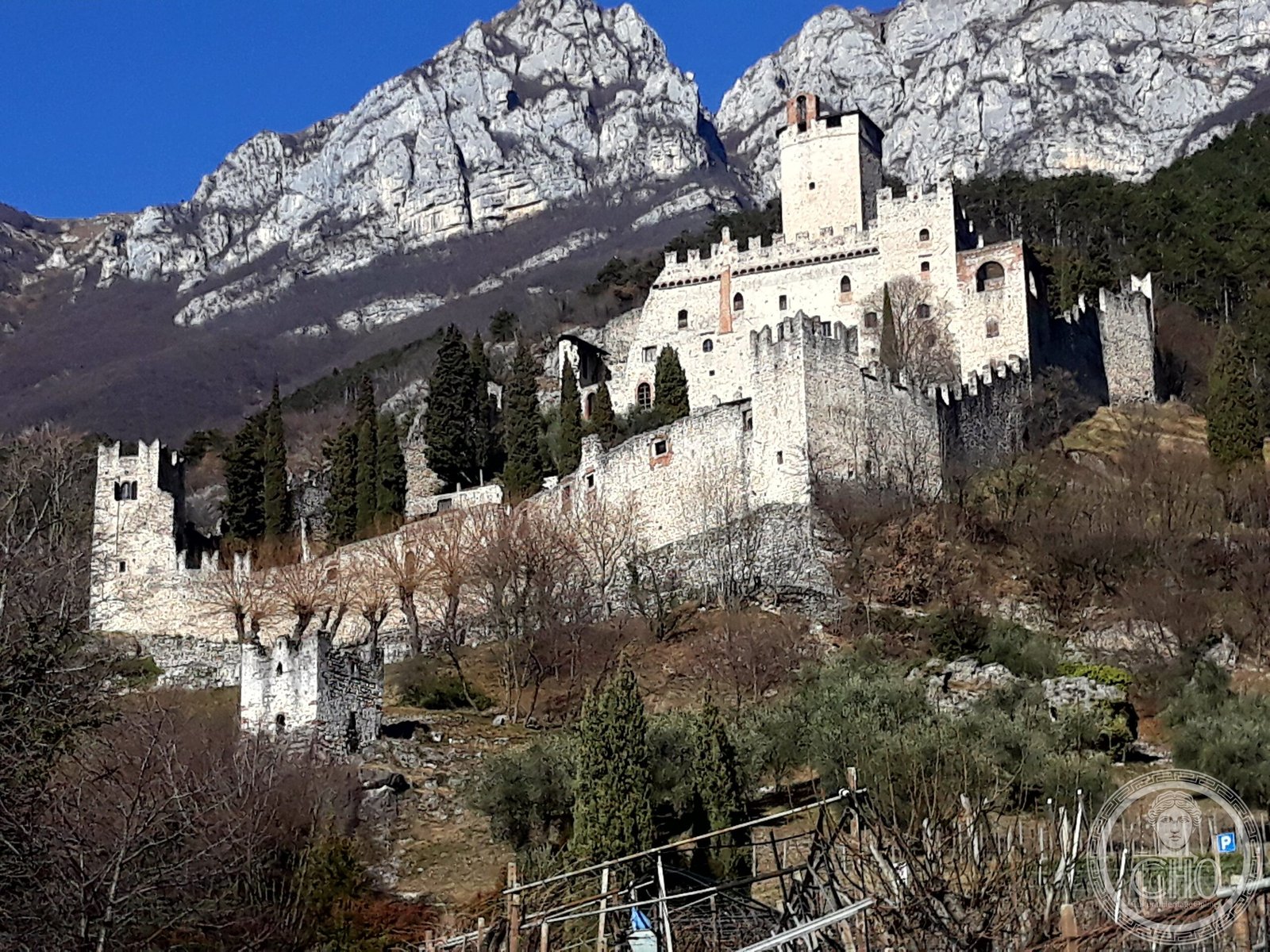
The Castle of Avio, known as Sabbionara di Avio, is one of the largest and best-preserved medieval fortresses in Trentino, commanding the southern end of the Vallagarina valley from a vine-covered ridge above the Adige River. First documented in the tenth century and expanded through the late medieval period, the castle passed to the Castelbarco family and later to the Counts of Trapp before being donated to the Fondo per l’Ambiente Italiano (FAI), Italy’s national trust, in 1977. Today it is open to the public as one of FAI’s flagship properties, celebrated for its rare surviving cycle of thirteenth-century secular frescoes depicting chivalric battle and love scenes.
At a glance
- Type
- Medieval hilltop castle; FAI heritage property
- Period
- 10th century (origins); principal construction 12th–15th century
- Style
- Italian medieval military architecture; Romanesque and Gothic phases
- Location
- Avio, Trentino, northern Italy (southern Vallagarina)
- Coordinates
- 45.7464° N, 10.9517° E
Overview
The Castle of Avio occupies a long narrow ridge between terraced vineyards above the town of Avio, at the point where Trentino meets the Veneto and Lake Garda country. Its silhouette — a sequence of towers, walls and residential blocks stepping down the ridge — is one of the iconic images of the southern Trentino landscape. The FAI has restored the castle progressively since 1977, consolidating structures while making the interior accessible to visitors, and the surrounding vineyard (a working property producing Castel Avio wines) forms an integral part of the estate experience.
History
Documentary references to a fortification at Avio date to the year 1000, though the site’s defensive logic suggests earlier occupation. The castle rose to prominence under the Castelbarco family, who held it from the thirteenth century and carried out the principal construction campaigns that shaped the present layout, including the great hall, the towers and the circuit of walls. The Castelbarcos passed the property to the Counts of Trapp in the sixteenth century, under whose long tenure the castle gradually declined from a military stronghold to a working estate. The Trapp family donated Avio to the FAI in 1977 — the first major property received by the recently founded institution — and restoration began shortly afterward.
What you see
The highlight of any visit is the Camera delle Guardie (Guard Room) on the upper floor of the main residential tower, whose walls and ceiling retain an exceptionally rare cycle of secular frescoes from the early fourteenth century. The paintings depict mounted combat, tournaments and courtly love scenes in a vivid chivalric idiom, representing one of the finest and most complete examples of non-religious medieval painting surviving in northern Italy. Beyond the frescoes, visitors explore the castle’s sequence of towers, the Mastio (keep), the curtain walls with their original merlons, and the panoramic terrace overlooking the Adige valley and the Lessini mountains.
Cultural significance
The Castle of Avio holds a central place in Italian heritage conservation history as the first property donated to the FAI, whose subsequent growth into a national heritage trust managing over seventy properties owes much to the visibility and public success of the Avio model. The thirteenth-century secular frescoes are classified among the most significant medieval paintings in Trentino and are studied internationally for their iconographic content and state of preservation. The castle’s integration of working viticulture within a heritage site also exemplifies a sustainable approach to rural heritage management that has influenced other FAI properties.
Practical information
- Address
- Via Castello 10, 38063 Avio TN, Italy
- Opening hours
- Open March to November; check FAI website for current hours (closed Tuesdays)
- Admission
- Paid; FAI members free; reduced rates available
- Website
- fondoambiente.it
Getting there
Avio is located on the A22 Brennero motorway; take the Affi/Lago di Garda Sud exit and follow signs toward Avio, then follow castle signs. The castle lies approximately 15 km south of Rovereto. Train travellers can reach Avio via the Rovereto–Verona line (stop: Avio), then walk or take a local bus uphill to the castle. Lake Garda ferry connections at Torbole are approximately 10 km west.
Sources & resources
See the place
Find it on the map
See this place and what’s around it →📷 Become a Cultural Heritage Online photographer
Share your photos of places: they stay published under your name as the author. The more they're seen, the more you get noticed — and soon a contest will reward the most appreciated photos.
Log in or sign up free to add a photoIs this page about you?
This page is read by travellers and heritage enthusiasts who find it on Google. Tell us how you are connected to this place and we will take it from there.