
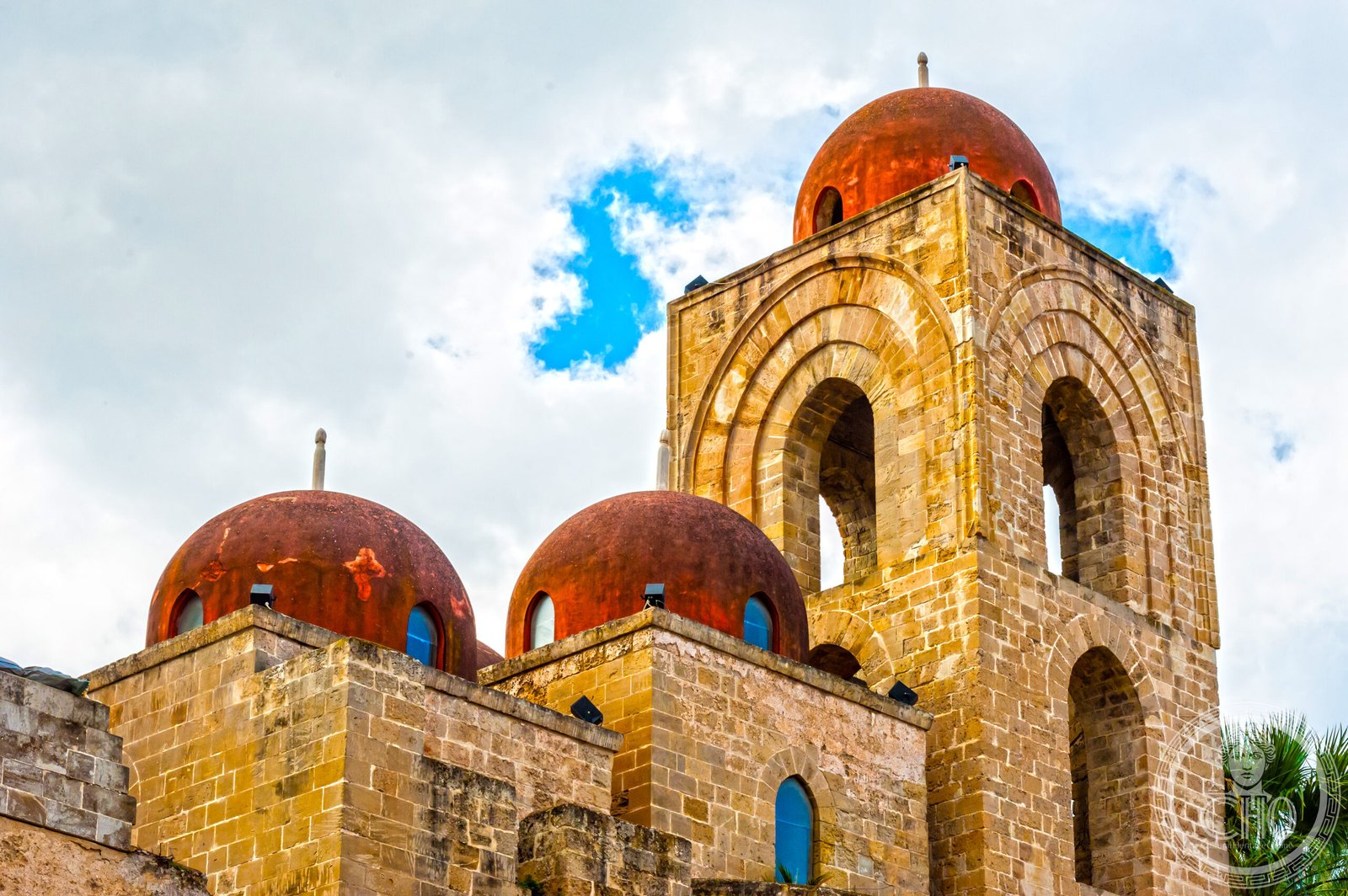
San Giovanni degli Eremiti is a former Benedictine monastic church in the Albergaria quarter of Palermo, Sicily, built in the twelfth century under Norman rule and celebrated as a masterpiece of Arab-Norman architecture. Its five distinctive red domes — four over the church and one over the adjoining former mosque — make it one of the most recognisable silhouettes in Palermo, while the ruined Romanesque cloister set in a lush garden of palms, orange trees, and subtropical plants creates one of the most atmospheric heritage sites in southern Italy.
At a glance
- Type
- Former Benedictine monastic church (now state museum)
- Period
- 12th century (Norman); cloister c. 1150–1180
- Style
- Arab-Norman (Sicilian Romanesque with Islamic architectural elements)
- Location
- Via Benedettini 20, Albergaria quarter, Palermo, Sicily, Italy
- Coordinates
- 38.1097° N, 13.3547° E
- Patron
- Roger II of Sicily
Overview
San Giovanni degli Eremiti stands two blocks south of the Palazzo dei Normanni, the seat of the Norman kings of Sicily, and was built as part of Roger IIs programme of royal patronage that also produced the Cappella Palatina and San Cataldo. The interior is intentionally spare — virtually devoid of decoration or furnishings — which throws into relief the extraordinary geometry of the red-painted domes visible from outside. The church is now managed as a state monument by the regional government of Sicily and is one of the UNESCO-listed Arab-Norman Palermo sites.
History
The site had been occupied by a mosque during the Arab period of Sicilian history (827–1072), and Roger II granted it to Benedictine monks from Calabria around 1132, commissioning a new church while retaining the mosque structure alongside it. The building was completed during the reign of William I (r. 1154–1166). In the thirteenth century it passed to the Cistercians, and later to secular use, falling into gradual disrepair after the suppression of monasteries in the nineteenth century. Restoration work in the late nineteenth and twentieth centuries stabilised the fabric, though the cloister remains evocatively ruined.
What you see
Five hemispherical domes covered in warm red render define the exterior silhouette — four arranged over the nave and transept of the church, and one over the former mosque to the south. The interior is a single nave of bare stone walls illuminated by small windows, its emptiness contrasting dramatically with the lush garden surroundings. The cloister to the north features twin columns with interlaced arches in the Romanesque-Islamic fusion style characteristic of Norman Sicily, framing views of palms and citrus trees. An adjacent chapel, sometimes called the “chapel of the hermits,” is among the oldest surviving elements of the complex.
Cultural significance
San Giovanni degli Eremiti is inscribed as part of the UNESCO World Heritage Site “Arab-Norman Palermo and the Cathedral Churches of Cefalù and Monreale” (2015), recognised as an exceptional testimony to the coexistence and interchange of Arab, Byzantine, and Latin cultures under Norman rule in twelfth-century Sicily. Its red domes have become a symbol of Palermos multicultural urban identity, widely reproduced in art and photography as an emblem of the islands layered history.
Practical information
- Address
- Via dei Benedettini 20, 90134 Palermo PA, Italy
- Hours
- Tuesday–Saturday 09:00–19:00; check official website for current hours and closures
- Admission
- State monument admission fee applies; check Regione Siciliana website for current prices
Getting there
The church is a ten-minute walk south-west from Palermo Centrale station via Corso Vittorio Emanuele, or a five-minute walk from the Palazzo dei Normanni. Bus lines 109 and 389 stop nearby on Via dei Benedettini. The church is within the extended ZTL restricted traffic zone; visitors arriving by car should park at the Parcheggio Basile on Viale Strasburgo and continue by bus or on foot.
Sources & resources
See the place
Find it on the map
See this place and what’s around it →📷 Become a Cultural Heritage Online photographer
Share your photos of places: they stay published under your name as the author. The more they're seen, the more you get noticed — and soon a contest will reward the most appreciated photos.
Log in or sign up free to add a photoIs this page about you?
This page is read by travellers and heritage enthusiasts who find it on Google. Tell us how you are connected to this place and we will take it from there.