
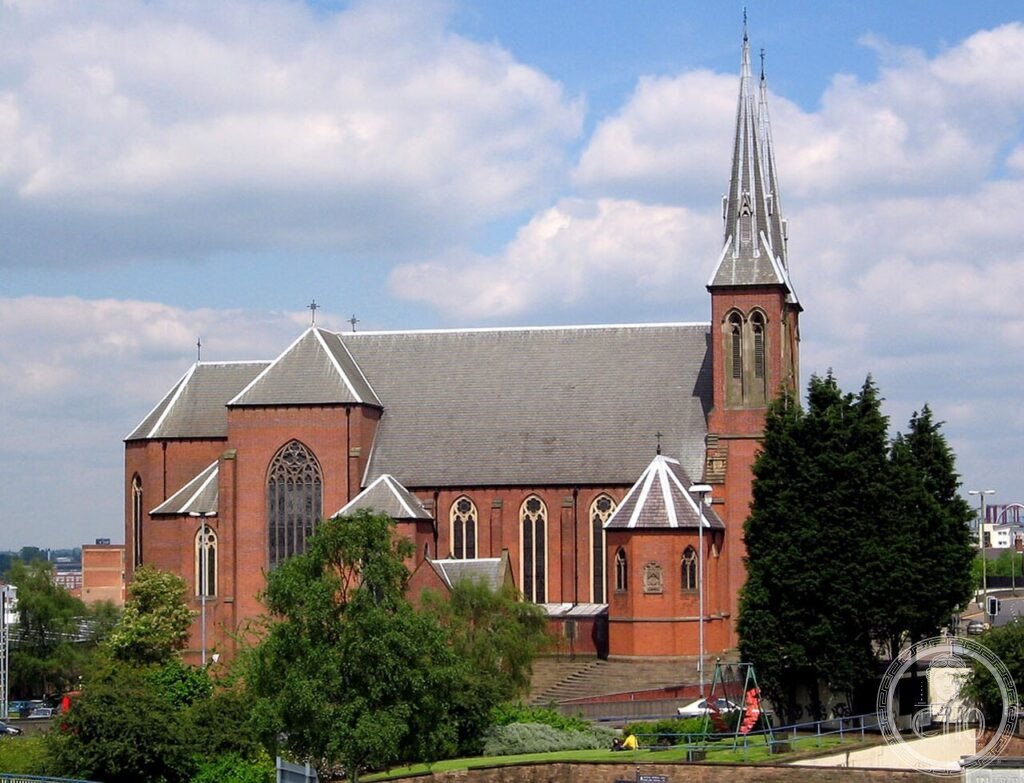
Rising in brick rather than stone, St Chad’s borrows its soaring proportions from the great hall-churches of Germany — the first Catholic cathedral built in England since the Reformation, designed entirely by Augustus Welby Pugin.
At a glance
The Cathedral Church of St Chad, generally known as St Chad’s Cathedral, is the Metropolitan Cathedral of the Archdiocese of Birmingham and one of the earliest Catholic cathedrals built in England following the Reformation. Constructed between 1839 and 1841 to a design by Augustus Welby Pugin, one of the driving figures of the Gothic Revival, it was consecrated on 21 June 1841 and elevated to cathedral status in 1852, when Pope Pius IX restored the Catholic hierarchy in England and Wales. Pope Pius XII later declared it a minor basilica in 1941. Built in brick rather than the stone typical of English Gothic churches, St Chad’s follows the “hall church” (Hallenkirche) tradition more common in Germany, giving it a markedly different silhouette and interior volume from its Anglican counterparts.
Key facts
- Built: 1839–1841; foundation stone laid October 1839, consecrated 21 June 1841
- Architect: Augustus Welby Pugin (1812–1852), a central figure of the English Gothic Revival
- Cathedral status: since 1852, following the restoration of the Catholic hierarchy in England and Wales
- Minor basilica: declared by Pope Pius XII in 1941
- Style: brick “hall church” (Hallenkirche), comparable to Munich Cathedral, with a westwerk and narrow broached spires recalling Lübeck Cathedral
- Listing: Grade II* listed building, designated 25 April 1952
- Historic first: one of the first four Catholic churches built in England after the Reformation
History
By the late 1830s, English Catholics were building openly for the first time in centuries, though still under considerable social and legal caution. St Chad’s foundation stone was laid in October 1839, and the building — designed from the outset by Augustus Welby Pugin, who had converted to Catholicism in 1835 and devoted much of his career to designing churches for his adopted faith — was consecrated on 21 June 1841, after less than two years of construction. It stands among the first four Catholic churches erected in England since the Reformation, a milestone that made its completion a moment of real significance for English Catholic communities well beyond Birmingham.
The church’s status changed in 1852, when Pope Pius IX restored the Catholic diocesan hierarchy in England and Wales, an act that had been legally impossible under English law for three centuries. St Chad’s was designated the cathedral of the newly restored Archdiocese of Birmingham, elevating Pugin’s parish-scale design to the seat of a bishop. Nearly a century later, in 1941, Pope Pius XII conferred on it the honorific status of minor basilica, recognising its historical and spiritual importance within English Catholicism.
The cathedral has remained in continuous use since its consecration, surviving the bombing that damaged much of central Birmingham during the Second World War and the large-scale postwar redevelopment of the surrounding Queensway area, which left the building somewhat isolated from its original streetscape. It was listed Grade II* in 1952, recognising both Pugin’s authorship and the building’s rarity as an early and largely intact example of Catholic Gothic Revival cathedral architecture in England.
What you see
Pugin’s decision to build in brick rather than stone was as much practical as aesthetic, but the result is a building that looks distinctly different from England’s stone Gothic cathedrals. Its “hall church” plan, in which nave and aisles rise to comparable heights rather than the aisles stepping down beneath a taller central nave, is a form more associated with German Gothic churches such as Munich Cathedral; St Chad’s high arcades, carried on notably thin stone shafts, exaggerate the sense of verticality, with the nave reaching nearly twice the height of its width.
The west front’s twin spires, slender and sharply pointed, echo the “broached spire” tradition seen at Lübeck Cathedral in northern Germany, underscoring Pugin’s deliberate reach toward Continental Gothic precedent rather than native English models. Beneath the church, a substantial crypt serves as both a burial space for bishops and clergy and, in more recent use, a rehearsal space for the cathedral choir — a practical continuity between the building’s sacred and everyday functions.
Practical information
- Weekday hours: cathedral open approximately 9:30am to 4pm; Mass at 12:15pm
- Saturday: open approximately 11am, with vigil Mass at 4:30pm
- Sunday: open from approximately 9am; Masses at 9:30am and 11:30am
- Admission: free entry
Getting there
St Chad’s Cathedral stands on St Chad’s Queensway in central Birmingham, a short walk from Birmingham Snow Hill railway station and close to the Midland Metro’s St Chad’s stop. Birmingham New Street station, the city’s main rail hub, is about 15 minutes on foot. GPS: 52.4856° N, 1.8988° W.
Nearby
- Birmingham Museum & Art Gallery — the city’s major Victorian civic art museum, roughly 15 minutes’ walk from St Chad’s
- Aston Hall — a Grade I listed Jacobean mansion built between 1618 and 1635, a short journey north of the city centre
- St Philip’s Cathedral — Birmingham’s Anglican cathedral, a Georgian building raised to cathedral status in 1905, a short walk across the city centre
Sources
Find it on the map
See this place and what’s around it →📷 Become a Cultural Heritage Online photographer
Share your photos of places: they stay published under your name as the author. The more they're seen, the more you get noticed — and soon a contest will reward the most appreciated photos.
Log in or sign up free to add a photoIs this page about you?
This page is read by travellers and heritage enthusiasts who find it on Google. Tell us how you are connected to this place and we will take it from there.