
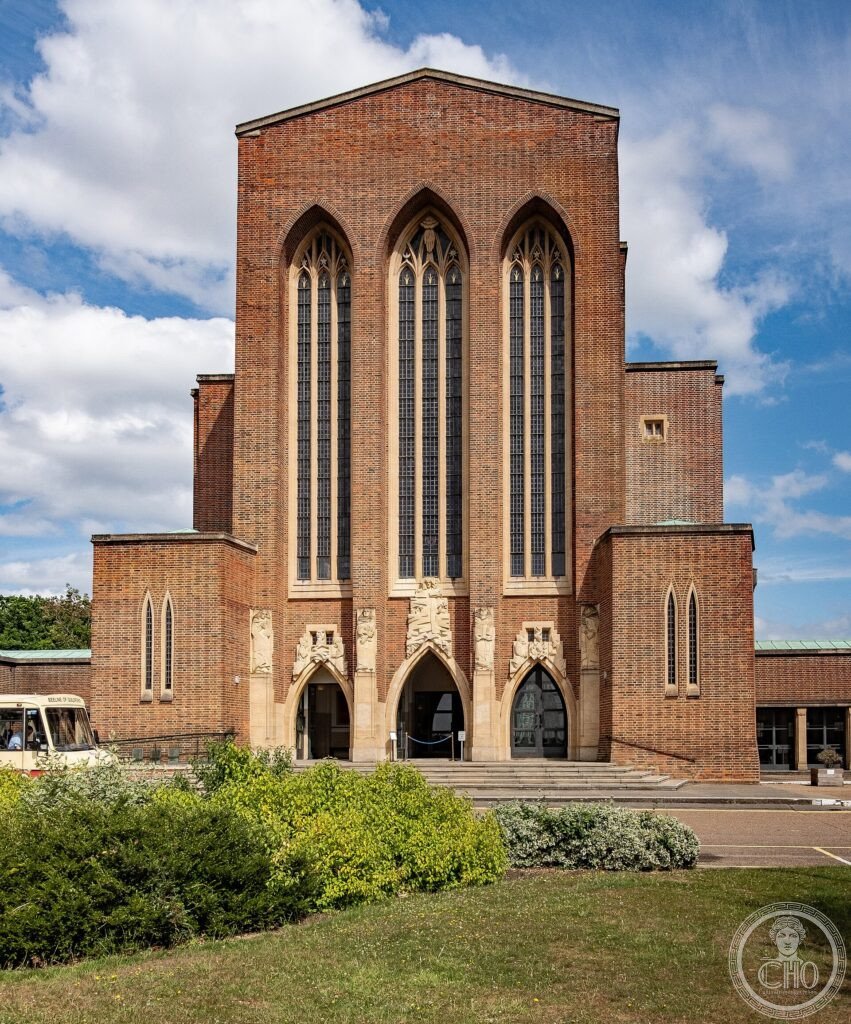
Edward Maufe won an open competition in 1932 and spent twenty-five years turning a bare hilltop into the last Church of England cathedral built on an entirely new site.
At a glance
Guildford Cathedral, dedicated to the Holy Spirit, sits on top of Stag Hill on the western edge of the town, visible for miles across the Surrey countryside. Architect Edward Maufe designed it after winning a 1932 open competition against 183 other entries, and construction ran from the laying of the foundation stone in 1936 to consecration on 17 May 1961, in the presence of Queen Elizabeth II and Prince Philip. It was the last Church of England cathedral consecrated on a new site and one of only three English cathedrals built in the twentieth century, alongside Liverpool and Coventry. Grade II* listed since 1981, it is built of local Guildford and Sussex brick over a concrete frame, a practical choice during years of wartime shortage and postwar rationing that became the building’s defining material.
Key facts
- Architect: Edward Maufe, selected by open competition in 1932
- Built: foundation stone 1936, consecrated 17 May 1961
- Status: Grade II* listed building (1981)
- Materials: concrete frame faced in red brick, pale Somerset limestone piers inside
- Tower: 160 feet high, carries 12 bells and a 15-foot gilded angel weathervane
- Interior art: stained and etched glass by Eric Gill, Lawrence Lee, Moira Forsyth and John Hutton
- Kneelers: 1,447 individually designed and embroidered kneelers, made by volunteers
History
Guildford had no cathedral of its own until the diocese was created in 1927, carved out of the diocese of Winchester to serve a growing part of Surrey. A competition for a new building drew 183 entries, and in 1932 the judges chose the scheme submitted by Edward Maufe, an architect who had until then built houses, university colleges and war memorials rather than churches. Archbishop Cosmo Lang laid the foundation stone on Stag Hill in 1936, on land bought specifically because the site could be seen from most of the town below.
Work stopped for the Second World War and resumed slowly afterward, funded largely through public subscription rather than any single patron. Guildford residents bought bricks for a shilling each to pay for the walls, a fundraising device that left the cathedral’s fabric quite literally built by the town it serves. The building was not finished until 1961: Queen Elizabeth II and Prince Philip attended the consecration on 17 May of that year, closing a twenty-nine-year project that had spanned a world war and a change of national mood about what a modern English cathedral should look like.
Because it belongs so plainly to the twentieth century, the cathedral later found a second life on screen. Its plain Gothic silhouette and empty hilltop setting made it a filming location for the 1976 horror film The Omen, and more recently for the television series The Sandman and The Witcher, a use its Victorian and medieval counterparts, cluttered with centuries of monuments, could not have offered.
What you see
Maufe called his approach “a design, definitely of our own time” while keeping “the line of the great English cathedrals,” and the result reads as Gothic reduced to its structural essentials: tall lancet openings, a long unbroken nave, and buttressed massing, without the carved profusion of a medieval facade. The red brick, laid plain and repetitive across the exterior, gives the building a quiet, almost domestic texture up close that contrasts with its scale from a distance, where the tower and its gilded angel weathervane catch the light over the whole town.
Inside, pale Somerset limestone piers rise against white Italian marble floors, and Maufe kept the glazing largely clear rather than filling every window with stained glass, so that daylight floods the nave in a way no medieval cathedral allows. Where glass does appear, it carries real names: Eric Gill’s lettering and design work, Moira Forsyth’s windows, and John Hutton’s engraved glass panels at the entrances, added incrementally through the 1950s and 60s as funds allowed. The 1,447 kneelers, each embroidered by a different parish, guild, regiment or family group, turn the nave floor into an unplanned record of who paid for the building, seat by seat.
Practical information
- Opening hours: Monday–Saturday 8:30am–4:30pm (nave only 4:30–5pm); Tuesdays from 7:30am; Sundays from 7am ahead of the 7:30am service, with access limited during services
- Admission: free entry; the cathedral receives no government funding and welcomes donations, with Gift Aid available for UK taxpayers
- Facilities: Seasons Café, a cathedral shop, and guided or tower tours (small fee for group tower tours)
- Time needed: allow 45 minutes to an hour for the nave and chapels, longer with a guided tour
- Before you go: check the cathedral’s online diary, since concerts, graduations and filming occasionally close parts of the building to visitors
Getting there
Guildford sits about 30 miles southwest of London on the A3, with a mainline station served by regular trains to and from London Waterloo and Victoria; the cathedral is roughly a 20–25 minute walk uphill from the station, or a short taxi ride. Stag Hill also carries the University of Surrey’s main campus, and two footpaths connect the campus directly to the cathedral grounds, so visitors coming from the university can reach it on foot in a few minutes. Drivers can use the A3 and follow signs for the University of Surrey, with on-site parking available near the cathedral. GPS: 51.241148, -0.590052.
Nearby
- Guildford Castle: the town’s medieval castle grounds and keep, a short walk into the historic centre, with grounds open daily from 8am until dusk
- Guildford House Gallery: a 17th-century townhouse on the High Street with a carved staircase and plasterwork ceilings, now a free gallery and local history venue
- University of Surrey, Stag Hill campus: the university shares the hilltop with the cathedral, connected by two footpaths through the grounds
Sources
- Guildford Cathedral, official website, “Maufe’s Vision” and “Beginnings” — history and design pages, guildford-cathedral.org
- Guildford Cathedral, official website, “Visiting Guildford Cathedral” — opening hours and admission, guildford-cathedral.org/visit
- Historic England / British Listed Buildings, listing entry for the Cathedral Church of the Holy Spirit, Guildford (Grade II*, 1981)
- Wikipedia, “Guildford Cathedral”, accessed July 2026
- OpenStreetMap Nominatim, geocoding for the Cathedral Church of the Holy Spirit, Guildford
Find it on the map
See this place and what’s around it →📷 Become a Cultural Heritage Online photographer
Share your photos of places: they stay published under your name as the author. The more they're seen, the more you get noticed — and soon a contest will reward the most appreciated photos.
Log in or sign up free to add a photoIs this page about you?
This page is read by travellers and heritage enthusiasts who find it on Google. Tell us how you are connected to this place and we will take it from there.