
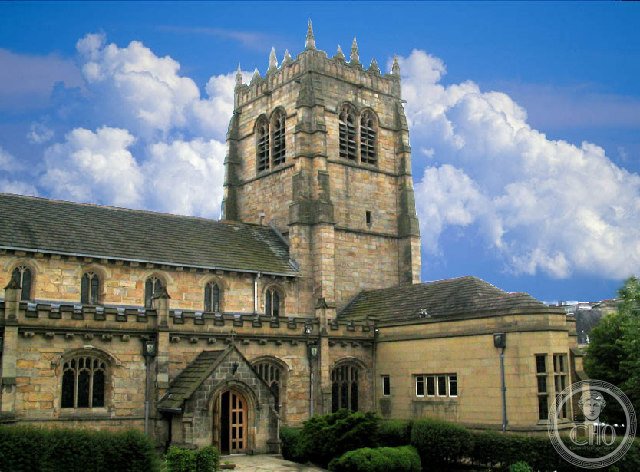
On a hill above Bradford’s Little Germany district, a parish church rebuilt after a 14th-century raid holds one of Morris & Co.’s earliest stained-glass commissions, designed jointly by Ford Madox Brown, Rossetti and Burne-Jones.
At a glance
Bradford Cathedral, dedicated to St Peter, occupies a site of Christian worship recorded since the 7th century, though the building standing today dates mainly from the 15th century, following the destruction of an earlier church by Scottish raiders around 1327. It served as Bradford’s parish church for centuries before the Diocese of Bradford was created in 1919, elevating it to cathedral status. A major 20th-century extension by Sir Edward Maufe added the east end and two west wings, and since 2014 the building has shared cathedral status with Ripon and Wakefield under the Diocese of Leeds. Its gritstone tower, 14th-century nave arcades and 1862 chancel glass make it one of West Yorkshire’s most architecturally layered churches.
Key facts
- Dedication: Cathedral Church of St Peter, Church of England
- Site history: Christian worship recorded here since the 7th century; the second church on the site was largely destroyed by Scottish raiders around 1327
- Present building: nave arcades rebuilt in the 14th century after the 1327 fire; the current fabric completed by 1458; the west tower, in heavy Perpendicular style, built 1493-1508
- Cathedral status: raised from parish church to cathedral in 1919 with the creation of the Diocese of Bradford; became one of three co-equal cathedrals (with Ripon and Wakefield) when the Diocese of Leeds was formed on 20 April 2014
- 20th-century extension: Sir Edward Maufe extended the building in the 1950s-60s, adding the east end and two west wings housing the Song Room and cathedral offices
- Stained glass: chancel glass of 1862 by Morris & Co., designed by Ford Madox Brown, Dante Gabriel Rossetti and Edward Burne-Jones, among the firm’s earliest church commissions; further windows by C. E. Kempe, 1899-1900, and an Arts and Crafts memorial window by Archibald John Davies, 1921
- Listing: Grade I listed building, Historic England list entry 1133250, built of coursed gritstone
History
A church has stood on this hilltop site above the Bradford beck since at least the 7th century. That early foundation and its immediate successor did not survive: the second stone church built around 1200 was largely burnt by Scottish raiders in about 1327, during the border warfare that followed the Wars of Scottish Independence. The nave arcades visible today were rebuilt in the aftermath of that fire, in the 14th century, forming the oldest fabric now standing in the building.
Reconstruction continued over more than a century: the wider church, with its battlemented aisles, was substantially complete by 1458, and the west tower, built in a heavy Perpendicular style with prominent buttresses and battlements, followed between 1493 and 1508. For nearly four hundred years afterward the building served simply as Bradford’s parish church, gaining its major Victorian stained glass, including the 1862 chancel windows designed by three of the most significant names in Pre-Raphaelite and Arts and Crafts art working under the newly founded Morris, Marshall, Faulkner & Co., and later windows by Kempe at the turn of the 20th century.
Status changed in 1919, when the new Diocese of Bradford was carved out of the Diocese of Ripon and the parish church became a cathedral. Sir Edward Maufe, architect of Guildford Cathedral, extended the building substantially in the 1950s and 1960s, adding the east end and two west wings for the Song Room and cathedral offices, and incorporating some of the earlier Morris & Co. glass into his new east window. A further renovation in 1987 replaced the Victorian pews with chairs and relocated the nave organ. On 20 April 2014, the creation of the Diocese of Leeds brought Bradford, Ripon and Wakefield together as three co-equal cathedrals serving a single diocese, a structure without direct precedent in the Church of England.
What you see
From Church Bank, the cathedral reads as a compact, battlemented Yorkshire parish church in coursed gritstone, its scale modest next to England’s larger medieval cathedrals but its massing coherent: a low, wide nave under a clerestory added toward the end of the 15th century, and a sturdy west tower whose heavy Perpendicular tracery and buttressing were finished in 1508. Inside, the 14th-century nave arcades, rebuilt after the 1327 fire, are the building’s oldest surviving structural elements, their proportions noticeably earlier and plainer than the Perpendicular work around them.
The chancel’s 1862 glass is the building’s single most significant artistic survival: designed jointly by Ford Madox Brown, Dante Gabriel Rossetti and Edward Burne-Jones for Morris & Co. in the firm’s first years, it predates the studio’s more famous later commissions and was retained, reset, when Maufe rebuilt the east end in the mid-20th century. Later glass by C. E. Kempe (1899-1900) and Archibald John Davies’s 1921 Arts and Crafts memorial window add two further, distinct chapters of English stained-glass design under one roof, alongside John Flaxman’s neoclassical monuments and a William Hill pipe organ dating from 1904.
Practical information
- Opening hours: Monday-Saturday, 10am-4pm; Sunday open for services only; hours vary around events and Christmas-New Year
- Admission: free entry; suggested donation around £5 for a full day visit or £2.50 for a shorter visit
- Time needed: 30-45 minutes for the nave and chancel glass; longer for a guided tour, bookable in advance
- Contact: 1 Stott Hill, Bradford BD1 4EH; +44 1274 777720; info@bradfordcathedral.org
Getting there
Bradford Cathedral is a five-minute walk from Bradford Forster Square railway station and about ten minutes from Bradford Interchange, which also serves as the city’s bus station; both stations have regular services from Leeds, roughly 15-20 minutes away by train. By air, Leeds Bradford Airport lies about 10km to the north, roughly a 25-minute drive or taxi ride. By car, the cathedral sits close to Bradford’s inner ring road, signposted from the M606 spur off the M62. GPS: 53.7954° N, -1.7478° W.
Nearby
- Saltaire — UNESCO World Heritage industrial village and Salts Mill, about 5km north-west, reachable by train from Forster Square
- Little Germany — Bradford’s Victorian wool-merchants’ quarter of warehouses, a short walk downhill from the cathedral
- National Science and Media Museum — a few minutes’ walk in Bradford city centre, part of the city’s UNESCO City of Film designation
- Undercliffe Cemetery — Victorian hillside cemetery with grand merchant-family monuments, about a mile east
Sources
- Historic England — List Entry 1133250, “Cathedral Church of St Peter” (historicengland.org.uk)
- Wikipedia — “Bradford Cathedral” (en.wikipedia.org)
- Bradford Cathedral — official history and visitor information (bradfordcathedral.org.uk)
Find it on the map
See this place and what’s around it →📷 Become a Cultural Heritage Online photographer
Share your photos of places: they stay published under your name as the author. The more they're seen, the more you get noticed — and soon a contest will reward the most appreciated photos.
Log in or sign up free to add a photoIs this page about you?
This page is read by travellers and heritage enthusiasts who find it on Google. Tell us how you are connected to this place and we will take it from there.