
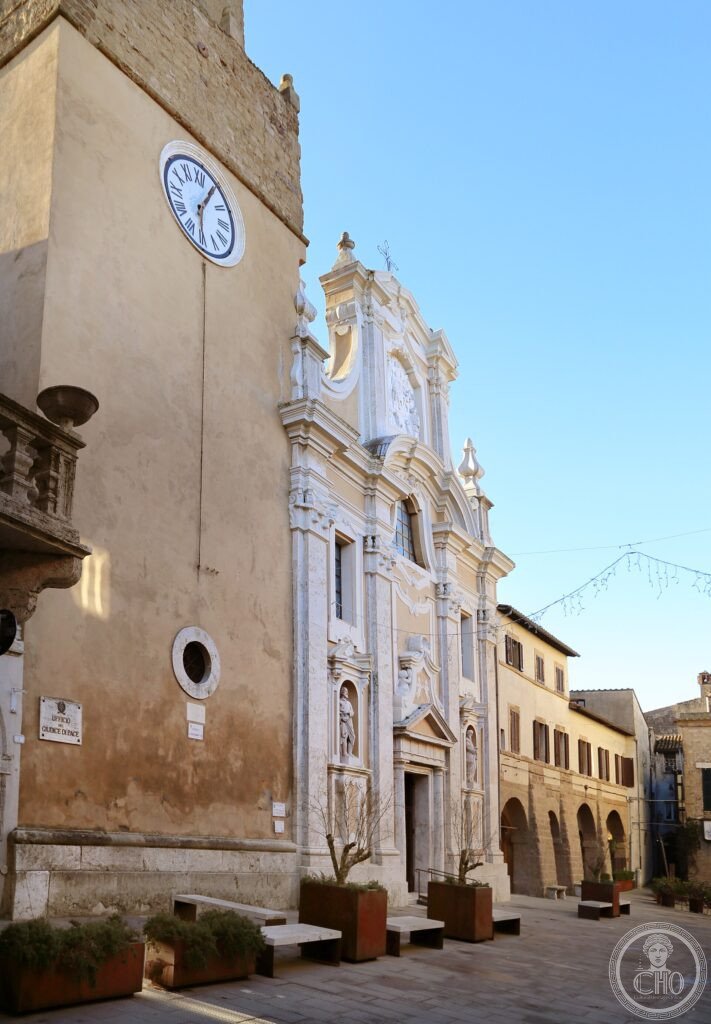
Nel punto più alto della città del tufo, la cattedrale custodisce quattro secoli di rifacimenti: dalla pieve medievale al barocco settecentesco voluto dai conti Orsini.
At a glance
The Cathedral of Saints Peter and Paul stands at the highest point of Pitigliano, the tufa-stone hill town in southern Tuscany’s Maremma. Behind its restrained Baroque facade lies a building with a much longer history: a parish church first recorded in 1061, rebuilt in 1509 under the Orsini counts who ruled the town, and reshaped again during the eighteenth century into the sober Baroque interior seen today. The church became a cathedral only in 1845, when the bishop of the neighboring diocese of Sovana moved his official seat to Pitigliano. A single nave of more than 600 square meters, four lateral chapels, and a 35-meter bell tower that anchors the town’s skyline testify to a status the building has held, with changing diocesan boundaries, ever since.
Key facts
- First record: a parish church on the site is documented in 1061.
- Collegiate church: by 1276, the parish of San Pietro had absorbed the town’s other two parishes and taken the joint dedication to Saints Peter and Paul.
- Major rebuilding: 1509, commissioned by Niccolò III Orsini, count of Pitigliano, recorded on a plaque beside the entrance.
- Cathedral status: granted in 1845, when the bishop of Sovana transferred his residence to Pitigliano.
- Facade: eighteenth-century Baroque, divided by four pilasters, with a Carrara marble bas-relief of the Assumption flanked by Saints Rocco and Francis.
- Paintings: a Rosario altarpiece by Sienese painter Francesco Vanni (1563–1610) and two nineteenth-century canvases by Pietro Aldi depicting episodes from the life of Pope Gregory VII.
- Bell tower: 35 meters tall, the dominant vertical landmark on Pitigliano’s skyline.
History
The first documentary trace of a church on this site dates to 1061, one of several parish churches serving the small tufa-rock settlement of Pitigliano. By 1276, records list three parishes in the town — San Giovanni, Santa Maria, and San Pietro — of which San Pietro had already grown into a collegiate church with its own chapter of canons, taking the joint dedication to Saints Peter and Paul that it still bears.
The building’s present structure owes most to a major reconstruction ordered in 1509 by Niccolò III Orsini, count of Pitigliano, whose family had ruled the town since the fourteenth century; a plaque beside the entrance still records the commission. Further transformation came in the eighteenth century, when the interior was reworked in a sober Baroque style: lateral chapels were added, the main altar received its Baroque architectural “machinery,” and the facade was given the tripartite, pilaster-divided front visible today.
The church’s status changed once more in 1845, when the bishop of the diocese of Sovana chose to establish his permanent residence in Pitigliano, elevating the collegiate church to the rank of cathedral. Later diocesan reorganization merged Sovana with Pitigliano and Orbetello, but the building has kept its cathedral title.
What you see
The facade is the clearest record of the 1509 and eighteenth-century campaigns layered on top of the medieval church: four pilasters divide a travertine portal beneath a Carrara marble bas-relief of the Assumption of Mary flanked by Saints Rocco and Francis, a Baroque insertion into an otherwise plain elevation. Inside, the single nave — over 600 square meters, unusually large for a town of Pitigliano’s size — opens onto four lateral chapels frescoed in the eighteenth century, including work attributed to the Tuscan landscape painter Francesco Zuccarelli, executed in the 1720s.
The most distinctive furnishings are the two nineteenth-century canvases by Pietro Aldi narrating episodes from the life of Pope Gregory VII — a subject chosen for its connection to the reforming papacy rather than to any local cult — alongside the earlier Rosario altarpiece by the Sienese painter Francesco Vanni. A carved eighteenth-century wooden baptismal font and the Baroque “machinery” framing the main altar complete an interior that reads, overall, as a single coherent eighteenth-century remodeling of a much older church.
Practical information
- The cathedral functions as an active parish church; hours outside Mass times are not fixed and can vary seasonally.
- Admission is free.
- To confirm access outside Mass, contact the parish directly: +39 0564 616074, info@pitigliano.chiesacattolica.it.
- Allow 20–30 minutes for a visit to the interior and facade.
Getting there
Pitigliano sits on the SR74 in the Maremma hills of southern Tuscany, in the province of Grosseto. The nearest railway stations with regular service on the Rome–Pisa coastal line are Grosseto and Albinia (Orbetello), both roughly 40 km away; from either, Autolinee Toscane (formerly RAMA) buses connect to Pitigliano, with direct daily coaches also running from Siena. Drivers coming from Rome typically take the coastal SS1 Aurelia toward Grosseto, exit at Albinia, and follow signs via Manciano. GPS: 42.6336, 11.6661.
Nearby
- Sovana (about 8 km) — former seat of the diocese, with its own Romanesque cathedral and, just outside the village, an Etruscan necropolis.
- Sorano (about 9 km) — another tufa hill town, dominated by an Orsini fortress overlooking the Lente river gorge.
- Vie Cave — the network of deep Etruscan sunken roads carved through the tufa rock connecting Pitigliano, Sovana, and Sorano.
Sources
- Wikipedia (Italian), “Duomo di Pitigliano”
- Diocesi di Pitigliano-Sovana-Orbetello, parish page for Pitigliano cathedral
- VisitTuscany, “Cathedral of Santi Pietro e Paolo in Pitigliano”
- OpenStreetMap / Nominatim, geocoding verification
Find it on the map
See this place and what’s around it →📷 Become a Cultural Heritage Online photographer
Share your photos of places: they stay published under your name as the author. The more they're seen, the more you get noticed — and soon a contest will reward the most appreciated photos.
Log in or sign up free to add a photoIs this page about you?
This page is read by travellers and heritage enthusiasts who find it on Google. Tell us how you are connected to this place and we will take it from there.