
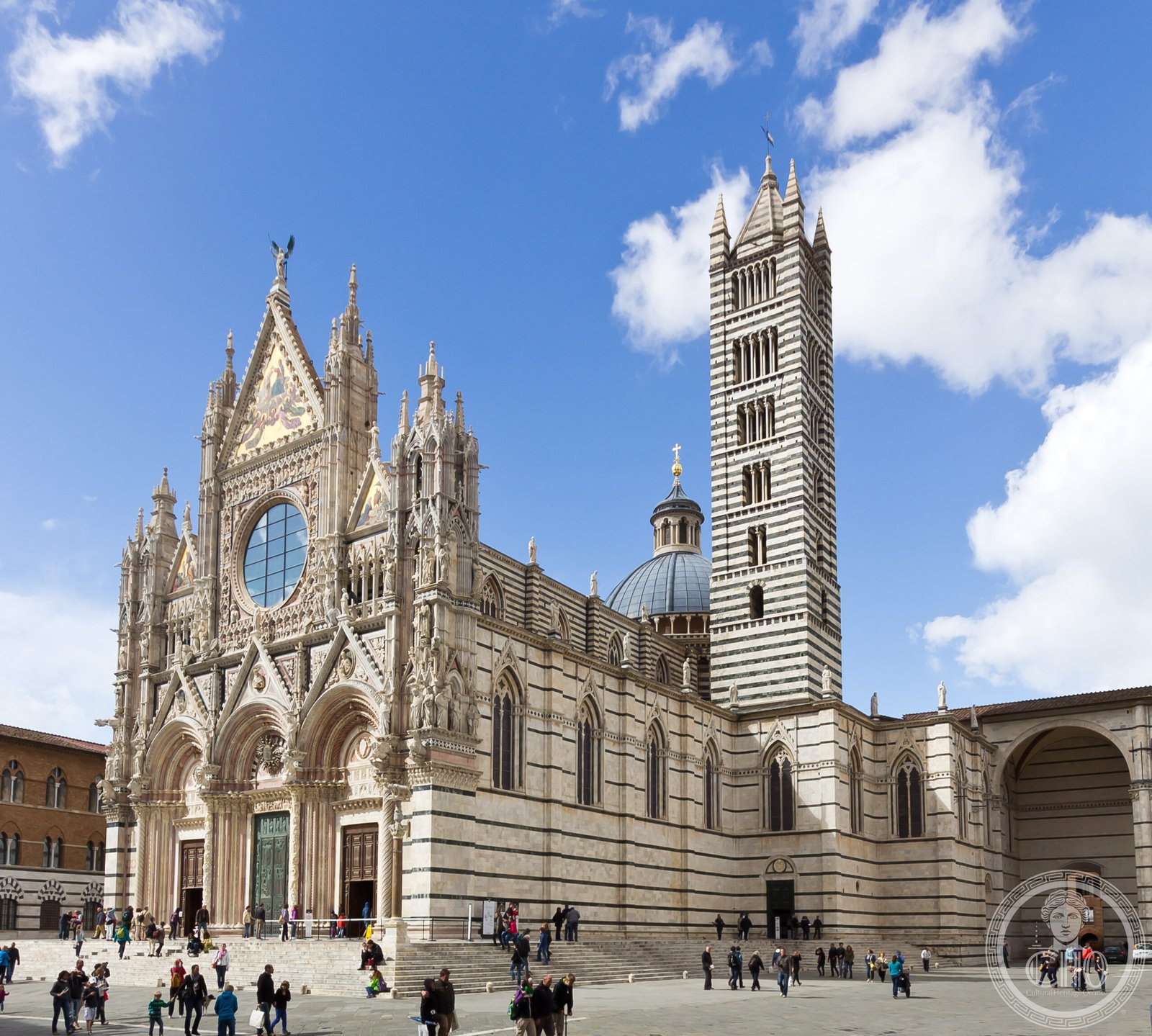
Siena Cathedral, formally the Cattedrale Metropolitana di Santa Maria Assunta, is a medieval Roman Catholic church in Siena, Tuscany, and one of the supreme examples of Italian Gothic and Romanesque architecture. Founded in the 12th century and expanded ambitiously throughout the 13th and 14th centuries — including an abortive plan to create the largest church in Christendom — the cathedral is celebrated for its polychrome marble facade, its inlaid marble pavement of 56 figured panels, and an interior filled with masterworks by Nicola Pisano, Donatello, Michelangelo, and Pinturicchio.
At a glance
- Type
- Roman Catholic cathedral (Archdiocese of Siena–Colle di Val d’Elsa–Montalcino)
- Period
- 12th–14th century construction; major expansions 1215–1376
- Style
- Italian Gothic and Romanesque; polychrome marble
- Location
- Piazza del Duomo, historic centre of Siena, Tuscany
- Coordinates
- 43.3177° N, 11.3267° E
Overview
Siena Cathedral stands at the topographical and spiritual heart of medieval Siena, crowning the highest point of the city’s three hills. Dedicated from its earliest days to the Virgin Mary, it remains in active liturgical use as a Metropolitan cathedral. The building is an UNESCO World Heritage Site component as part of the Historic Centre of Siena, recognised in 1995.
History
Construction of the present cathedral began in earnest around 1215 on the site of an earlier Romanesque church, proceeding through the 13th century under the direction of master builders influenced by the emerging Gothic idiom from France and northern Italy. Between 1339 and 1357, the Sienese Republic launched its most audacious project: the Duomo Nuovo, or New Cathedral, which would have incorporated the existing building as a mere transept of a vastly larger church. The Black Death of 1348 devastated Siena’s population and permanently halted the expansion; the incomplete nave walls of the Duomo Nuovo survive to this day as the Facciatone. Later campaigns added the Piccolomini Library (1492–1502) with its Pinturicchio frescoes, and the facade’s upper register was completed by Giovanni di Cecco in the 14th century.
What you see
The facade combines white, green, and red Tuscan marbles in an intricate pattern of pointed arches, mosaics, and sculpture, topped by gilded spires. Inside, the nave alternates bands of black and white marble in the columns and walls — a visual rhythm unique in Italian ecclesiastical architecture. The cathedral’s floor is its greatest surprise: 56 panels of inlaid marble imagery, executed between 1369 and 1547 by over forty artists including Pinturicchio and Beccafumi, many of which are protected under wooden covers and revealed only for a period in August and September each year. Key works include Nicola Pisano’s hexagonal pulpit (1265–68), Donatello’s bronze pavement tomb of Bishop Giovanni Pecci, and Michelangelo’s four unfinished Piccolomini Altar statues.
Cultural significance
Siena Cathedral is one of the defining monuments of Italian medieval art and architecture, concentrating an extraordinary density of masterworks across sculpture, painting, and decorative arts within a single building. The failed Duomo Nuovo project, frozen in 1348, preserves a unique historical memory of medieval civic ambition cut short — arguably the most dramatic architectural ruin of the Italian Middle Ages. As the seat of the Archdiocese and a UNESCO-listed monument, it remains central to Sienese civic and cultural identity.
Practical information
- Address
- Piazza del Duomo 8, 53100 Siena SI, Italy
- Hours
- Check official website for seasonal hours; combined OPA SI Pass available for cathedral, Piccolomini Library, Baptistery, and Museo dell’Opera
- Admission
- Ticketed; combined passes available at operaduomo.siena.it
Getting there
Siena is in the Tuscan hills, approximately 68 km south of Florence. The cathedral is in the historic centre, a 15-minute walk from Siena’s railway station or from the main bus terminal at Piazza Gramsci. Both Trenitalia regional trains and Tiemme/Siena Mobilità coaches connect Siena to Florence and other Tuscan cities. The historic centre is a pedestrian ZTL zone; car parks are available at the perimeter.
Sources & resources
See the place
Find it on the map
See this place and what’s around it →📷 Become a Cultural Heritage Online photographer
Share your photos of places: they stay published under your name as the author. The more they're seen, the more you get noticed — and soon a contest will reward the most appreciated photos.
Log in or sign up free to add a photoIs this page about you?
This page is read by travellers and heritage enthusiasts who find it on Google. Tell us how you are connected to this place and we will take it from there.