
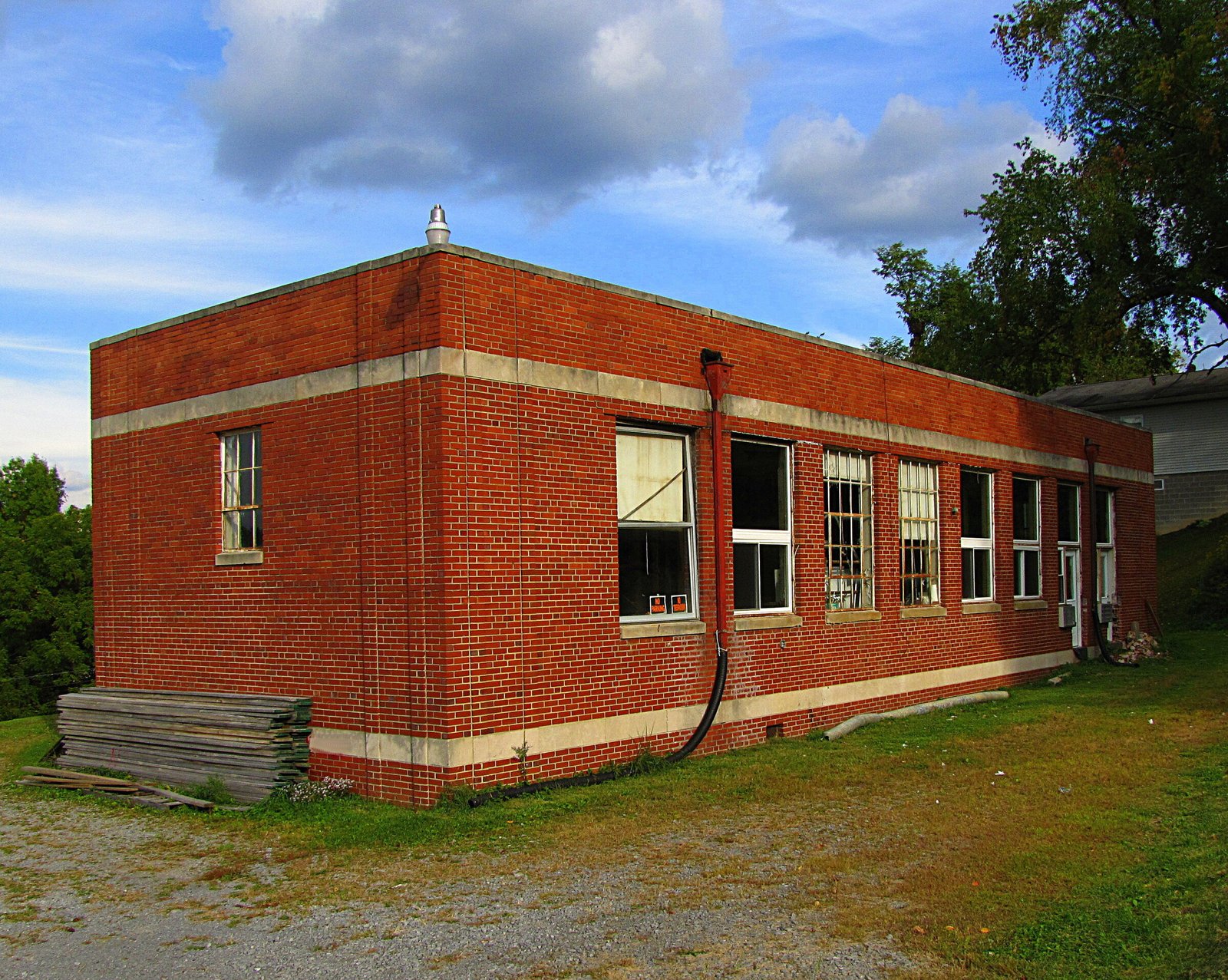
Federal relief money built this Art Deco schoolhouse for Morgantown’s segregated Black students in 1939, and it kept teaching children for more than half a century after the system it was built to serve was declared unconstitutional.
At a glance
Tucker & Silling, with architect John W. Russell, designed the Second Ward Negro Elementary School, built in 1938-1939 with Works Progress Administration funds at the junction of White and Posten Avenues in Morgantown. The one-story-plus-basement, T-shaped brick building sits on a sandstone foundation in the Art Deco style — a rare instance of Depression-era federal architecture serving a segregated Black school and community center. It functioned in that role until the end of segregation in 1954, then continued as a school annex and instructional materials center into the 1990s.
Key facts
- Built: 1938-1939
- Architects: Tucker & Silling; John W. Russell
- Style: Art Deco
- Funding: Works Progress Administration (WPA)
- Address: Junction of White and Posten Avenues, Morgantown, West Virginia
- Heritage: NRHP #92000896 (July 28, 1992)
- School use ended: 1993
History
The WPA built the Second Ward school in 1938-1939 to serve Morgantown’s African American students under West Virginia’s segregated school system, doubling as a community center for the city’s Black residents at a time when few public buildings were built specifically for that purpose. The building’s Art Deco design put it in the same architectural language as countless other Depression-era federal projects, applied here to a segregated institution rather than the courthouses and armories more typically remembered.
Segregation in West Virginia schools ended in 1954, following Brown v. Board of Education, and the Second Ward school’s original role ended with it. Rather than closing, the building was repurposed as a school annex and, later, an instructional materials center, continuing in educational use into the 1960s and beyond. It finally ceased functioning as a school in 1993, by which point it had already been recognized on the National Register of Historic Places, listed in 1992 for its architectural and social history significance.
What you see
The school’s T-shaped plan and single-story-plus-basement massing are modest by design, brick construction on a sandstone foundation reflecting WPA construction standards rather than architectural ambition. Its Art Deco detailing is restrained — geometric massing and simplified ornament typical of federal school buildings of the period — making the building’s significance rest more on what it represents than on architectural spectacle.
Practical information
- Status: No longer in school use since 1993 — check current occupancy before visiting
- Best view: From the junction of White and Posten Avenues
- Photography: Exterior photographable from the public street
Getting there
The building stands at the junction of White and Posten Avenues in Morgantown, a short drive from the West Virginia University campus. Morgantown Municipal Airport is a few miles north of downtown.
Nearby
- West Virginia University downtown campus — a short distance away
- Warner Theatre (1931) — another Morgantown Art Deco landmark, in the downtown core
- Downtown Morgantown historic district — nearby on foot
Sources
- Wikipedia: Second Ward Negro Elementary School
- National Register of Historic Places, NRHP #92000896 (July 28, 1992)
Find it on the map
See this place and what’s around it →Record researched and written by Luigi De Marchi for Cultural Heritage Online, 2026.
📷 Become a Cultural Heritage Online photographer
Share your photos of places: they stay published under your name as the author. The more they're seen, the more you get noticed — and soon a contest will reward the most appreciated photos.
Log in or sign up free to add a photoIs this page about you?
This page is read by travellers and heritage enthusiasts who find it on Google. Tell us how you are connected to this place and we will take it from there.