
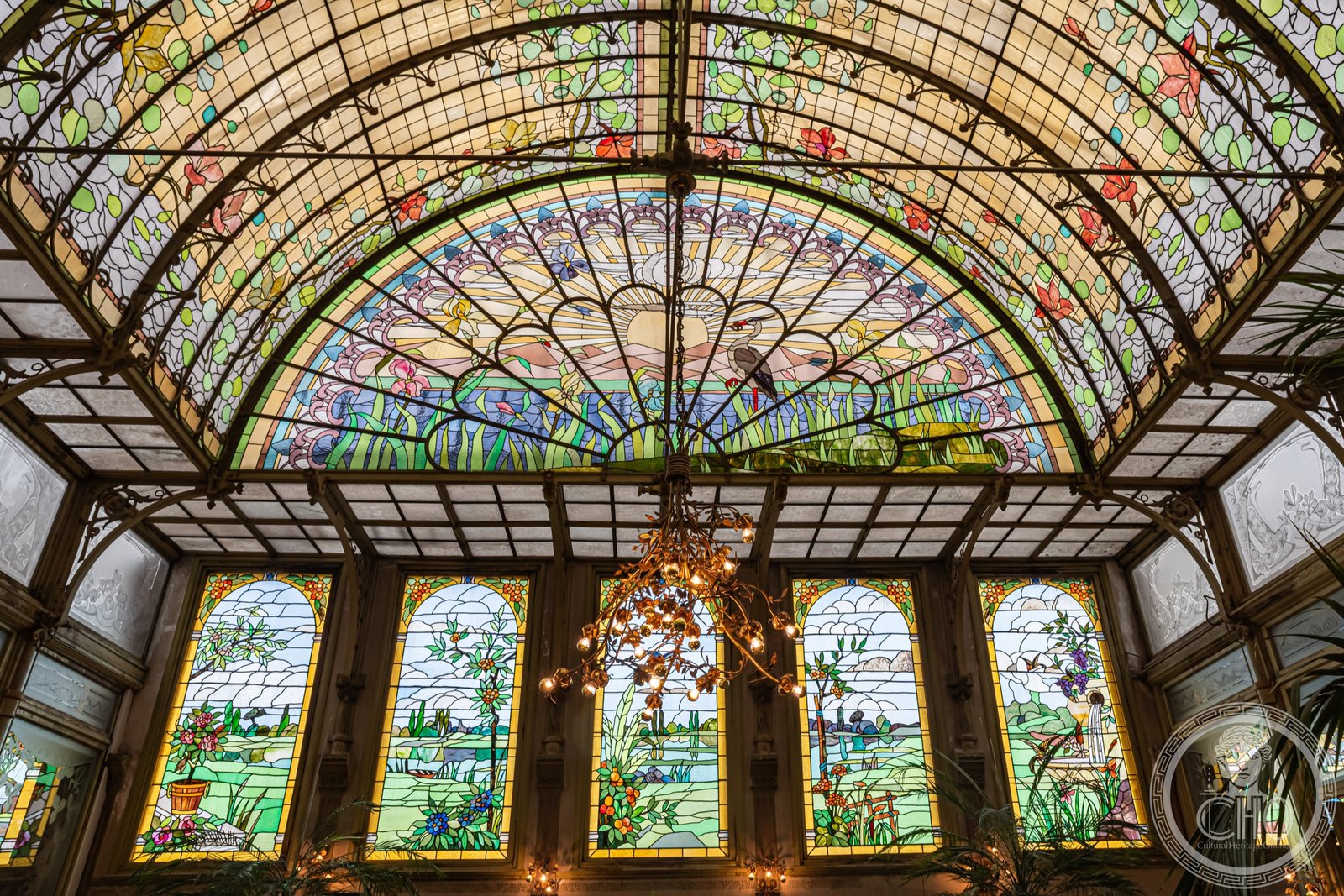
A leaded-glass vault of morning, noon and evening, built in 1900 as the showpiece of an Ursuline girls’ school near Mechelen, and one of Belgium’s most complete Art Nouveau interiors.
At a glance
The Winter Garden of the Ursulines is a glazed Art Nouveau hall built in 1900 inside a girls’ boarding school at Onze-Lieve-Vrouw-Waver, in the countryside near Mechelen. Its ceiling is the reason people come. A barrel vault of coloured glass runs the length of the room, worked in floral and animal motifs and reading, panel by panel, as morning, day and evening. Neither the architect nor the maker of the leaded glass was ever recorded, although the glass is often wrongly credited to one of Belgium’s leading Art Nouveau glass-masters. Restored and reopened to visitors in 2024, the garden survives as one of the country’s most complete interiors from the movement’s brief, intense flowering.
The Winter Garden of the Ursulines is an exceptional early suburban example of this particular style, embedded in a Catholic educational project for girls — which makes it even more exceptional.
Key facts
- Built: 1900, at the height of Art Nouveau in Belgium
- Setting: the Ursuline Institute, a former convent and girls’ boarding school founded in 1841
- Leaded glass: undocumented, no name survives in the records
- Architect: undocumented — no name survives in the records
- Protection: listed monument since 1987; the institute was registered as Flanders’ 5,000th protected monument in 1994
- Address: Bosstraat 9A, Onze-Lieve-Vrouw-Waver (Sint-Katelijne-Waver), province of Antwerp
History
The Ursuline sisters settled at Onze-Lieve-Vrouw-Waver in 1841, when a community moved out from Tildonk to found a convent, a day school and a paying boarding school for girls. Over the following decades the institute grew into a small town of its own, with refectories, reception rooms, a museum and, from 1909, a neo-Gothic cloister church. Boarding schools of that era competed for families, and a winter garden was a statement of ambition: a warm, planted room where pupils could walk and receive visitors through the Belgian winter.
The garden went up in 1900, at the peak of Art Nouveau in Belgium, the decade of Victor Horta’s Brussels town houses. Its designers left no name in the archive, an unusual silence for a work of this quality.
The garden itself came through that war with some damage. In 1919 the complete structure was moved, somewhat adapted, and back in use by 1921. It was protected as a monument in 1987, together with the cloister church, and in 1994 the wider complex was registered as the five-thousandth listed monument in Flanders. After a long restoration that addressed foundation problems and the stability of the floor — relaid with encaustic tiles — the winter garden reopened to the public in 2024.
What you see
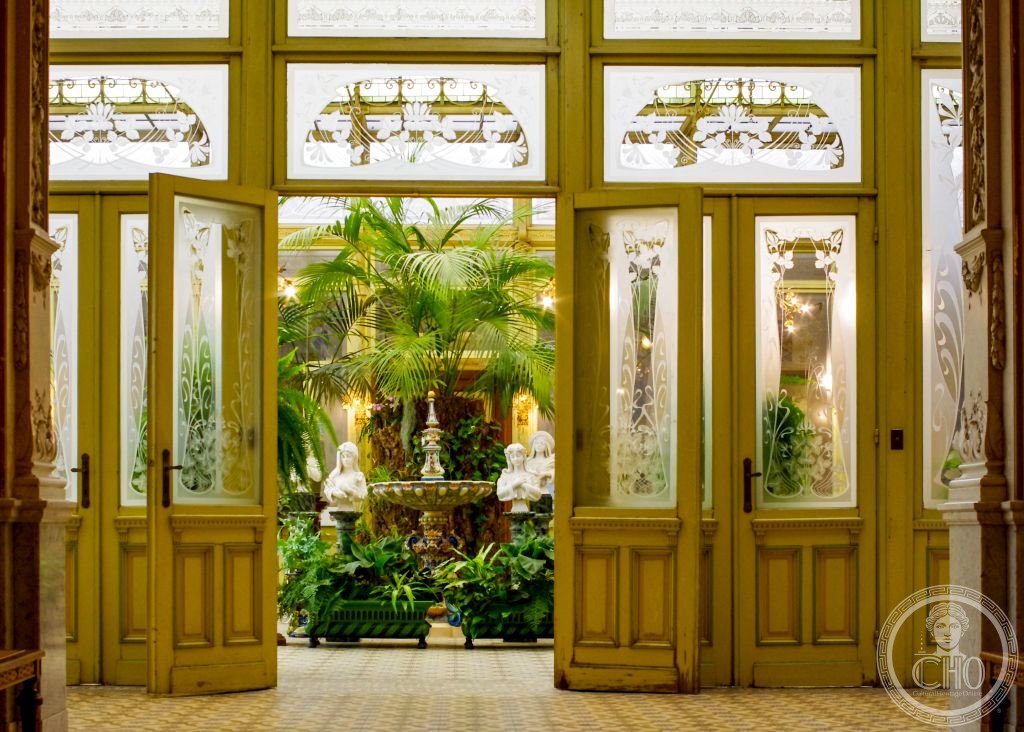
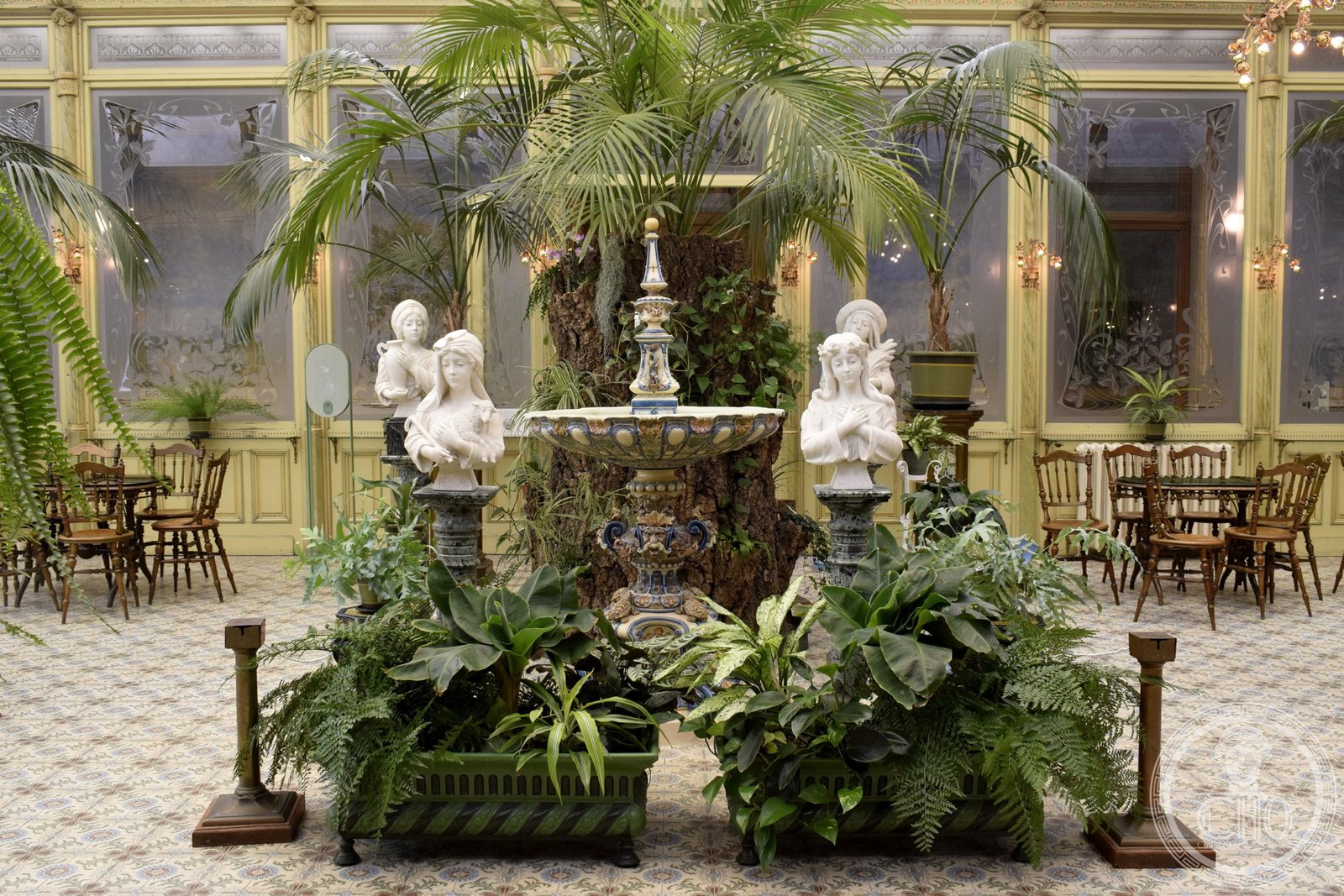
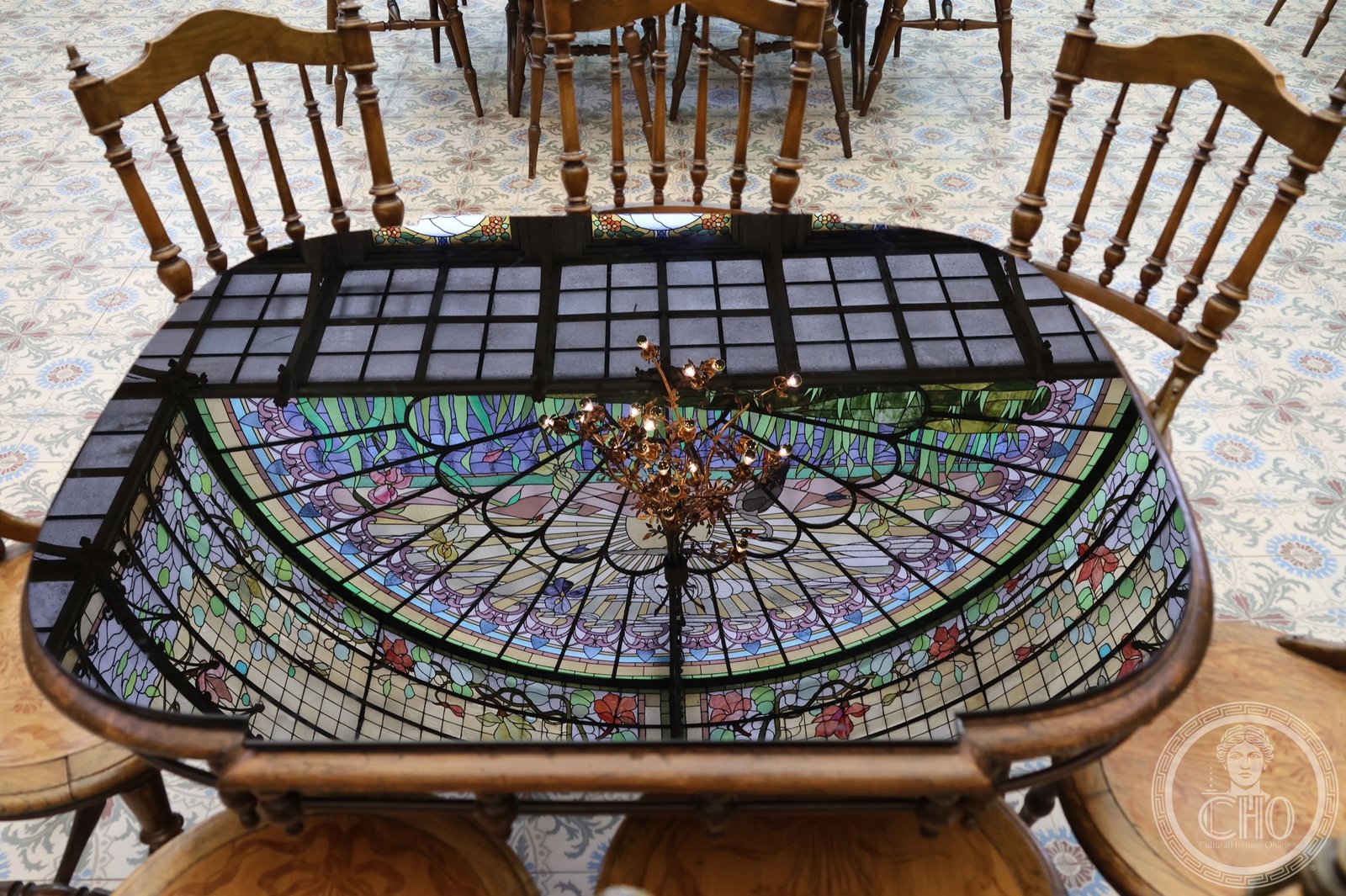
The room is rectangular, its walls lined in panelled wood and etched glass, with cast-iron plant brackets and consoles between the windows. Overhead, the barrel vault carries the whole display: a continuous canopy of leaded glass in yellow, with greens, ambers and rose, threaded with flowers, foliage and the occasional bird, and framed by the fine wrought-iron ribs that hold it up. On a bright day the colour falls onto the tiled floor and moves as the sun crosses.
The vault is composed as a triptych. One end reads as morning, the long central span as day, the far end as evening, so that a walk down the room passes through the hours in coloured light. The curved, tendril-like lines that Art Nouveau made its signature, the so-called whiplash, run through both the glass and the ironwork, tying ceiling and structure into a single idea.
Practical information
- Open: seasonal — the garden closes in the coldest months (roughly December to February) and welcomes visitors the rest of the year; check current dates before travelling
- Tickets: booked online through visitwintertuin.be
- Visit: a signed trail with an audio guide leads through the garden and the adjoining historic rooms of the institute
- Time needed: about an hour
- Coordinates: 51.06521, 4.57703 · open in Google Maps
Getting there
Onze-Lieve-Vrouw-Waver sits between Mechelen and Lier in the province of Antwerp. Mechelen, about ten minutes away by road, is the nearest rail hub, with frequent trains from Brussels, Antwerp and Brussels Airport; local buses and taxis cover the last stretch to the Bosstraat. Drivers arrive via the E19 motorway between Antwerp and Brussels.
Nearby
- Mechelen — the historic city ten minutes away, with St Rumbold’s Tower and a compact medieval centre.
- Antwerp — half an hour north, with its own Art Nouveau quarter around Zurenborg.
- Brussels — the city where Art Nouveau began and where Horta built, under an hour by train.
Gallery
Photographs donated to Cultural Heritage Online by Dr. Mario Baeck, historian of the Winter Garden of the Ursulines.
Sources
- Winter Garden of the Ursulines, official visitor site: visitwintertuin.be
- Visit Mechelen, tourism board: Wintertuin Ursulinen
- Focus on Belgium: The extraordinary Art Nouveau winter garden of the Ursuline nuns
- Ursuline Institute, Flemish heritage inventory (Onroerend Erfgoed)
- Dr. Mario Baeck, local historian, direct correspondence with Cultural Heritage Online (2026)
Find it on the map
See this place and what’s around it →📷 Become a Cultural Heritage Online photographer
Share your photos of places: they stay published under your name as the author. The more they're seen, the more you get noticed — and soon a contest will reward the most appreciated photos.
Log in or sign up free to add a photoIs this page about you?
This page is read by travellers and heritage enthusiasts who find it on Google. Tell us how you are connected to this place and we will take it from there.