
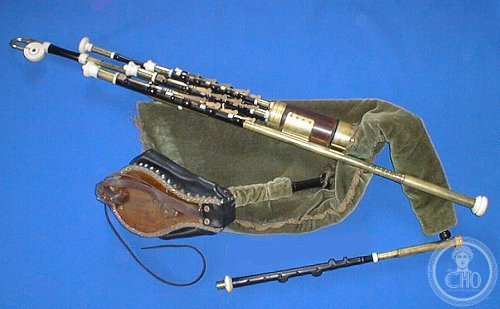
Ireland’s national bagpipes, played sitting indoors with bellows strapped to the waist, produce a sweet and complex sound unlike any other bagpipe tradition.
At a glance
The uilleann pipes (literally “pipes of the elbow” in Irish) are Ireland’s characteristic bagpipe tradition. Unlike bagpipes blown by mouth, the uilleann pipes are powered by small bellows strapped around the waist and arm, allowing the player to maintain steady air pressure while keeping hands free for fingering and chord-making. The instrument produces a notably sweeter and quieter tone than Highland bagpipes or Italian zampognas, and is almost always played sitting down—often in intimate indoor settings where conversation or singing can continue between passages.
Origins & history
The uilleann pipes emerged as a distinct Irish tradition, though their early history remains obscure. The modern name “uilleann pipes” was coined in the 20th century by Grattan Flood. A poem from 1796 used the term “union” to describe the pipes, suggesting the name had earlier currency—contrary to the common misconception that it derives from the 1800 Act of Union.
The practice
A piper sits with the bag clamped under one elbow, which is then squeezed to control airflow. The bellows, worn around the waist and arm, pump air into the bag—a mechanism that allows dry air to reach the reeds, improving tuning stability and longevity compared to mouth-blown bagpipes. The player’s free hands manage three distinct sound-producing components: the chanter, played with fingers like a flute and resting on the thigh, produces the melody across two full octaves with sharps and flats through overblowing; three simple drones sound continuously at notes spread an octave apart; and three regulators—closed pipes with keys opened by wrist and hand motion—allow the piper to play simple chords for rhythmic and harmonic accompaniment. Grace notes and ornaments embellish the melody throughout. The instrument’s distinctive sweet tone and indoor, sitting performance style set it apart from all other bagpipe traditions.
Cultural significance
Uilleann piping is woven into Irish musical identity and social life. The instrument’s design—enabling accompaniment without a separate musician—makes it uniquely suited to intimate performance. Its technical sophistication and expressive range have made it central to Irish traditional music, carried forward by generations of pipers who maintain both technique and repertoire.
Key facts
- Countries: Ireland
- Anchor community: Dublin, Ireland (53.34941°N, 6.25668°W)
- UNESCO Intangible Cultural Heritage reference: 01264
- Name origin: Coined in the 20th century by Grattan Flood; the term “union” appears in a 1796 poem
- Playing position: Sitting, usually indoors
- Air source: Bellows strapped to waist and arm, not mouth-blown
- Range: Chanter spans two full octaves including sharps and flats
Where to experience it
Dublin and the wider Irish tradition remain the heartland of uilleann piping. The instrument is performed in traditional sessions, concerts, and domestic settings throughout Ireland. Visitors seeking to hear or learn about the practice should explore Dublin’s traditional music venues and consult local cultural institutions for current performance schedules.
Sources & resources
- Uilleann pipes — Wikipedia
- Uilleann piping — UNESCO Intangible Cultural Heritage
- Cultural Heritage Online
Find it on the map
See this place and what’s around it →📷 Become a Cultural Heritage Online photographer
Share your photos of places: they stay published under your name as the author. The more they're seen, the more you get noticed — and soon a contest will reward the most appreciated photos.
Log in or sign up free to add a photo