
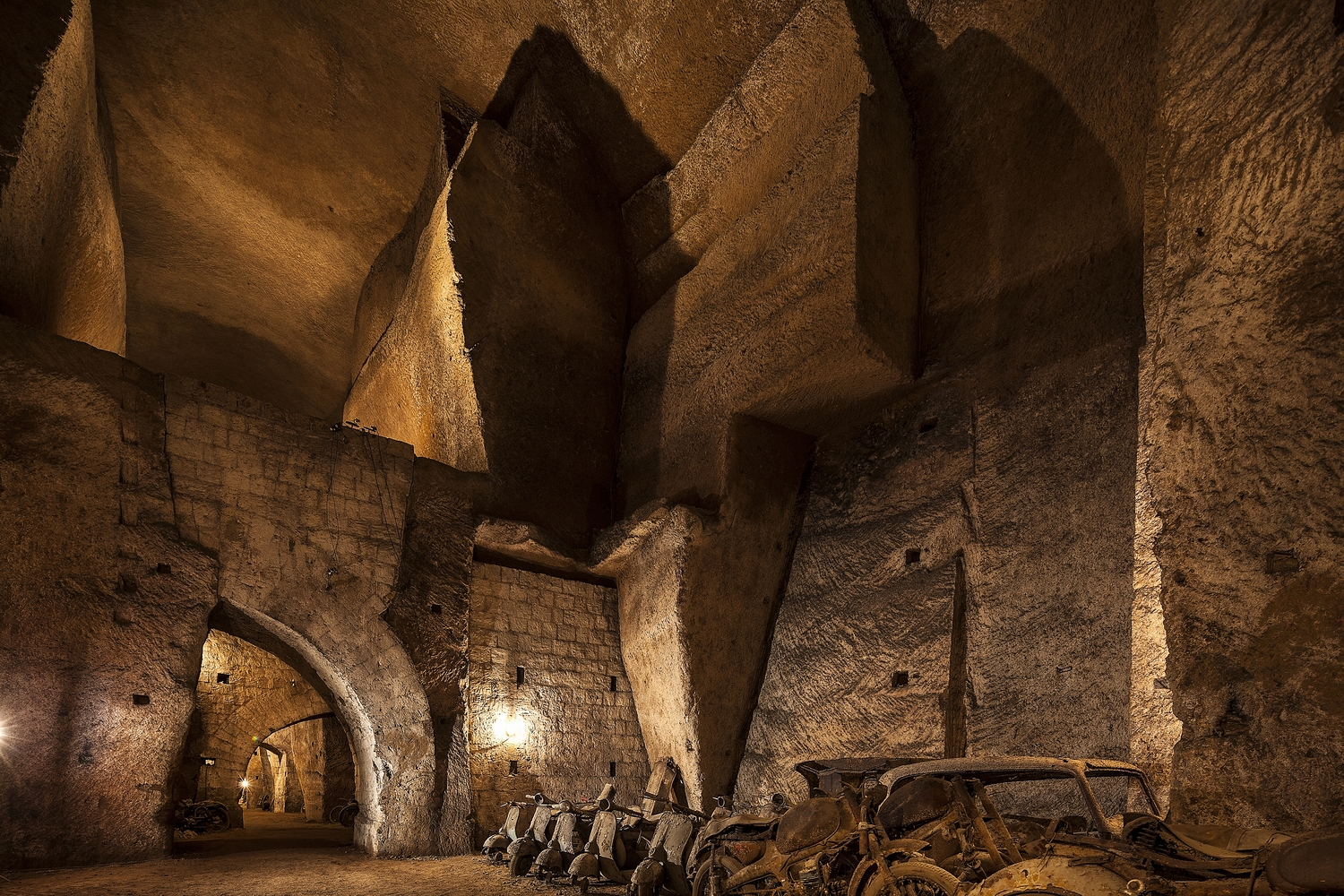
The Galleria Borbonica, or Bourbon Tunnel, is an underground passage beneath the Chiaia hill of Naples, originally constructed in 1853 on the orders of King Ferdinand II of the Two Sicilies to connect the Royal Palace of Naples to the military barracks of Via Morelli, providing the royal court with a secure escape route. Repurposed as a WWII air-raid shelter, a post-war impound for hundreds of confiscated vehicles, and finally a site of public memory, the tunnel is today one of Naples most evocative underground heritage attractions.
At a glance
- Type
- Historic underground passage and heritage museum
- Period
- Constructed 1853; WWII shelter use 1940-1944; public opening 21st century
- Style
- Bourbon-era civil engineering within earlier cistern network
- Location
- Chiaia, Naples, Campania, Italy
- Coordinates
- 40.8342 N, 14.2426 E
Overview
The Bourbon Tunnel runs through the tuff bedrock beneath the Chiaia district, connecting the Royal Palace wing near Piazza del Plebiscito to Via Domenico Morelli on the other side of the hill. Ferdinand II commissioned Errico Alvino and Luigi Giura to design the route, which incorporated portions of earlier Aragonese-era cisterns and water channels cut into Naples volcanic tuff. The gallery was never fully completed for its royal purpose before the unification of Italy in 1861 rendered the Bourbon monarchy obsolete.
During the Second World War the tunnels served as a shelter for an estimated 10,000 Neapolitan civilians during Allied bombing raids. After the war the municipal police used adjacent caverns as a vehicle pound, and hundreds of cars, motorcycles, and police equipment were left underground for decades, becoming unintentional time-capsule artefacts.
History
The project was proposed by Alvino in 1853 and work proceeded through the mid-19th century, cutting new galleries and widening existing cisterns. At the fall of the Bourbon Kingdom of the Two Sicilies in 1861, the passage remained unfinished and was partially sealed. During the Fascist era some sections were used by civil authorities, but the complex became strategically important in 1940-1943 when WWII bombing made underground shelter critical for the civilian population.
The post-war impound use created a remarkable cemetery of vintage vehicles including Fiat 500s, Alfa Romeos, and police motorbikes, discovered by urban explorers in the late 20th century. A volunteer association began systematic documentation from around 2005, opening the first official guided tours and eventually the Tunnel Borbonico museum experience.
What you see
Visitors descend via a spiral staircase into a vaulted tuff gallery approximately 8 metres wide and up to 10 metres high. The route passes through sections of the original 19th-century Bourbon passage, Aragonese-era cisterns with water channels still visible in the rock, WWII-era shelter spaces equipped with period medical and domestic artefacts, and the abandoned vehicle compound with dozens of cars and motorcycles preserved in suspended decay.
Informational panels and guided narration contextualise the site overlapping historical layers. An adventure route by rubber dinghy through flooded cistern sections is offered as an optional experience for those wishing to explore deeper passages.
Cultural significance
The Galleria Borbonica is among the most compelling examples of Naples stratified underground urban archaeology, a city built and rebuilt on layers of Greek, Roman, medieval, and modern infrastructure. Its WWII chapter connects it to the memory of the Quattro Giornate di Napoli uprising of September 1943, and the vehicle impound preserves a unique 20th-century vernacular archive. It contributes to the broader heritage of Underground Naples recognised as an outstanding urban phenomenon.
Practical information
- Address
- Vico del Grottone 4, 80132 Napoli NA
- Hours
- Check official website (tunnelborbonico.info) for current tour times; advance booking recommended
- Admission
- Guided tour fee applies; adventure route has separate pricing
Getting there
From Naples Centrale station, take metro Line 1 to Municipio or Dante, then walk toward Piazza del Plebiscito, roughly 10-15 minutes. Alternatively, take bus R3 or the funicular to Chiaia. The tunnel entrance on Vico del Grottone is signed from the via Roma and via Toledo area.
Sources and resources
See the place
Find it on the map
See this place and what’s around it →📷 Become a Cultural Heritage Online photographer
Share your photos of places: they stay published under your name as the author. The more they're seen, the more you get noticed — and soon a contest will reward the most appreciated photos.
Log in or sign up free to add a photo