
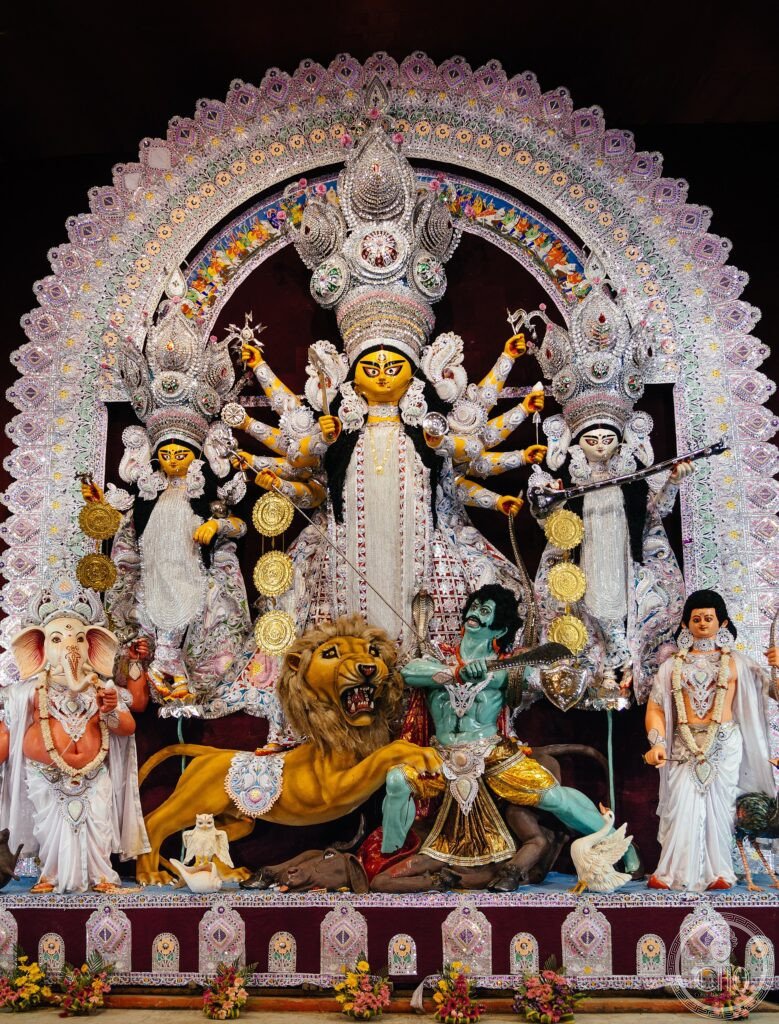
A ten-day Hindu festival honouring the goddess Durga and her victory over evil, observed across Bengal with temporary shrines, ritual worship, cultural performances, and communal feasting.
In UNESCO’s words
Durga Puja is an annual festival celebrated in September or October, most notably in Kolkata, in West Bengal of India, but also in other parts of India and amongst the Bengali diaspora. It marks the ten-day worship of the Hindu mother-goddess Durga. In the months preceding the festival, small artisanal workshops sculpt images of Durga and her family using unfired clay pulled from the Ganga River. The worship of the goddess then begins on the inaugural day of Mahalaya, when eyes are painted onto the clay images to bring the goddess to life. It ends on the tenth day, when the images are immersed in the river from where the clay came. Thus, the festival has also come to signify ‘home-coming’ or a seasonal return to one’s roots. Durga Puja is seen as the best instance of the public performance of religion and art, and as a thriving ground for collaborative artists and designers. The festival is characterized by large-scale installations and pavilions in urban areas, as well as by traditional Bengali drumming and veneration of the goddess. During the event, the divides of class, religion and ethnicities collapse as crowds of spectators walk around to admire the installations.
Official description, UNESCO Intangible Cultural Heritage List — Durga Puja in Kolkata
At a glance
Durga Puja is an annual festival held in September or October that centres on ten days of worship of the Hindu mother-goddess Durga. Celebrated most notably in Kolkata, it also takes place across India and among Bengali communities worldwide. The festival is recognised as a significant public performance of both religion and art, drawing together collaborative artists and designers.
Origins & history
In the months before the festival, artisanal workshops sculpt images of Durga and her family from unfired clay taken from the Ganga River. Worship begins on Mahalaya, the inaugural day, when eyes are painted onto the clay images to animate the goddess. The festival has come to symbolise homecoming and a seasonal return to one's roots.
The practice
Large-scale installations and pavilions are constructed in urban areas, accompanied by traditional Bengali drumming and veneration of the goddess. Spectators gather to walk around and admire these installations. The festival concludes on the tenth day, when the clay images are immersed in the river from which the clay originally came.
Cultural significance
Durga Puja represents a space where class, religious, and ethnic divisions temporarily dissolve as crowds gather to participate. The festival serves as a thriving ground for collaborative artistic expression, bringing together diverse communities in shared celebration and demonstrating the public performance of both religious devotion and cultural creativity.
Key facts
- Country: India
- Inscribed: 2021
- UNESCO list: Representative List of the Intangible Cultural Heritage of Humanity
- UNESCO reference: 00703
- UNESCO vocabulary: Handicrafts; Sculpture
- Map: Kolkata — the locality named in UNESCO’s official description of this element
Where to experience it
Durga Puja is celebrated across India and amongst the Bengali diaspora, most notably in West Bengal, where the festival reaches its grandest public expression. Throughout urban areas, temporary pavilions dedicated to the goddess are constructed and elaborately decorated, drawing visitors and devotees during the ten-day celebration in September or October. Visitors can witness large-scale installations, traditional Bengali drumming, and the ceremonial painting of eyes onto clay images on Mahalaya, as well as the final immersion of the goddess in the river. The festival welcomes spectators from all backgrounds to admire the artistry and participate in this public performance of religion and art.
Sources & resources
- UNESCO — official element page: Durga Puja in Kolkata
- UNESCO — open data record: Intangible Heritage List, reference 00703
- UNESCO — official video: UNESCO film on this element — embedded on this page
- UNESCO — official photograph: The full goddess ensemble, sculpted in alluvial clay, still to be painted, clothed and ornamented at a workshoip at Kumartuli, the oldest and main image-makers' hub in the city. — Devi Chakrabarti, India, 2018
- Reference — Wikipedia (secondary): Durga Puja — consulted as a secondary reference, not as confirmation
- Cultural Heritage Online: Our archive and city guides

Find it on the map
See this place and what’s around it →📷 Become a Cultural Heritage Online photographer
Share your photos of places: they stay published under your name as the author. The more they're seen, the more you get noticed — and soon a contest will reward the most appreciated photos.
Log in or sign up free to add a photo