
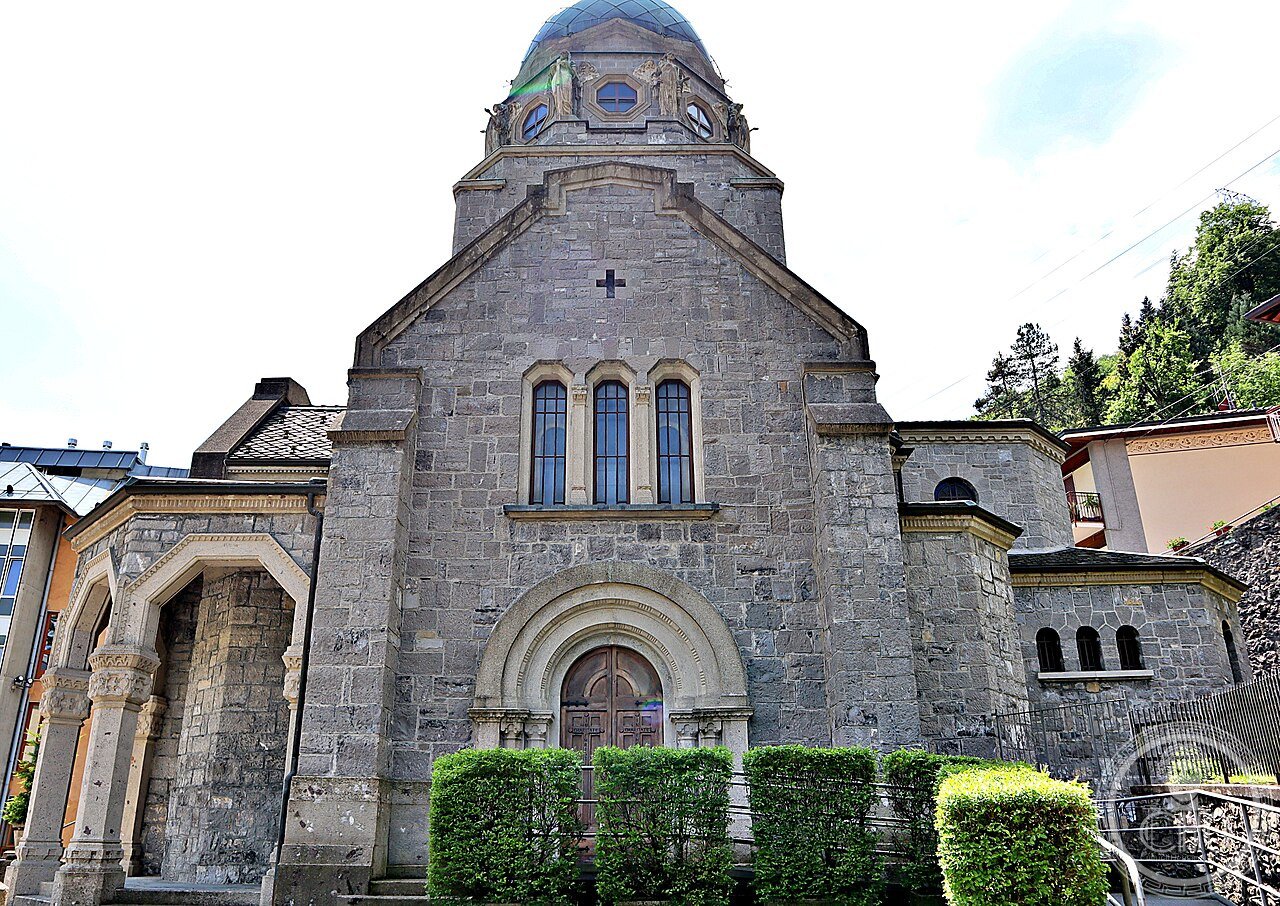
Luigi Angelini’s war memorial of 1921–24 rises over San Pellegrino on a Greek-cross plan, its octagonal dome later lined with some 600 square metres of mosaic by Filiberto Sbardella — grief turned into gold.
At a glance
The Tempio dei Caduti — the Temple of the Fallen, dedicated to Saint Charles — was built between 1921 and 1924 to honour San Pellegrino’s First World War dead. The Bergamo engineer Luigi Angelini designed it on a Greek-cross plan crowned by an octagonal dome, in an eclectic manner with neo-Gothic references. Its interior was later lined with mosaics by Filiberto Sbardella. First named the Tempio della Vittoria, it was renamed the Tempio dei Caduti after the Second World War.
Key facts
- Built: 1921–1924
- Engineer: Luigi Angelini (Bergamo)
- Plan: Greek cross under an octagonal dome
- Decoration: about 600 m² of mosaics by Filiberto Sbardella (executed in the 1940s, restored 2017); frescoes by Giovanni Fasciotti; altar and medallions by Umberto Marigliani
- Style: eclectic, with neo-Gothic references
- Status: an active church (San Carlo)
History
The First World War left few Italian towns untouched, and the spa town of San Pellegrino marked its losses with a memorial church. The foundation stone was laid in September 1921 and the building was completed by 1924, replacing the earlier church of San Carlo. The commission went to Luigi Angelini, one of the leading engineer-architects of the Bergamo area in the early twentieth century.
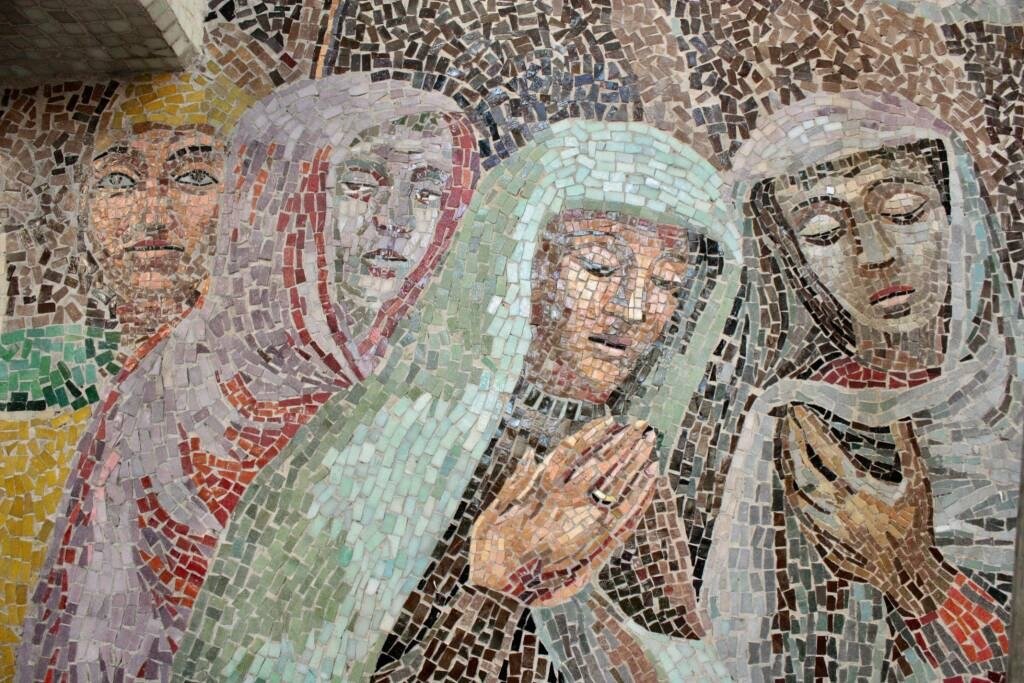
Angelini chose the language of a centralised temple rather than a triumphal arch — a Greek-cross plan gathered under a single octagonal dome, a form that reads as both church and shrine. In the following decades the mosaicist Filiberto Sbardella covered roughly 600 square metres of wall and vault — work carried out in the 1940s and restored in 2017 — with frescoes by Giovanni Fasciotti and further decoration by Umberto Marigliani.
First dedicated as the Tempio della Vittoria, the building was renamed the Tempio dei Caduti after the Second World War. It remains in use as the church of San Carlo, a place of both worship and remembrance.
What you see
From outside, the temple is a compact, vertical mass — the octagonal dome riding above a Greek-cross body, the detailing drawing on neo-Gothic motifs. The effect is sober rather than triumphal, in keeping with its purpose.
Inside, Sbardella’s mosaics carry the memorial across some 600 square metres, their gold grounds catching what light the openings allow. For a town of this size, the decorative scheme is strikingly ambitious.
Practical information
- An active church and war memorial; open for worship and visits
- The mosaic interior is the highlight
- A short walk from the spa buildings, along Viale della Vittoria
- Allow 20 minutes
Getting there
San Pellegrino Terme lies in the Brembana valley north of Bergamo. By car, take the SP470 up the valley, about 25 km from Bergamo; buses run from Bergamo, which is reached by train from Milan.
Nearby
- Casinò Municipale
- Grand Hotel San Pellegrino
- Terme di San Pellegrino
See the place
Sources
- Comune di San Pellegrino Terme — Tempio dei Caduti
- Catalogo dei beni culturali (scheda BG120-00527)
- Eco di Bergamo / BergamoNews
Find it on the map
See this place and what’s around it →
📷 Become a Cultural Heritage Online photographer
Share your photos of places: they stay published under your name as the author. The more they're seen, the more you get noticed — and soon a contest will reward the most appreciated photos.
Log in or sign up free to add a photoIs this page about you?
This page is read by travellers and heritage enthusiasts who find it on Google. Tell us how you are connected to this place and we will take it from there.